Blog

Innovations in Hen Housing

With the release of Unnaturally Delicious today, I thought I'd initiate a series of posts on the book over the next week or two.  

One of the main purposes of the posts is to share some pictures associated with the chapter contents. Originally the publishers planned to include the photos in the book, but decided to pull them at the last minute.  The upside is that I have clearance to reproduce a variety of interesting pictures associated with the book content, and I plan to do that here on the blog.  

The second chapter of the book talks about some innovative housing systems for egg laying hens.  What can be done to improve the welfare of laying hens which typically live in a crowded wire cage.  Why not just go cage free? 

Typical cage-free systems (often called barn or aviary systems) provide hens with much more space than do the cage systems. The barns allow the birds to exhibit natural behaviors like scratching and dust bathing, and they provide nesting areas for laying eggs. But they are far from the paradise many people envision. As Silva put it, “Cage-free isn’t what most people think it is.”

No hen housing system is superior to another in all respects, and there are tradeoffs and costs with each.  A really nice illustration of this is via the results of the research project that goes by the name Coalition for Sustainable Egg Supply.  I highly recommend their visuals that compare how different systems rate along dimensions related to food safety, animal welfare, environment, etc.   

In any event, one relatively new system in the U.S. is the so-called enriched colony cage system that attempt to provide some of the benefits of cage free without some of the downsides. I write:

Unlike the barren environment in the battery cages, the enriched colony cages have the mat area that allows the hens to exercise their natural urge to scratch. Also available are perches that allow the hens to get up off the wire floor. In addition to the nests, the perches are a popular sleeping area for the hens. Running underneath the colony cage is a conveyor belt that removes the manure and keeps it away from the birds. The enriched colony cages aren’t perfect, and some animal advocacy groups think they don’t go far enough. But they’re an innovative compromise.

Here's a picture of the housing system from the cage manufacturer Big Dutchman.

Of course, we can go even further still.  One group of Dutch researchers has been working to create a system—the Roundel (the eggs are sold in a circular, biodegradable carton under the name Rondeel).  As I write:

The Roundel is the Ritz Carlton of hen living. Hens have virtually all the freedoms and amenities they’d want from the wild but with ample feed and without any of the dangers from predators or hardships from adverse weather. The Roundel also comes with a luxury hotel price.

Here's a cool image of the Roundel system from the Wageningen UR Livestock Research group.  

The chapter also discusses some animal welfare trading schemes that might also offer innovative ways to improve farm animal living conditions at a price we're willing to pay. To find out more, you'll have to see the book.

Effective Altruism and the Meat Eater Problem

A few days ago I received an email from Scott Weathers who pointed me to a post he wrote on the Effective Altruism Form.  He brought my attention to a debate in the effective altruist community.  In particular, what are the full consequences of various human development projects on the well-being of people AND animals?  

For background, it might be useful to first define effective altruism, which according to Wikipedia, is: 

a philosophy and social movement that applies evidence and reason to determine the most effective ways to improve the world. Effective altruists aim to consider all causes and actions, and then act in the way that brings about the greatest positive impact

So, effective altruists aren't content to simply engage in activities that make them feel good - they want to look at the actual consequences.

Here's the issue.  Altruists aim to increase the well-being of people in developing countries.  But, development economist have long known that when poor people in developing countries begin to earn a bit more money, they tend to increase consumption of meat and other animal products.  Increasing demand for animal products leads to more animals.  Is it possible that the net effect of increasing the poors' wellbeing on total "happiness" (animals and human) is negative?  Scott put the "meat eater problem" as follows:  

Many GiveWell charity recommendations, particularly the Against Malaria Foundation, could be affected by this consideration – if saving human lives means increasing suffering for a large number of animals killed for meat consumption, should we support human health interventions at all?

Scott makes a number of good counter arguments to this concern in his post.  I too have a hard time getting overly worried about this "meat eater" problem.  Here are some of the first things that come to mind.

  • The impact isn't anywhere close to 1 to 1.  Even in a heavy meat eating country like the US, per-capita consumption of beef and pork are around 55 and 50 lbs/person/year.  One US steer is yields around 500-600 lbs of edible meat; one hog yields about 125 lbs of edible muscle.  So, if a person goes from zero beef and pork consumption to the (high) US average, they're only eating about 55/550=0.10 cows a year and 50/125=0.4 pigs a year. It would take (550/55)=10 years for this person to eat the equivalent of a whole steer and (125/20) = 2.5 years for the person to eat the equivalent of one whole hog.  Stated differently, are you ok helping 10 desperately poor people improve their lot in life (and eat a bit better too) even if it meant the suffering of 1 cow?  
  • Even the 10:1 ratio (or 2.5:1 ratio for hogs) dramatically overstates the problem. This is because consumption in the developing world isn't likely to increase anywhere close to that in the US.  Per-capita consumption of beef in sub-Saharan Africa is only about 6.82 lbs/person/year.   Thus, 1 US cow can feed 550/6.82=80.6 Africans for a year.  One review of the literature suggests that a 1% increase in the income of consumers in low income countries increases quantity demanded for meat and dairy by about 0.8% (i.e., the income elasticity of demand for meat is 0.8).  If per-capita GDP in sub-Saharan African were able to miraculously double (from $1,638/person to $3,276) for a 100% increase, we'd increase meat demand by 80%.  So, per-capita consumption would increase from 6.82lbs/person/year to 6.82*1.8=12.276 lbs/person/year.  Now 1 US cow would only feed 550/12.27=44.8 Africans for a year.  Each African goes from consuming 0.0124  to 0.0222 cows/year.  Pulling it all together, DOUBLING the per-capita income of the 973 million people who live in Sub-Saharan Africa, would require (by these back of the envelope calculations, which you can check for homework) about 9.65 million more cows.  So, what we want to compare is the extra happiness of 973 million Africans who have doubled their income and who are now eating 80% more meat to the welfare of an extra 9.65 million cows (the ratio of cows affected to humans affected is 0.01 to 1).  
  • One might say: well an African cow (or pig or sheep) doesn't provide as much meat as a US cow (or pig or sheep), so the ratios above are way off.  Fair enough.  But, what's the implication?  I say, it means we should invest in research (or donate to research organizations) that increase the productivity of animals in Africa.  Indeed, one counter-intuitive insight is that intensive animal agriculture, because it is so much more efficient, may be more "ethical" because it requires many fewer animals to meet consumer demand.
  • We don't want to compare numbers of people affected to numbers of animals affected, we want to compare units of "happiness" or "suffering".  Economists have long been uncomfortable with making such inter-personal utility comparisons, but presumably an effective altruist has to make such calculations in some form or fashion.  Even if we buy the arguments by philosophers like Peter Singer that all units of suffering should receive equal consideration regardless of the source (cow or human), we have to keep in mind that "suffering" relates not just to the ability to feel pain but the ability to contemplate pain, infer intention and meaning from the pain, anticipate future pain, etc., and thus my assessment is that it would take a lot more to create an equivalent "unit" of suffering from a cow than a human.
  • Why the presumption of suffering?  Are all animals better off dead than alive?  I highly doubt it.  In fact, if increased demand for meat brings more animals into the world that are better off alive than dead, then total happiness increases.  As we've argued elsewhere, there are good reasons to believe most US beef cows lead relatively high quality lives.  See here for my armchair philosophizing on the ethics of eating meat.
  • As I discuss in a chapter of my forthcoming book, Unnaturally Delicious, it is now possible to grow meat in a lab.  Lab grown meat doesn't suffer because it isn't connected to a brain. 
  • If you're concerned that giving to human charity adversely affects animals, then one possible solution is a market (like the one I've proposed) where you can buy "animal well being unit" offsets.  

Why aren't all chickens cage free?

Jennifer Chaussee has a piece at Wired on hen housing.  She attempts to answer some questions that I get frequently asked: why isn't the egg industry converting faster to cage free?  Isn't that the trend?  Why aren't we all cage free yet?

She writes

As it turns out, going cage-free requires much more planning, money, and logistical engineering than the seemingly simple notion of setting some hens free would suggest. Ironically, this massive supply chain overhaul stems from consumer demand to return to the egg-producing practices of our pre-industrial past, but without undoing all the positive benefits of scale, affordability, and safety that were achieved through industrialization. It actually took farmers a really long time to figure out how to put the bird in the cage—and it’s going to take a while to figure out how to get it back out.

Overall, it's a pretty good piece, and recounts many of the issues we've written about in other places.

Possible Impacts of Massachusetts Ballot Question on Animal Welfare

Joshua Miler of the Boston Globe has a piece on a ballot initiative in Massachusetts.  He writes:

The proposed Massachusetts ballot initiative, backed by a coalition called Citizens for Farm Animal Protection, has met the first and most arduous signature-gathering hurdle to make the ballot and is expected to clear the other obstacles that remain to make the November ballot.

It would ban the production and sale in the state of eggs from hens and meat from pigs and calves kept in tight enclosures starting in January 2022. For selling of shell eggs in Massachusetts, each hen would have to have access to at least 1.5 square feet of usable floor space.

What are the possible cost implications?  

On the one hand:

a consulting firm being paid by advocates to conduct an economic analysis of the ballot question’s impact, said the price increase would be modest. He predicted something on the order of 1 or 2 cents per egg, 12 to 24 cents a dozen

On the other hand:

[a top executive at Sauder’s Eggs, a big producer in Pennsylvania which ships many eggs to Massachusetts] estimates that the Massachusetts ballot question would raise the price by 70 or 80 cents per dozen, maybe more.

Here was my take, as cited in the story:

Some experts in the field say the best place to look to compare prices is California, where the sale of eggs from hens kept in small “battery cages” became illegal at the start of last year.

In a recent paper, Jayson L. Lusk, a professor of agricultural economics at Oklahoma State University, and another researcher used grocery store scanner data from California and other states to estimate how California’s animal welfare law changed the price of eggs. Per a dozen eggs, they found it raised prices by around 75 cents on average, a 22 percent increase over what the price of eggs would have been had the laws not gone into effect.

Lusk acknowledged that there are several confounding variables in extrapolating that data to Massachusetts, from last year’s avian influenza outbreak to Massachusetts importing more of its eggs than California (which could make the increase bigger) to the growth of the cage-free industry by 2022 (which could make the increase smaller).

But the overarching conclusion was clear.

“Egg prices are going to increase in Massachusetts” if the ballot measure passes, he said, “I don’t think there’s any doubt about that. The question really is ‘how much?’ ”

The cited research papers are discussed in this post.

Food Demand Survey (FooDS) - December 2015

The December 2015 edition of the Food Demand Survey (FooDS) is now out.

Some observations from the regular tracking questions:

  • Compared to last month willingness-to-pay for all products, particularly beef products, was up.
  • There was a sizable drop in the proportion of respondents who say they plan to eat out more in the next two weeks.
  • There was again a big spike in awareness and concern for E. Coli and Salmonella, likely as a result of the publicity surrounding the Chipotle outbreaks,
  • There was a large increase in visibility of GMOs in the news in the past two weeks.
  • The fraction of respondents who said they suffered from food poisoning doubled compared to last month.

Three new ad-hoc questions were added this month.

The first set of questions dealt with consumers perceptions of different animal welfare labels. Respondents were asked: “Which of the following labels, if seen on a meat or animal product in a grocery store, do you think would indicate and assure the highest and lowest levels of farm animal welfare?”

Participants were then shown images of nine different labels (randomly ordered across surveys) and were asked to click three labels and move them to a box indicating the highest level of animal welfare and then click three of the labels and move them to a box indicating the lowest level of animal welfare.

Here's what we found.


More than half the respondents put the following three labels in the highest welfare category: Certified Humane, Animal Welfare Approved, and American Humane Certified. Two labels, 100% natural and non-GMO verified had nothing to do with animal welfare and they were generally ranked neither high nor low. The largest percentage of respondents placed the Tyson brand label in the lowest animal welfare category, but it had more “highest welfare” category placements than Global Animal Partnership or Food Alliance Certified. The Global Animal Partnership label (which showed a Step 4 rating) was most likely to not be placed in either
the the highest or lowest welfare categories.

The next set of questions were added to investigate issues related to consumer aversion/acceptance of GMOs and perceptions of corporate involvement and control.  The questions came about as a result of a Q&A after a talk I game in Amsterdam last month at the Conference on Coexistence between Genetically Modified (GM) and non-GM based Agricultural Supply Chains.  In particular, Norbert Wilson from Auburn followed up and helped devise the following questions.  

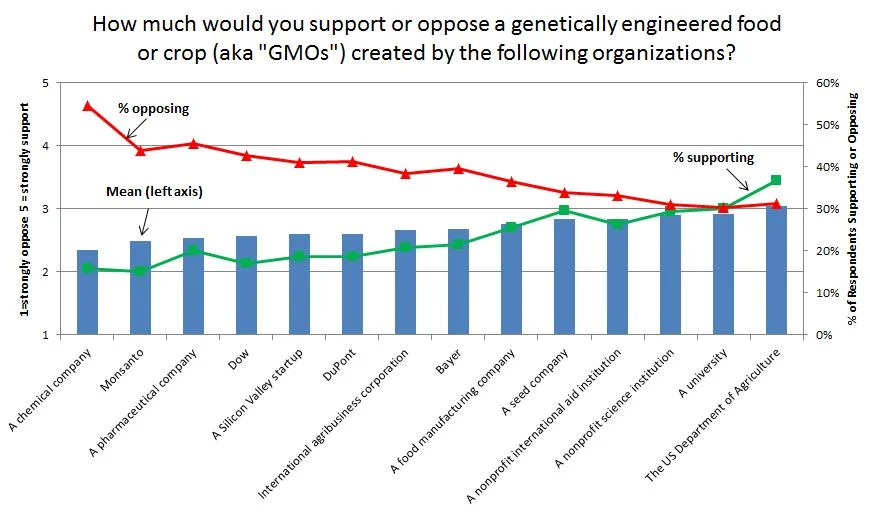
We first asked, “How much would you support or oppose a genetically engineered food or crop (aka “GMOs”) created by the following organizations?” Then, fourteen different entities were listed (in random order across respondents), some of which were specific company names and others that were generic entities.  Respondents replied on a 1 to 5 scale ranging from strongly oppose to strongly support.


GMOs from a chemical company, Monsanto, and a pharmaceutical company were the were least supported. GMOs from a non-profit scientific organization, a university, and the USDA were most supported. For the latter two categories the percentage of respondents supporting equaled or exceeded those opposing. 

Finally, the last question asked, “Of all the possible benefits that arise from the genetically engineered (or “GMO”) food and crops currently being produced, what percent of the benefits do you believe go to the following entities?” Eight different groups were listed (in random order), and respondents had to allocate 100 points across the groups.


Respondents thought seed, chemical and farm input suppliers received the largest share of the benefits (at 17.7%) followed by governments and food processors (each at about 15%). Farmers were next at almost 14%. At the bottom were consumers (10.6%) and universities (8.7%). 

Who consumers think benefits from GMOs appears to have some relationship with concerns and acceptance of GMOs.  Recall, one of our standard questions asked every month is how concerned that GMOs pose a food safety risk in the next two weeks.  When we calculate correlations between GMO concern and the distribution of benefits from above, there are some statistically significant correlations.  The larger the perceived benefits to consumers and farmers, the lower the perceived concern about eating GMOs.    

Similarly, the correlations between the average level of support for GMOS made from the 14 entities indicated above and perceptions of who benefits are shown in the following table.  People who think universities and consumers benefit more from GMOs are more likely to support GMOs.  By contrast, people who think seed, chemical, and farm input suppliers and governments benefit more are less likely to support GMOs.