Blog

Curious trend in sales of plant-based meat alternatives

I came across a report from IRI showing changes in sales of plant-based meat alternatives during March, April, and May relative to the same time last year. The figure below shows some dramatic sales growth during the early part of the pandemic. Of course, the large percentage growth is partly explained by the fact that plant-based sales were starting from a low base (i.e., if you go from 1lb to 2lbs, that’s 100% growth, whereas if you go from 100 to 101lbs, that’s only 1% growth).  The rest of the report shows the enormous difference in relative magnitudes as plant-based sales are only about 0.66% of total dollar sales (or 0.33% of total lbs of meat sales) .

pbsales.JPG

What I want to focus on here though isn’t the spike in sales in March, but rather what happened later. Why wasn’t there a similar spike in sales in April and May? It was in late April and early May that beef and pork production were being most adversely affected from plant shutdowns. During this time, wholesale meat prices were skyrocketing and there were stories in every major media outlet about the possibilities of meat shortages. Data from USDA and the Bureau of Labor Statistics shows retail ground beef prices in grocery stores, for example, jumped more than 10% from April to May (after rising about 5% from March to April).

So, at time when beef prices rose dramatically, retailers were limiting how much beef consumers could buy, and there was overall limited availability of beef, the growth in sales of plant based meats began to fall from almost 80% at the end of April to 57% at the end of May.

At the time the economic environment was most opportune for consumers to switch from beef and pork to plant-based alternatives, it seems that few made that substitution. The figure below shows the trends in volume (or lbs) market share. The share of plant-based sales did indeed rise over the period in question from 0.22% of all lbs purchased to 0.33% of lbs purchased. I’m a bit surprised it wasn’t more.

One of the inferences we can draw from these data, which is also consistent with the research we recently conducted, is that a lot of the purchases of plant-based alternatives are coming from consumers who wouldn’t have bought much beef or pork to begin with.

I look forward to seeing how these trends continue to evolve.

pbsales2.JPG

Consumer Preferences for Beef Alternatives

The journal Food Policy just published a paper I co-authored with Ellen Van Loo and Vincenzina Caputo entitled, “Consumer preferences for farm-raised meat, lab-grown meat, and plant-based meat alternatives: Does information or brand matter?” I blogged about the working version of this paper this past fall when we finished the first draft, so I won’t re-iterate all the main findings (I should also note the paper at Food Policy is open access, and as such the results are freely available).

What I thought I’d do here is convey some results from the study that are not in the published paper but that are based on the models described therein.

First, a big unresolved question that often comes up when discussing the introduction and evolution of plant-based or lab-based alternatives is whether the the projected market share for the new alternatives is “stealing” sales from beef or rather drawing new people into the market who wouldn’t bought beef to begin with. Using the models estimated in our paper (in the “control” no information, no brand condition), I project that before any alternatives are introduced about 74% of consumers would buy ground beef on a grocery shopping trip (assuming the price is $5/lb) and 26% would refrain from buying ground beef. After the alternatives are introduced (at an assumed price of $9/lb), it is projected about 12% of shoppers would buy one of the beef alternatives. Thus, of the buyers of the new alternatives, I project about 57% (6.9/12.1) would have instead bought conventional ground beef whereas the remaining 43% (5.2/12.1) wouldn’t have bought beef in the first place.

altbeef1.JPG

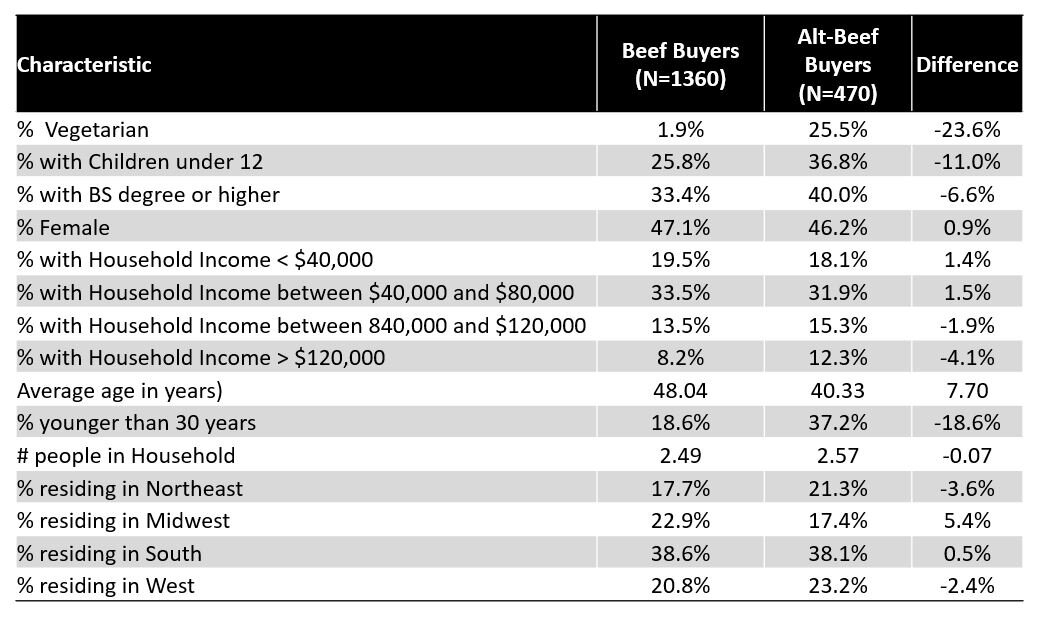
The paper in Food Policy shows some results related to the relationship between demographic characteristics and projections of which alternatives people would buy. To help make these findings a little more digestible, below is a table that shows the demographics of people predicted to choose conventional beef vs. people predicted to choose one of the beef alternatives (assuming all are the same price). Unsurprisingly, the people who are predicted to choose a beef alternative are way more likely to be vegetarian than are people predicted to choose beef. It is also the case that alt-beef buyers are much more likely to be younger and are somewhat more likely to have a college degree than conventional beef buyers. There are not big gender differences.

altbeef2.JPG

The table below shows a similar breakdown but instead of focusing on demographics, I report the importance consumers say they place on 12 different factors when buying food. Predicted beef buyers place greater importance on safety, taste, appearance, and naturalness. By contrast, people projected to buy one of the beef alternatives place more importance on novelty, environment, and animal welfare. (note: in general differences greater than about 0.1 are significantly different than zero at the 0.05 significance level).

altbeef3.JPG

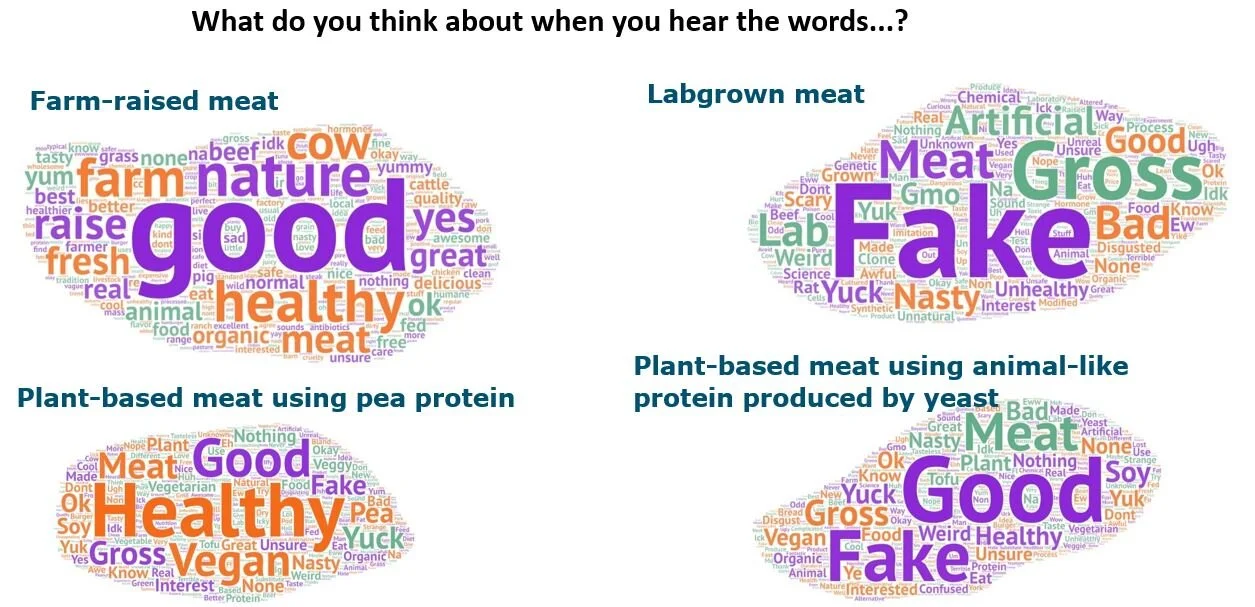
Finally, one of the most interesting results of the survey were responses to open-ended questions we asked about people’s perceptions of the competing products. Here are some word clouds Ellen created.

altbeef4.JPG

These data were collected about a year and a half ago, and given the novelty of the products, it is possible perspectives have changed, particularly following COVID19. Fortunately I have some follow-up work planned with Glynn Tonsor and Ted Schroeder. Be on the lookout for some of those results hopefully some time this coming fall.

America’s Indispensable Industry

That’s the title of an editorial Glynn Tonsor and I wrote for the City Journal.

Here’s an excerpt:

In the future, owners of large food-processing and packing facilities may look to more regionally distributed facilities to mitigate supply risks that occur from a total plant shutdown. It may be prudent to sacrifice some economies of scale in order to provide insurance against plant shutdowns caused by human-spread illnesses. Such analyses will surely start soon, warranting a balance of security during pandemics with economic efficiency during normal times.

Besides economies of scale, the concentration of meat processing is a function of high regulatory and oversight costs, which may deter the emergence of a larger number of smaller processors. Requiring federal inspectors and testing regimes is prudent from a food-safety standpoint, but as we’re now seeing, such measures may create other risks when the barriers to entry are too high. In fact, adjustments in some of these regulations may well help the industry navigate current Covid-19 challenges.

Another solution is to reduce labor use through increased automation. The nuts-and-bolts assembly of automobiles or even computer chips doesn’t carry over well to animals that come in widely varying shapes, sizes, weights, and even colors. Advancements in robotics, machine learning, and artificial intelligence, however, are beginning to allow more automation in the processing of animal carcasses. We need to invest in research in digital agriculture and automation to help eliminate tedious—and sometimes dangerous—jobs, while reducing the likelihood of disrupted food supplies resulting from illnesses in processing plants. This approach, combined with the likely continuation of workforce health monitoring, may permanently alter labor relations in the meat-processing industry.

More Meat Market Madness

Plant closures and slow-downs from COVID-19 have reached such levels that it will be impossible for consumers not to notice effects on meat prices or availability in the coming weeks. If the full page ad in the New York Times wasn’t enough to convince you, below is some updated data on animal processing numbers and wholesale beef and pork prices.

Estimated daily hog and cattle slaughter are both down about 40% compared to this time last year.

cattleslaughter2020_3.JPG
hogslaughter2020_3.JPG

Less meat being produced means less meat available for grocery stores to buy. As a result grocery stores and consumers are bidding up the price of the available supplies. Wholesale beef prices have skyrocketed, and have reached a level (at least in nominal terms) we haven’t seen in at least a decade. Wholesale pork prices have also increased significantly from the dip a few weeks ago, but as of today, they remain below where they were in 2019.

wholesale_beef_price_3.JPG
wholesale_pork_price_3.JPG

Unprecedented volatility in meat markets

The words "unprecedented” and “uncertain” are being thrown around a lot these days, and it is precisely because the words have never been more true. I’ve been positing on happenings in the meat and livestock markets in the wake of COVID-19, and thought it might be useful to try to illustrate just how unusually volatile these markets have been.

Consider the weekly changes in wholesale met prices (all data are from the USDA compiled by the Livestock Marketing Information Center). Below are weekly changes in pork prices over the past decade. For the week ending April 4, 2020, wholesale pork prices were down $16.32/cwt (or $1.63 per pound). This is the largest change in wholesale pork prices since at least the year 2000 (I haven’t looked at data prior to that). However, just two weeks prior (the week ending March 20, 2020) wholesale pork prices were up $7.58/cwt. This was the largest weekly increase in the past decade. So, within a three week time period, we’ve witnessed the 3rd largest weekly price increase and THE largest weekly price decrease in at least a decade.

porkpricechanges.JPG

We see a similar outcome for beef. For the week ending March 20th, 2020, we witnessed the largest weekly increase in the wholesale price of beef (an increase of $35.88/cwt) we’ve seen in at least a decade. And just two weeks later, the price fell $16.58/cwt, the largest weekly price decline in at least a decade. Prices fell again $13.10/cwt the following week, for the 3rd largest weekly price decline in a decade. Within a three week time period, we’ve witnessed THE largest weekly price weekly increase and THE largest weekly price decrease in at least a decade.

I’d call that volatile!

beefpricechanges.JPG