Blog

Adaptation to Climate Change

I ran across this fascinating paper by Richard Sutch on the the relationship between the Dust Bowl and hybrid corn adoption.  The discussion is interesting in light of current discussions bout how and whether farmers will be able to adapt to climate change and whether technology development can help mitigate some adverse effects.

Here's a passage from Sutch.

The suggestion that I make in this chapter is that the severe drought of 1936 revealed an advantage of hybrid corn not previously recognized— its drought tolerance. This ecological resilience motivated some farmers to adopt hybrids despite their commercial unattractiveness in normal years. But that response to climate change had a tipping effect. The increase in sales of hybrid seed in 1937 and 1938 financed research at private seed companies that led to new varieties with significantly improved yields in normal years. This development provided the economic incentive for late adopters to follow suit. Because post- 1936 hybrid varieties conferred advantages beyond improved drought resistance, the negative ecological impact of the devastating 1936 drought had the surprising, but beneficial, consequence of moving more farmers to superior corn seed selection sooner than they might otherwise.

This long quote is from the conclusions and is well worth reading.

The sociologists Bryce Ryan and Neal Gross, writing in 1950, studied the diffusion of hybrid corn in two communities located in Greene County, Iowa (Ryan and Gross 1950). In their view, late adopters were farmers bound by tradition. They were irrational, backward, and “rural.” The early adopters by contrast were flexible, calculating, receptive, and “urbanized.” “Certainly,” they summarized, “farmers refusing to accept hybrid corn even for trial until after 1937 or 1938 were conservative beyond all demands of reasonable business methods”. They drew a policy implication: “The interest of a technically progressive agriculture may not be well served by social policies designed to preserve or revivify the traditional rural- folk community”. In part, this view was based on Ryan and Gross’s (incorrect) belief that hybrid corn was profitable in the early 1930s. I have suggested that this was not the case. Figure 7.11 should also give pause to the view that rural laggards delayed the adoption of hybrid corn. It would be hard to argue that the farmers in Iowa Crop Reporting District 6 were predominantly forward-thinking leaders, attentive, and flexible, while those in Indiana and Ohio were predominately backward rustics trapped by inflexible folk tradition.

I think an implication of this study is that farmers (even those of rural America in the 1930s) are remarkably resilient and adaptive. Sudden and dramatic climate change induced a prompt and prudent response. An unexpected consequence was that an otherwise more gradual process of technological development and adoption was given a kick start by the drought and the farmers’ response. That pushed the technology beyond a tipping point and propelled the major Corn Belt states to the universal adoption of hybrid corn by 1943. The country as a whole reached universal adoption by 1960.

The paper has a number of interesting discussions about the role of the USDA, federal research, and strong personalities that pushed along the development of hybrid corn.  For more on the history of the development of hybrid corn, see this previous post.
The Economist on the Future of Agriculture

The Economist magazine seems to have taken a page out of Unnaturally Delicious.  Their quarterly technology issue focuses on agricultural innovations.

A few excerpts: 

MICROBES, though they have a bad press as agents of disease, also play a beneficial role in agriculture. For example, they fix nitrogen from the air into soluble nitrates that act as natural fertiliser. Understanding and exploiting such organisms for farming is a rapidly developing part of agricultural biotechnology. . . .The big prize, however, would be to persuade the roots of crops such as wheat to form partnerships with nitrogen-fixing soil bacteria. These would be similar to the natural partnerships formed with nitrogen-fixing bacteria by legumes such as soyabeans. In legumes, the plants’ roots grow special nodules that become homes for the bacteria in question. If wheat rhizomes could be persuaded, by genomic breeding or genome editing, to behave likewise, everyone except fertiliser companies would reap enormous benefits.

More robots may hit the farm.

A truly automated, factory-like farm, however, would have to cut people out of the loop altogether. That means introducing robots on the ground as well as in the air, and there are plenty of hopeful agricultural-robot makers trying to do so.

At the University of Sydney, the Australian Centre for Field Robotics has developed RIPPA (Robot for Intelligent Perception and Precision Application), a four-wheeled, solar-powered device that identifies weeds in fields of vegetables and zaps them individually. At the moment it does this with precise, and precisely aimed, doses of herbicide. But it, or something similar, could instead use a beam of microwaves, or even a laser. That would allow the crops concerned to be recognised as “organic” by customers who disapprove of chemical treatments.

For the less fussy, Rowbot Systems of Minneapolis is developing a bot that can travel between rows of partly grown maize plants, allowing it to apply supplementary side dressings of fertiliser to the plants without crushing them. Indeed, it might be possible in future to match the dose to the plant in farms where individual plants’ needs have been assessed by airborne multispectral cameras.

There is a lot of other interesting discussion in the piece about CRISPR, indoor farming, drones, soil sensors, precision agriculture, improved photosynthesis, fish farming, animal welfare, lab grown meat, and more.  

Who moved my corn?

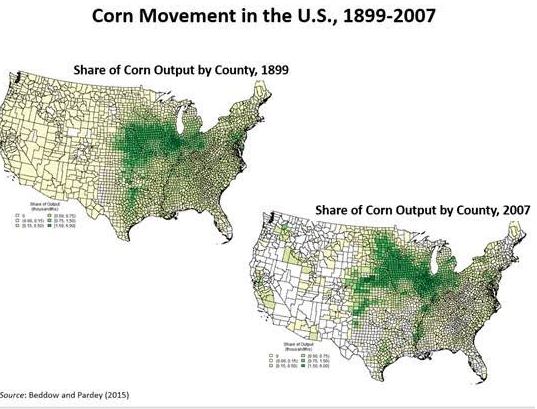
I have the great pleasure of giving a talk this week at the annual meeting of the Australian Agricultural and Resource Economics Society (AARES).  Tonight they held their awards ceremony, and I happened to be sitting next to Phil Pardey from the University of Minnesota who won (along with Jason Beddow) one of the research awards for a paper they published in the Journal of Economic History titled "Moving Matters".  

This is a fascinating paper that documents the movement of corn production over time in the US.  The paper illustrates the impact of hybrid and then genetically modified corn influencing what can be grown and where.  Changes in genetics and management practices allowed the corn plant to move  to soils that best suited the production of the crop.  As a result, they calculate that upwards of 21% of the growth in corn production can be explained by the geographic movement of the crop.   The results have implications for assumptions about impacts of climate change (i.e., that farmers can adapt by moving which crops, and which genetics, are planted where in response to changing temperatures) and for arguments about local foods (i.e., the sustainable production of crops depends on location of production, and allowing farmers to specialize in the geographic production of a crop can dramatically increase production).  

Here's the abstract:

U.S corn output increased from 1.8 billion bushels in 1879 to 12.7 billion bushels in 2007. Concurrently, the footprint of production changed substantially. Failure to take proper account of movements means that productivity assessments likely misattribute sources of growth and climate change studies likely overestimate impacts. Our new spatial output indexes show that 16 to 21 percent of the increase in U.S. corn output over the 128 years beginning in 1879 was attributable to spatial movement in production. This long-run perspective provides historical precedent for how much agriculture might adjust to future changes in climate and technology.

And, an interesting graph:

Thinking about risk

Consider this passage from a recent New York Times article

Mr. Portier, who led the center when the revision process was initiated, said he believed parents should have been presented “with enough information to say caution isn’t ill advised, because we really don’t know, and there are enough indicators to say we should be cautious.”

The quoted former CDC official is espousing a form of the precautionary principle.  What do you think he's referring to? GMOs?  A new pesticide?  Food irradiation?

Nope. He's talking about cell phones.   The article describes some squabbles at the CDC on whether using cell phones cause cancer (the same World Health Organization group that says bacon and the weed-killer glyphosate may be carcinogenic  have also said that cell phones are a possible carcinogen), and how to communicate with the public on the issue.

So, here he have an issue for which there is apparently some scientific uncertainty, for which some government officials want the public to proceed only with caution, and the the public response?  A big shrug.  

Why is it that people think about the risks surrounding cell phones so differently than they do the risks surrounding GMOs, glyphosate, irradiation or many other food and agricultural technologies?  One could write a whole paper on that topic.  In fact I have (along with Jutta Roosen and Andrea Bieberstein).

There are a variety of reasons.  For one, people tend to conflate benefits and risks.  If something is beneficial then, people tend to think of it as less risky (even though we can imagine some very beneficial products that are also risky).  People directly see the benefits of using cell phones every day and thus they are perceived as less risky than, say, a pesticide that they have never heard of and scarcely can imagine  using.  Then, there is the old risk perception literature that originated with folks like Paul Slovic that is still relevant today.  The idea is that risk perceptions aren't driven by objective probabilities of possible bad outcomes but by how familiar or unusual a product seems and by how much control we believe we have over the risk.  Cell phones seems relatively safe because they're now quite familiar and because we decide whether to pick it up or turn it off.  Many food and agricultural technologies, by contrast, seem foreign and have secretly been slipped into our food supply (or so the story goes; ever notice now many of the top-selling food books use words like "hidden" or "secret" in the subtitles?).  

Whether there are good reasons for these psychological biases is less clear, particularly when they run at odds with the best scientific evidence we have on relative risks.  I for one, am perfectly at ease eating a tortilla made from Roundup-Ready corn while chatting on my cell phone.  The biggest risk is probably getting salsa on my iPhone.      

The Science of Taste

This article by David Owen in National Geographic is chock full of interesting tidbits on the science of taste and flavor.  

For example, why many kids hate broccoli?

The aversion to bitter foods is inborn too, she said, and it also has survival value: It helps us avoid ingesting toxins that plants evolved to keep from being eaten—including by us.

The idea that many of us were taught as kids - that there are taste buds on different parts of the tongue that signal different flavors - is flat wrong:

It’s true that in some people the receptors for particular tastes may be more concentrated in certain areas on the tongue, but all of them are found all over, and a Q-tip dipped in lemon juice will seem sour no matter where you dab it. (The receptors sit on the surface of taste cells, which are bundled together in taste buds.)

and

Although the tongue map doesn’t exist, there may be a taste map in the brain . . .

That is, taste is about more than what hits our tongue.  

Taste receptors alone don’t produce tastes; they have to be connected to taste centers in the brain. In recent decades scientists have discovered receptors identical to some of those on the tongue in other parts of the body, including the pancreas, intestines, lungs, and testes. We don’t “taste” anything with them, but if, for example, we inhale certain undesirable substances, the bitter receptors in our lungs send a signal to our brains, and we cough.

Interestingly, most chefs are taught very little about the science of taste and flavor.

Stuckey teaches a course at the San Francisco Cooking School called “The Fundamentals of Taste.” “Most culinary schools don’t teach students how to taste before they start to cook,” she said. “They jump right in with, like, knife skills. But how can you possibly start an education around food without the building blocks of flavor?” She and her students do an exercise in which they make barbecue sauce. Most of the ingredients she provides are ones you would guess: tomato sauce, tomato paste, sugar, honey, liquid smoke, paprika. But there’s also a tray of ingredients whose predominant taste is bitter: coffee, cocoa, tea, bitters. “It’s not really intuitive, because you don’t think of barbecue sauce as bitter, but if you taste it before and after you add a bitter ingredient, you realize that bitter changes the whole gestalt

All these complex interactions make it tough when we decide to vilify an ingredient - say sugar or fat - because ingredients have complex interactions in term of smell, taste, mouth feel, etc.  In fact,, we can trick our brain into thinking something is sweeter than it actual is:

Bartoshuk told me that increasing the concentration of sweetness-enhancing volatiles in certain foods may make it possible to reduce their sugar content without making them taste less sweet. But she worries about unintended consequences. “As soon as we can produce a sweet experience that has no calories, isn’t toxic, and has no nasty characteristics—what will that mean for the brain?”

The whole thing is interesting.  


(HT Bailey Norwood)