Blog

TED talks and GMOs

A friend sent me a link to this TEDx talk about GMOs by Robyn O'Brian in 2011.  The speaker strikes me as incredibly earnest, very persuasive (the video has been downloaded 760,000 times!), and ultimately very wrong.  The speaker, after finding one of her children had food allergies, came to the conclusion that the answer must be GMOs or hormones used in milk or some combination of those things.  But, this is sheer illusory correlation and she cites no credible scientific study to make such a link.  She also uses a number of persuasive and scary but misleading story lines.  Some examples.

She says that the US has the highest rates of cancer compared to anywhere else on the planet.  I'm not sure whether that's true or not (presumably people in many countries don't live long enough to develop cancer).  But, what I do know is that CDC data shows that age adjusted cancer deaths and incidence rates have been falling over time in the US.  Falling at the same time we have adopted GMOs and other technologies that worry O'Brian.  So much for that link. 

She doesn't mention that rBST use in milk fell dramatically after the initial adoption phase and that almost any grocery store sells milk without rBST (in fact milk without rBST is all many stores offer).

She says that the concept of "substantial equivalence" used in the US regulatory process was invented by the tobacco industry.  I don't know whether that's true or not but that is simply an ad hominem argument trying to falsely equate GMOs and tobacco.  She also claims that other countries took a more precautionary approach than the US to GMOs.  That's true.  But, what she doesn't say is that in Europe, despite their different regulatory process, many GMO varieties are approved

I could go on but I believe the point has been made.  

Taking a step back, I found it interesting to see what the TED organizers put up on their web site as advice to organizers of TEDx events (independently run events that license the TED brand name) to avoid pseudo-scientific presentations:

2. Red flag topics

These are not “banned” topics by any means — but they are topics that tend to attract pseudo-scientists. If your speaker proposes a topic like this, use extra scrutiny. An expanding, depressing list follows:

Food science, including:

  • GMO food and anti-GMO foodists (EDIT 10/3/13: “Foodist” was the wrong word here and we recognize it was offensive to many.)
  • Food as medicine, especially to treat a specific condition: Autism and ADHD, especially causes of and cures for autism

Because of the sad history of hoaxes with deadly consequences in the field of autism research, really look into the background of any autism-related talk. If you hear anything that sounds remotely like, “Vaccines are related to autism,” — RUN AWAY. Another non-legitimate argument: “We don’t know what works, so we have to try everything.” Pretty much all the time, this argument is designed to cause guilt in suffering parents so they’ll spend money on unproven treatments.

Curiously, it seems there were conspiracy theories upon conspiracy theories because the TED site added the following last month:

If you’re coming to this post because of an allegation that TED has “banned discussion of GMOs” or has a relationship with Monsanto, please know that these rumors are not true. We have not banned these topics, and we have no relationship with Monsanto. 

In fact, we have many great talks on food and health that challenge entrenched ideas in smart and creative ways. 

Now is the time that I should add that I talked about GMOs in my own TEDx talk (and judging by the mere 1800 downloads, I must not be nearly as convincing as O'Brian) and have also let it be known that I don't work for Monsanto.


Colbert on GMOs

It is little wonder the general public is so misinformed on effects of GMOs when this is where they get their news on the subject.  Of course it is funny and meant to be satirical, but for the average watcher who doesn't know much about the subject, what is message they're being sent?

I-522 Tomorrow

Tomorrow Washingtonians will vote on I-522, which will require mandatory labeling of foods produced with biotechnology if passed.     

I came across this interesting (and apparently neutral) web site from Voter's Edge MapLight that catalogs the major arguments, donors, endorsements, etc. 

The list of donors on both sides is predictable, but after clicking through on the donations page, I found it interesting to see where the donations originated.  

This is not a fight between regular people but vested interested and organizations on both sides of the issue.  

Less than 1% of donations against I-522 are from individuals and only about 20% of donations for I-522 are from individuals.  The rest comes from "organizations" and "other" (I have no idea what "other" refers to).  

Also of interest is the location of donors.  Neither pro or anti I-522 camps can list Washington state as the largest source of donations.  The largest share of donations for I-522 (38.5%) comes from California and against I-522 (25%) are from Missouri (that's Monsanto).  Interesting that 7.5% of donations for I-522 are from the tiny geographic spot of D.C.   

i522donors.JPG

Make no mistake about it, this is a proxy fight for something much bigger than whether people in WA see labels on GMO foods.   

For interested readers, I've already offered my thoughts on the substance of the debate here.

The Politics of GMOs and GMO Labels


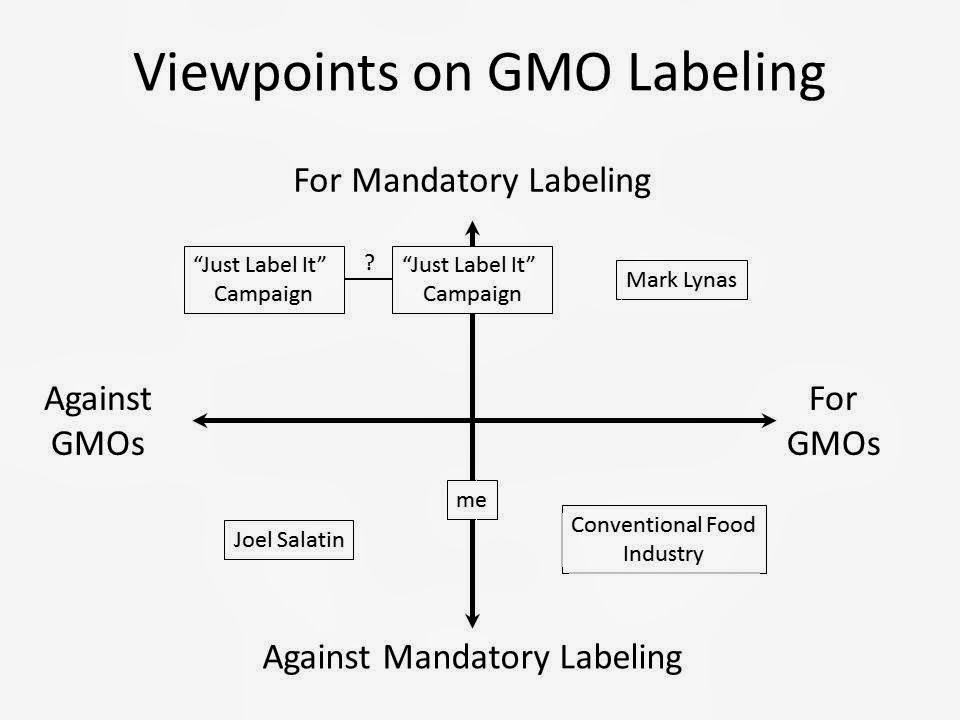
I was fascinated by a graph Parke Wilde put up on his Food Policy blog a couple weeks ago, in which he noted that not everyone who supports biotechnology opposes mandatory GMO labels or vice versa.  He proposed segregating people based on their views to two questions.

people commonly fail two distinguish two separate issues:
Is GMO technology dangerous or beneficial?
Should GMO labeling be mandatory or voluntary?
This scatter plot separates the two issues by putting attitudes toward GMOs on the horizontal axis and attitudes toward mandatory labeling on the vertical axis.

And then he included the following graph:

I like Parke's distinction.  But, I think there is something deeper going on here.  It is politics.  

I've previously commented  on the remarkably high correlations among voter's preferences for gay marriage, GMO labels, and size of farm animal cages.  What this suggest to me is that there is a strong political-ideology undercurrent driving much of the food debates.

In the case of GMOs, the evidence I have suggests that where one falls on the labeling issue (and somewhat on the GMO issue) is driven by political ideology.   

In a survey I did with Brandon McFadden in California just prior to the vote on mandatory labeling for GMOs, we found that political ideology strongly correlated with voting intentions.  According to my calculations, moving from the "extremely liberal" category to the "extremely conservative" category led to a 22.5 percentage point reduction in likelihood of voting "yes" on Prop 37.  Liberals are much more likely to want to mandate GMO labels.

Interestingly, however, this isn't because they are more likely to think GMOs are unsafe. 

In a different survey I conducted this summer (nationwide survey, N=1010) , I asked people whether they agreed/disagreed that "genetically engineered foods are safe to eat."  On a 5 point scale (1=strongly disagree and 5=strongly agree), I find that "extremely liberal" folks answer 3.05 on average and "extremely conservative" folks answer a 2.82 on average, a statistically significant difference.  Liberals are (somewhat) more likely to believe GMOs are safe.  

So, there seems to be something of a tension between beliefs about safety and willingness to use the state to mandate outcomes one desires.  

I strongly suspect there is another dimension here that partially explains the liberal tendency to want to regulate GMOs: the tendency to see corporations and capitalism as corrupting forces - i.e., aversion to agribusiness in the food sector. Thus, even if many liberals support GMOs in theory (being "for GMOs" on Parke's graph), they may not in practice (being "for mandatory labeling" on Parke's graph).