Blog

How does the media cover GMOs?

I just ran across this interesting article by Katherine Mintz in the Journal of Environmental Studies and Sciences (ungated version here)  Here's a portion of the abstract:

To understand this divergence in opinion related to GMOs, I analyzed 200 headlines and articles from the Los Angeles Times, New York Times, Wall Street Journal, and Washington Post published between 2011 and 2013. I focused on the key arguments and who is making them. The results showed that newspapers presented 207 favorable and 250 unfavorable mentions of GMOs. The findings revealed the arguments “GMO technical performance” and “potential for environmental harm,” along with actors described as the “biotechnology industry” and “U.S. government,” received more media attention, measured by the frequency of mentions in articles.

Interestingly, of all  the groups mentioned in media stories, the one that received the least attention was the actual people paying to use the technology: farmers. 

Pew Survey on Consumers, GMOs, and Trust in Science

About a week ago, the PewResearchCenter released a new report (report summary here) on GMOs, organic, and trust in food science.  The report has already been covered quite a bit in the media, but I thought I'd share a few observations on the study's headline results.  

First, the study finds:

Four-in-ten Americans (40%) say that most (6%) or some (34%) of the foods they eat are organic.

It's hard to know what to make of this claim as "some" is a pretty loose category.  One important point to keep in mind here is that USDA data reveal that, except for a few exceptions like lettuce or carrots, for most foods the percent of production that is is organic is typically far less than 5%. 

The study also finds:

The minority of U.S. adults who care deeply about the issue of GM foods (16%) . . . are also much more likely to consider organic produce healthier

The finding is consistent with prior research showing that WTP for organic is heavily influenced by the desire to avoid pesticides and GMOs.  In fact, there was a lot of attention given to the organic industry's support of the new mandatory labeling law for GMOs, which allowed disclosure via relatively innocuous QR codes.  The organic industry has worked to make sure people know non-GMO is not synonymous organic.  In other words, these two attributes (organic and non-GMO) are likely demand substitutes for consumers, and the organic industry knows this.  

One of the highlighted conclusions from the study is:

The divides over food do not fall along familiar political fault lines.

I'm not so sure.  While I agree things like concern for GMOs or preferences for organic don't have strong correlations with political ideology, the same can't be said for people's desires to regulate GMOs (say via labels or bans) or subsidize organics .  See, for example, this paper entitled "The political ideology of food" I published in Food Policy in 2012. From the abstract:

Food ideology was related to conventional measures of political ideology with, for example, more liberal respondents desiring more government involvement in food than more conservative respondents . . .

As I've written about in the past, I think it is important to separate "food preferences" from "policy preference", and on this last issue, there are big partisan and ideological divides.   

Much of the news coverage I saw about the report focused on the results related to American's trust in scientists and GMOs.  The study reports

Americans have limited trust in scientists connected with genetically modified foods.

 The study also reveals only about half the respondents think scientists think GMOs are safe to eat.  Well, Pew's other research shows us that it is more like 88%.  Thus, people under-estimate scientists beliefs about the safety of GMOs.  One might think then, that the answer is to just tell people about the scientific consensus regarding GMOs.  However, my research with Brandon McFadden suggests this probably won't have much affect.  In our study, the biggest determinant of how an individual responded to information about the science on GMOs was their prior belief about the safety of GMOs.  In fact, about a third of the people who thought GMOs were unsafe prior to information said they thought GMOs were even more unsafe after receiving statements from the National Academies of Science, the American Medical Association, etc. indicating GMOs were safe (we called these folk "divergent"); the plurality of people who thought GMOs were unsafe just ignored the scientific information indicating GMOs were safe.  This behavior is a form of motivated reasoning that Dan Kahan has discussed extensively in his work on cultural cognition.  We look for the information that supports our prior beliefs and ignore or discount the rest.  

On this issue of trust in scientists and GMO foods: it is important to note that trust in virtually ALL institutions is down over time.  Gallup has been tracking trust in about a dozen institutions since the 1970s.  Aside from a few exceptions (like the military and police), trust is way down for most institutions.  For example over 65% of people had a great deal or a lot of trust in "church or organized religion" in the 1970s, whereas today the figure is 41%.  For "public schools", confidence was running about 60% in the mid 1970s, but today is only 30%.  Newspapers went from around 40% to now around 20%.  "Big business" from around 30% to now around 18%.   "The medical system" from 80% to 39%.  Similar trends exist for congress, the presidency, organized labor, banks, and so on.   

As a result, it is important to ask how much trust is there in scientists . . . compared to what?  I haven't asked this question specifically in regard to GMOs in particular or food science in general, but a while back I asked on my monthly Food Demand Survey (FooDS):  “How trustworthy is information about meat and livestock from the following sources?” Fifteen sources were listed (the order randomly varied across respondents), and respondents had to place five sources in the most trustworthy category and five sources in the least trustworthy category. A scale of importance was created by calculating the proportion of times a meat and livestock information source as ranked most trustworthy minus the proportion of times it was ranked least trustworthy.

We found:

The USDA and FDA were reported as most trustworthy with 50% more people indicating the source as most trustworthy than least. A University professor from Harvard were seen as slightly more trustworthy than one from Texas A&M, but both were viewed as less trustworthy than interest groups like the Farm Bureau, the CSPI, or the HSUS.

News organizations, and particularly food companies, were viewed as least trustworthy. Chipotle was the seen as the least trust worthy organization studied – the restaurant chain was placed in the least trustworthy category 69% more often than in the most trustworthy category.

While individuals scientists at either Harvard or Texas A&M were less trusted than some others perhaps it was because it was phrased a single professor rather than a group of professors.  Indeed, the four top groups are all collections of scientists (among other people).  A subsequent survey asked how much people knew about each of these individuals and institutions, and while CSPI is trusted, it isn't well known.  I suspect people were responding to the word "science".  So, I think there is good reason to suspect people trust scientists as much or more than other societal institutions.

The issue of trust and acceptance of GMOs has been researched quite heavily in the academic literature (e.g., see several studies by Lynn Frewer).  In this paper,  she and coauthors show that people's response to information on GMOs doesn't depend on how much they trust the source per se, but rather it's the other way round: people trust the sources giving them the information that fits with their prior beliefs.  So, again we're back to motivated reasoning.  Still, we should acknowledge some research that shows "information matters."  I've done work on this topic, as has Matt Rousu, Wally Huffman and Jason Shogren.  This last set of researchers show, for example, that relatively uninformed people are influenced by information by interested and third party sources.

There is a lot more in the Pew report, but I think I'll leave it here for now.


The Benefits of Mandatory GMO Labeling

I ran across this post over at RegBlog which notes that the USDA will have to do a cost-benefit analysis of the new mandatory labeling law for GMOs.  The post relies heavily on this paper by Cass Sunstein written back in August.  Sunstein's article discusses the fact that regulatory agencies typically do a very bad job at quantifying the benefits of mandatory labeling policies (and identifying when or why those benefits only apply to mandatory rather than voluntary labels).

Sunstein argues that, in theory, consumer willingness-to-pay (WTP) is the best way to measure benefits of a labeling policy.  I wholeheartedly agree (and have even written papers using WTP to estimate the benefits of GMO labels) but I want to offer a couple important caveats.  

The issue in ascertaining the value of a label isn't whether consumers are willing a premium for non-GM over GM food.  Rather, as emphasized in this seminal paper by Foster and Just, what is key is whether the added information would have changed what people bought.  If you learn a food you're eating contains GMOs (via a mandatory label) but you're still unwilling to pay the premium for the non-GMO, then the the label has produced no measurable economic value.  Thus, a difference in WTP for GMO and non-GMO foods is a necessary but not sufficient condition for a labeling policy to have economic value.  

The Foster and Just paper outlines the theory behind the value of information.  Here's the thought experiment.  Imagine you regularly consume X units of a product.  Some new information comes along that lowers your value for the product (you find out it isn't as safe, not as high quality, or whatever).  Thus, at the same price, you'd now prefer to instead consume only Y units of the product.  The value of the information is the amount of money I'd have to give you to keep consuming X (the amount you consumed in ignorance) in spite of the fact you'd now like to consume only Y.  Given an estimate of demand (or WTP) before and after information, economists can back out this inferred value of information.      

But, here is a really important point: this conception of the value of information only logically applies in the case of so-called "experience" goods - goods for which you know afterward whether it was "high" or "low" quality.  Just and Foster's empirical example related to a food safety scare in milk.  In their study, people continued to drink milk because they didn't know that it had been tainted.  By comparing consumer demand (or consumer WTPs) for milk before and after the contamination was finally disclosed, the authors could estimate a value of the information.  In this case, the information had real value because the people would really have short and long term health consequences if they kept consuming X when they would have wanted to consume Y.

It is less clear to me that this same conceptual thinking about the value of information and labels applies to the case of so-called "credence" goods.  These are goods for which the consumer never knows the quality even after consumption.  Currently marketed GMOs are credence goods from the consumers' perspective.  Unless you're told by a credible source, you'll never know whether you ate a GMO or not.  So, even if a consumer learned a food was GMO when they thought it was non-GMO, and wanted to consume Y instead of X units, it is unclear to me that the consumer experienced a compensable loss.  

Expressing a view with which I'm sympathetic, Sunstein also notes that mandatory labels on GMOs don't make much sense because the scientific consensus is that they don't pose heightened health or environmental risks.  Coupling this perspective with the credence-good discussion above reminds me a bit of this philosophical puzzle published by Paul Portney back in 1992 in an article entitled "Trouble in Happyville".  

You have a problem. You are Director of Environmental Protection in Happyville, a community of 1000 adults. The drinking water supply in Happyville is contaminated by a naturally occurring substance that each and every resident believes may be responsible for the above-average cancer rate observed there. So concerned are they that they insist you put in place a very expensive treatment system to remove the contaminant. Moreover, you know for a fact that each and every resident is truly willing to pay $1000 each year for the removal of the contaminant.

The problem is this. You have asked the top ten risk assessors in the world to test the contaminant for carcinogenicity. To a person, these risk assessors - including several who work for the activist group, Campaign Against Environmental Cancer - find that the substance tests negative for carcinogenicity, even at much higher doses than those received by the residents of Happyville. These ten risk assessors tell you that while one could never prove that the substance is harmless, they would each stake their professional reputations on its being so. You have repeatedly and skillfully communicated this to the Happyville citizenry, but because of a deep-seated skepticism of all government officials, they remain completely unconvinced and truly frightened - still willing, that is, to fork over $1000 per person per year for water purification.

What should the Director do?  My gut response to this dilemma is the same as what my Ph.D. adviser Sean Fox wrote in a chapter for a book I edited a few years ago:

It’s a difficult question of course, and the answer is well beyond both the scope of this chapter and the philosophical training of the author.


Assorted Links

  • This NYT article by Stephanie Strom discusses an interesting fault line in the organic movement: whether hydroponic crops (which are not grown in soil) can be called organic. 
  • A couple days ago, the USDA Economic Research Service put out this "chart of of note" showing trends in private and public spending on agricultural research.  As the chart shows, public spending has been falling, although private spending has increased.
  • The USDA-AMS has started putting out what appears to be a relatively new monthly report on production and prices of cage free and organic eggs. 
  • The Journal of Economic Psychology has released a special issue I co-edited with Marco Perugini on food consumption behavior.  There are 11 articles on a whole host of interesting topics from organic, food labeling, school lunches, nutrition, "fairness", food security, and more.
  • More controversy over chicken pricing, this time from the Washington Post.  I spoke to some industry folks about this a few days ago, and one thing they highlighted is that the type of chicken priced by the Georgia Dock is quite different (higher quality - contracted in advance) than what is being priced by other indices like the Uner-Barry (chicken parts - in spot markets).  Thus, a lot is being made of an apples-to-oranges comparison (even if the apple price report is flawed). 
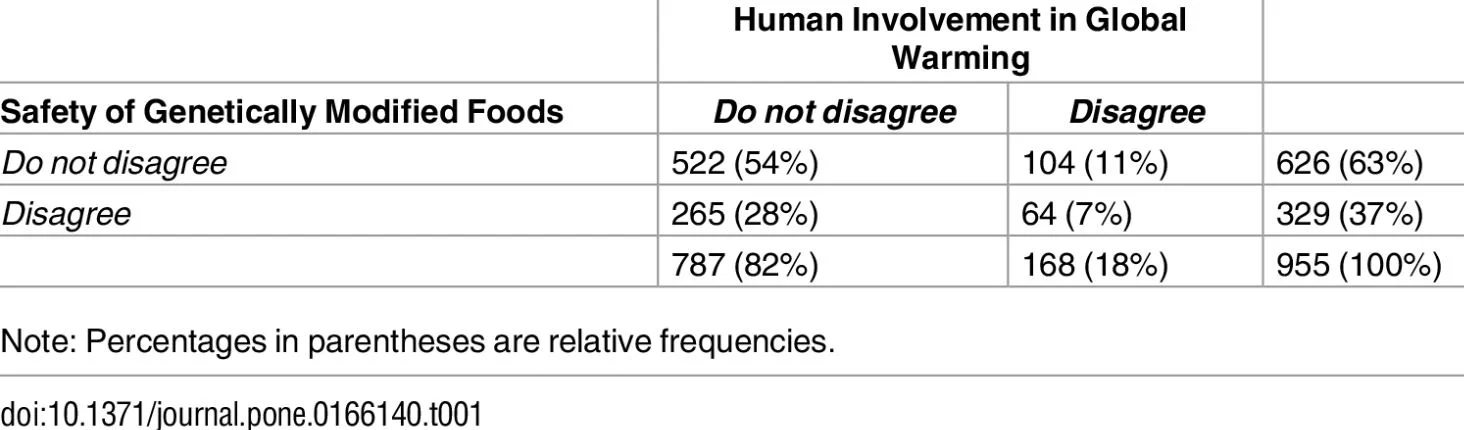
  • One of my former students, Brandon McFadden, has a new article in PloS ONE looking at the factors that drive a wedge between public and scientific option about climate change and genetically engineered food.  He's got some cool graphs showing people's joint beliefs about climate change and genetically engineered foods, and he explores how those beliefs are affected by cognitive ability, illusionary correlations, objective knowledge, and political party affiliation.

New York Times on GMOs

A New York Times article by Danny Hakim came out this weekend arguing that genetically engineered crops (aka "GMOs") have failed to live up to their promise: namely that they haven't increased yields or reduced pesticide use.  

The implications seems to be that Hakim believes farmers shouldn't be using biotechnology or that they were duped into adopting.  Even if we grant Hakim's premises that biotech crops increased herbicide use and didn't increase yield (as I'll detail below, there are good reasons not to fully accept these claims), the conclusions that benefits are "over hyped" seems a bit misplaced.   

To see this, let's consider a different example.  When Apple came out with the first edition of the iPhone, one might too have said its benefits were over-promised.  After all, we already had flip phones to make mobile calls, the iPod to listen to music, the Blackberry to type emails and texts, and so on.  Did the iPhone really offer that much new?  Was it all that much better than what previously existed?

Well, rather than trying to studiously compare features of the new iPhone to all the previous devices, shouldn't we just look and see whether consumers actually bought it?  Look at the millions of decisions of individual consumers who weighted the relative costs and benefits.  It seems millions of consumers judged the new phone to be worth the extra money (indeed, some people stood outside in lines for days to get it).  In short, we know the iPhone delivered on its promise because millions of customers bought the phone and have come back again and again to buy new versions.

This is what economists call revealed preferences.  If we want to know whether people think product A is better than product B, we don't have to survey and ask, we just have to look and see what they chose.  

Ok, what about biotech seeds?  Here is a graph from the USDA on farmer adoption of biotech corn, soybeans, and cotton in the U.S.  For each of these these three crops, adoption of genetically engineered varieties (including both herbicide tolerant (HT) and insect resistant (Bt)) is over 89% of acres planted.  So, when we look at the decisions made by thousands of real-life flesh and blood farmers who have weighted the costs and benefits, they have voluntarily adopted GMOs en mass.  The fact that biotech was so readily adopted by farmers (and is still so widely in use) aught to tell us something. 


Now, one possible explanation explanation is that farmers have no choice - they have to buy the biotech seed.  Yet, as you can read in many places (see here, here, or here), farmers have lots of seed choices.  Indeed, farmers pay hefty premiums to have the biotech varieties.  

Yet, if we are to believe the NYT's story, farmers are paying these higher premiums but aren't getting higher yields and they're spending more on herbicide.  They must be really dumb right?  I'm going to reject the dumb farmer hypothesis, which means that either the NYT's data are wrong or there are other benefits to biotech aside from yield (or some combination of both).  

The data and comparisons used in the Times story to support their claims are pretty crude (comparing national aggregates over time in the US and France).  It is curious they used these data when we have recent, well-done research summaries such as this one from the National Academies of Science.  Weed scientist, Andrew Kniss, has the best, most well-reasoned response to the article I've seen.

Kniss writes:

I have to say this comparison seems borderline disingenuous; certainly not what I’d expect from an “extensive examination” published in the New York Times. The NYT provides a few charts in the article, one of which supports the statement about France’s reduced pesticide use. But the figures used to compare pesticide use in France vs the USA are convoluted and misleading. First, the data is presented in different units (thousand metric tons for France, compared to million pounds in the US), making a direct comparison nearly impossible. Second, the pesticide amounts are not standardized per unit area, which is critically important since the USA has over 9 times the amount of farmland that France does; it would be shocking if the U.S. didn’t use far more pesticide when expressed this way.

and

It is true that France has been reducing pesticide use, but France still uses more pesticides per arable hectare than we do in the USA. In the case of fungicide & insecticides, a LOT more. But a relatively tiny proportion of these differences are likely due to GMOs; pesticide use depends on climate, pest species, crop species, economics, availability, tillage practices, crop rotations, and countless other factors. And almost all of these factors differ between France and the U.S. So this comparison between France and the U.S., especially at such a coarse scale, is mostly meaningless, especially with respect to the GMO question. If one of France’s neighboring EU countries with similar climate and cropping practices had adopted GMOs, that may have been a more enlightening (but still imperfect) comparison.

Given all of these confounding factors, I wonder why France was singled out by Mr. Hakim as the only comparison to compare pesticide use trends. Pesticide use across Europe varies quite a bit, and trends in most EU countries are increasing, France is the exception in this respect, not the rule.

My take?  As I've noted in previous posts before, it is pretty well acknowledged that biotech likely increased herbicide (but not pesticide) use, though it is important to consider relative toxicity of different pesticides used (which the Times article didn't do as best I can tell).  It is also important to recognize that research shows that adoption of herbicide resistant soy has led to greater adoption of low- and no-till farming practices.  And, while the biotech traits have sometimes been incorporated into varieties that were lower yielding, if you look, on average, at a large number of studies, that yield tends to increase with biotech adoption.   Moreover, as I wrote in a post about a study in Nature Biotechnology: 

the biotech varieties had an important risk-reducing effects, even if they sometimes led to slightly lower yields. Moreover, biotech can save on other inputs like labor. When I was a teenager, I spent a lot of time hoeing and spraying cotton weeds. That job is (thankfully) now obsolete due to biotechnology.

I don't know whether GMOs have fail to live up to their promise.  That would require us to know something about farmers' expectations prior to adoption.  What I do know is that the vast majority of corn, soybean, and cotton farmers have continued to buy higher priced biotech seeds.  Why?  The NYT article makes no attempt to answer this question.