Blog

Trends in Farm Land Acreage

I hear a lot of talk about the impacts of federal farm policy on our food system. It is sometimes suggested that farm policy is to blame for “cheap food” and thus obesity (see this nice twitter response by Tamar Haspel) or that many of our purported modern day farm and food ills can be traced back to Earl Butz, who as Secretary of Agriculture in the early 1970’s encouraged producers to plant “fence row to fence row.”

One way to evaluate these sorts of claims is to look at how much (or little) crop acreage in the U.S. has changed over time. Here is data according from the USDA, National Agricultural Statistics Service on the amount of land planted to nine major commodity crops over time (note: vegetable acreage, which comprises only about 1% of all acreage is not included; nor is fruit or nut acreage, which is also a very small share of the total).

The figure below shows the cumulative acreage in the U.S. planted to nine major commodity crops over 93 year time period from 1926 to 2018. Over the entire time period, there was an average of 246 million acres planted to these nine crops each year. Seven out of the 10 highest planting years were prior to 1937 with the remaining three being in 1980, 1981, and 1982.

The coefficient of variation (the standard deviation divided by the mean) is only about 7.5%, implying relatively low variation over time (usually a figure less than 100% would be considered low variation). Since 1990, there have been relatively small year-to-year changes. Over the most recent 28 year time period, about 225.7 million acres are planted each year to these nine commodity crops, with a coefficient of variation of only 1.8%. This lower variation in recent years is interesting because farm policy has been much more market-oriented since 1996, and this is precisely the period over which there has been more stability in planted acreage.

Total land devoted to farming (or crop acreage) today is about 12% lower than the highs of the 1930’s and the early 1980’s. This is amazing in many ways given that the U.S. population is now 130% higher than it was in the 1930’s. Stated differently, twice as many people are now being fed on fewer crop acres.

cum_acres.JPG

Moving away from total acreage, it is instructive to look at the mix of acreage (see the two following figures). Here, we can see some significant changes in which crops are planted in the U.S. over time. For example, in 1926, there were only 1.9 million soybean acres but in 2018, for the first year in history, more acreage (89 million acres) was planted to soybeans than any other crop. Prior to that corn had been king every year except 1981-1983, when more acres were devoted to wheat than corn.

Another big change was a reduction in the number of acres planted to oats. Prior to the 1960’s, more than 40 million acres of oats were routinely planted each year. In 2018, only 2.7 million acres were in oats. Why the change? One big reason is that there aren’t as many mules and horses that need to be fed. Cotton also experienced a precipitous reduction in acreage from the late 1920’s to the early 1960s, stabilizing a bit thereafter.

acres_bycrop.JPG

The following figure shows the same data, but with acreage dedicated to each crop expressed as a percentage of total acreage in a given year.

Taken together, these three figures suggests the big change hasn’t been the total farmland planted but rather the change in which crops are planted to the acres. Moreover, this crop mix issue (the rise of soy and the decline of oats) probably had little to do with farm policy.

acres_composition.JPG

Given all the concerns expressed these days about mono-cropping, it might be interesting to look at the variation in planted acreage (in terms of the mix of crops planted) today than in the past. To see this, I calculated the coefficient of variation across the number of acreages planted to each of the nine crops in each year. This gives a feel for how much crop variation there in a given year. Here are the results plotted over time.

cropvariation.JPG

The coefficient of variation ranges from about 87% to 138%. Comparing this to the coefficient of variation for total acreage planted (which was 7.5%), implies there is more variation in which crops are planted to which acreages in a given year than there is variation in the total planted acreage over time.

The figure above shows that the crop-mix variation (at least among these nine crops) has been increasing since the 1960s, and the variation is higher in the past decade than at any point in the preceding 80 years.
The Cost and Market Impacts of Slow Growth Broilers

I just finished up a new working paper (available here) with my Purdue ag econ colleague Nathan Thompson and Shawna Weimer, a soon-to-be assistant professor of poultry science at the University of Maryland.

Readers may recall my post from a couple months ago on consumer demand for slow-growth chickens. This new paper focuses on producer costs of switching to slow-growth broiler chicken. Here’s the motivation from the paper (references removed for readability):

While modern broilers only live about six weeks, there are concerns that the bird’s legs are unable to adequately support the larger bodyweights, leading to pain and an inability to exhibit natural behaviors. As a result of such findings, animal advocacy organizations have begun to pressure food retailers to use slower growing breeds, European regulators have encouraged slow growth broilers, national media attention has begun to focus on the issue, and some animal welfare standards and labels have begun to require slower growing broiler breeds. There has been some consumer research on demand for this attribute, but little is known about the added production costs associated with slow growth chickens.

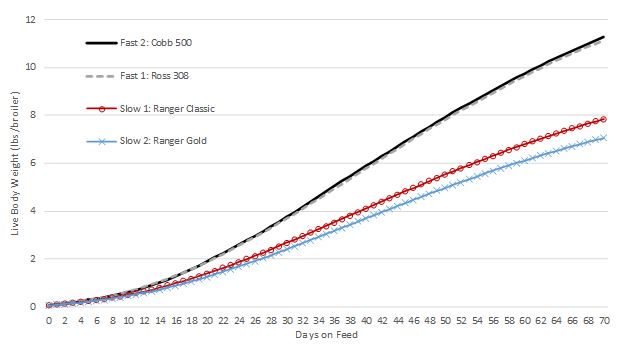
We obtained data from commercial breeding companies on two slow growth broiler breeds (called Ranger Classic and Ranger Gold) and data on two modern fast growing breeds (called Ross 308 and Cobb 500). Here are the growth curves for the four broiler breeds:

slow_growth3.JPG

The two slow growth breeds are, well, slower growing. The slower-growing breeds take 54 and 59 days, respectively to reach 6 lbs, whereas the faster growing breeds both hit this target weight in about 41 days.

These growth data are combined with data on feed intake, prices, assumptions about stocking density, and more, and we calculate costs and returns under a number of different scenarios. Here are the main results for the most likely scenario where producers choose the number of days to feed broilers so as to maximize net returns and where slow growth broilers have a more generous stocking density than fast growth broilers, as dictated in many animal welfare guidelines.

slow_growth4.JPG

About 17.45 lbs/ft2/year (or 73%) more chicken on a dressed weight basis is provided by the two fast vs. two slow growth productions systems, on average. Thus, substantially more barn space, or square footage, would be required to produce the same volume of chicken from slow as compared to fast growth breeds. Costs of production average $0.54/lb for the two slow growth breeds and average $0.47/lb for the two fast growth breeds, implying costs are 14% higher per pound for the slower growth breeds. Fast growth breeds are substantially more profitable - generating returns about twice as high per square foot than the slower growth breeds. We calculate that the slower growth broilers would need to obtain wholesale price premiums of $0.285/lb and $0.363/lb to achieve the same profitability as the best performing fast growth breed.

We also use these estimates to calculate potential market impacts that would occur if the entire industry transitioned from fast to slow growth broiler breeds. Under the most likely scenario, we calculate that converting to slow growth breeds would increase retail chicken prices by 1.17% and reduce the amount of retail chicken sold by 0.91%, resulting in losses in producer profits of $3.5 billion/year. We also calculate that consumers would be worse off by $630 million/year, assuming their demand for chicken doesn’t change in response to the switch from slow to fast growth. Increases in consumer willingness-to-pay of 8.5% would be needed to offset the adverse effect on producer profits.

It’s Election Season – For Food Too. California Prop 12 Edition

At this point, you’ve probably seen enough campaign ads that you don’t need me to tell you that elections are around the corner. 

Among several food and agricultural issues up for vote this year across the country is Proposition 12 in California.  The official California voter guide has the following information on the initiative:

prop12.JPG

If this feels like deja vu, you’re right. California votes passed a similar law in 2008 (Prop 2).  The new bill (Prop 12) goes further by explicitly specifying a minimum amount of space per farm animal and by requiring cage free production systems for egg laying hens by 2022.

Allison Van Eenennaam, animal scientist at UC Davis, has weighed in with her (critical) thoughts on Prop 12, and she pointed out the irony that the main donor against Prop 12 is an animal advocacy organization that would like the conversion to cage free to happen sooner than is required in this proposition.

I’ve received a few calls from reporters asking my thoughts on potential market impacts of Prop 12. I’ll share them here.

  • I’ve co-authored two papers on market impacts of the previous Prop 2 and the associated state legislation that went into effect in 2015 (see this paper with Conner Mallally and this one with Trey Malone). The paper with Conner showed a roughly 30% price impact of Prop 2 immediately after it went into place, an effect which fell to about 10% about a year and a half later.

  • There are reasons to expect Prop 12 to have smaller or larger effects than what we measured for Prop 2.

    • Why smaller? An increasing share of egg production, nationwide, is coming from cage free production systems (see data here), and if pledges by food retailers to go cage free are upheld, more than three quarters of the industry will be cage free by 2025. Moreover, a number of other states have passed laws to go cage free. Given these apparent trends toward increasing cage free, the effects of Prop 12 per se may be small. That’s not to say that egg prices won’t rise (they will), but that Prop 12 may not be the ultimate proximate cause.

    • Why larger? Well, retailer pledges may not be upheld and industry conversion to cage free has slowed. Cage free and organic combined are only around 17% of the total laying flock at present. Moreover, our previously estimated price impacts of Prop 2 occurred in a situation where producers did not have to undertake large capital investments. Producers could comply with the space requirements that resulted from Prop 2 by removing a hen or two from a cage. By contrast, Prop 12 will require entirely new housing systems, resulting in significantly higher conversion costs than did Prop 2.

  • If I was forced to make a guess about the effect size coming from a future study of the impacts of Prop 12 (a future study like the ones I conducted with Conner or Trey), I’d guess something around a 15-25% price increase in retail shell egg prices by mid-2022 relative to the counterfactual of no Prop 12.

  • There are other impacts of Prop 12 that are getting less attention but could have big impacts. In particular, Prop 12 would prohibit sales of pork from gestation crate systems. Because California relies on the rest of the U.S. for virtually all it’s pork, I could imagine situations in the short run where retailers have difficulty sourcing enough supplies that comply with the new regulation. If this seems far fetched, remember when Chipotle had to stop selling carnitas, and then, for at time, sold the pork dish with supplies that did not meet it’s guidelines? Another potential consequence, noted by Van Eenennaam is that Prop 12 would prevent “scientific and agricultural” research from studying animal behavior in conditions that don’t comply with Prop 12. It’s hard to quantify the impact of the inability to learn about certain research questions, but the impact isn’t zero.

Happy voting!

Trends in National School Lunch Program

Back in 2010, the U.S. Congress passed the Healthy, Hunger-Free Kids Act. The Act, championed by Michelle Obama, provided funding for free and reduced price school lunches and breakfasts, introduced a variety of new nutritional guidelines, and provided incentives for schools to offer healthier options.

The law went into effect at the beginning of the 2012-2013 academic year. There was a fair amount of initial push back. A video from these Kansas students protesting the calorie restrictions has been viewed more than a million times, and other students took to social media with photos of the new lunches using the hashtag #ThanksMichelleObama. This CNN article from 2017 provides some background and also reports on the efforts of a large school food service industry association to roll back some of the guidelines.

The new guidelines may well have generated some positive health benefits for students who ate school lunches. But, how have these policies potentially affected participation in the National School Lunch Program (NSLP)? Students are not required to eat the school-provided NSLP lunches. Students can bring food from home, go off campus, or find other substitutes at school.

I downloaded some data from the US Department of Agriculture (USDA), Food and Nutrition Service (FNS). These data show that in 2017, 4.89 billion lunches were served under the NSLP, with 73.6% being free or reduced price and the remaining 26.4% of students paying full price. How have these statistics changed over time?

As the figure below shows, there was a nearly linear increase in the number of lunches served each year in the NSLP right up until 2010, after which there was a slowdown and then a slow decline.

NSLP.JPG

The effects can be seen even more dramatically by converting the data in the above figure to annual percentage changes in the number of NSLP meals served. From 1990 to 2008, the school lunch program grew every year. Since 2011, the program has gotten smaller every year except in 2016. In the six years prior to the law’s enactment in 2010, there was an average annual increase of 1.4% in the number of NSLP meals served, but in the six years since the law’s enactment (from 2012 to 2017), there was an annual average decrease of -1.2% in the number of NSLP meals served.

NSLP3.JPG

The data also suggest another interesting dynamic at play. Below is the percent of NSLP meals that are free or reduced priced. Throughout most of the 2000’s just under 60% of NSLP meals were free or reduced price. Since then, there has been a fairly steady increase in the share of meals that are subsidized. Given that the increase started prior to the enactment of the 2010 Healthy Hunger-Free Kids Act, it is likely that other factors (such as the Great Recession) were playing a role. However, there has continued to be an increase in the share of NSLP meals that are free or reduced price well after the recession ended.

NSLP2.JPG

These data show there are fewer meals being served that fall under the National School Lunch Program umbrella and that students who pay full price have increasingly chose to eat meals not governed by the program.

The figures presented above do not causality prove that the 2010 Healthy, Hungry-Free Kids Act led to the decline in the meals served under the USDA National School Lunch Program, but they are interesting trends about which I was previously unaware.

Market Impacts of GMO Labeling

Readers might recall the result from the study Jane Kolodinsky and I published in Science Advances earlier this year. We found that the provision of mandatory labels in Vermont appears to have reduced opposition to GMOs in that state. However, as I noted at the time,

Our result does NOT suggest people will suddenly support GMOs once mandatory labels are in place.

Indeed, the data suggest consumers will still want to avoid products with GMO labels, which provides incentives for food retailers and manufacturers to find ways to avoid GMO ingredients.

Colin Carter and Aleks Schaefer just published an interesting new study in the American Journal of Agricultural Economics, which powerfully shows that mandatory GMO labels are already having significant market impacts. They found a creative way to explore this issue by focusing on the market for sugar. They provide the following background:

In the United States, sugar is produced from both sugarcane and sugarbeets. Sugarcane stalks are milled to produce raw sugar. Raw cane sugar is then sent to a refining facility to be transformed into refined sugar. Sugbarbeets, in contrast, have no raw stage; they are processed from beet to refined sugar in one continuous process. The U.S. market share for beet (cane) sugar is approximately 58% (42%). Almost all U.S. sugarbeet production is GE, while cane sugar is GE-free. However, sugar derived from beets is chemically identical to sugar derived from cane.

This summary data they provide on prices of sugar from cane and beet sources suggests “something” change around the same time as the Vermont mandatory GMO labeling law.

Source: Carter and Schaefer, American Journal of Agricultural Economics

Source: Carter and Schaefer, American Journal of Agricultural Economics

Here are the main findings.

Our analysis supports the explanation that the divergence in U.S. prices for refined cane and beet sugar was the result of Vermont’s mandatory GE labeling. The divergence occurred on or around July 2016— the month the Vermont Act took effect.

Counterfactual price estimates generated by a regression model suggest that GE food labeling initiatives generated a small premium for cane sugar and a price discount for beet sugar of approximately 13% relative to what prices would have been in the absence of such legislation.

These changes in raw ingredient prices will ultimately have impacts on retail food prices. All this is suggests that mandatory labels aren’t a free lunch.