Blog

Consumers are taking note of inflation and worsening economic conditions

The July 2022 edition of the Consumer Food Insights (CFI) report from the Center for Food Demand Analysis and Sustainability (CFDAS) at Purdue is now out. A key take-away from this month’s findings is consumers’ buying behaviors are beginning to be affected by inflation and worsening economic conditions.

We repeated a question we asked back in February, which asked respondents to pick the top 3 answers that most reflected how they were responding to higher food prices. Back in February, the most common response (selected by 31% of respondents) was “little or no change.” In July, that figure fell nine percentage points to 22%. Now, the most common answer is “sought out more sales and discounts” followed by “switched to generic brands.” Whereas the “switched to generic brands” category was only selected by 13% of respondents back in February, in July it was selected by 22% of respondents.

Despite this finding, we are not yet seeing an uptick in food insecurity rates, and total food spending continues to rise.

This month, we did a deep dive into effects of education on food behaviors and attitudes. We find:

  • Food insecurity in 2022 is highest among those without any college education.

  • The most educated consumers report being most satisfied with their diets.

  • The importance of nutrition increases as consumers complete more years of college.

  • Gardening, vegetarianism, and recycling are most popular among those with a graduate degree.

Here’s how various food-system related beliefs vary by education.

A lot more is available in the full report.

What Caused the Increase in Pork Prices?

That’s the question Glynn Tonsor and I tried to answer in a recent report we prepared for the National Pork Board. From January 2020 to May 2022, retail pork prices increased over 27%. Why? The figure below summarizes our assessment.

From the executive summary:

Several factors contributed to the 6.3% increase in consumer willingness-to-pay for pork. Analysis suggests that changes in the prices of beef and chicken relative to pork are probably not major drivers of the increased willingness-to-pay for pork. Rather, a more likely driver behind increasing pork demand is strong consumer food spending, buoyed by federal stimulus and COVID-19 relief payments.

A number of factors contributed to the estimated 45.6% increase in marginal costs of pork production. These include: 1) Significantly higher feed costs. Inflation-adjusted corn prices increased 79% from January 2020 to April 2022, and soybean meal prices increased 42% over the same period. 2) Fuel and transportation costs have escalated. Real gasoline and diesel prices are about 48% higher than in January 2020, and refrigerated trucking rates were up about 50% at the first of 2022. 3) Wages in packing and retailing have outpaced inflation, pushing up pork prices.

For the economists out there, the approach we used to quantify the price increases is one that could be readily applied in a variety of other contexts. If one knows the change in price and quantity and is willing to make assumptions about the elasticities of supply and demand, then it just takes a bit of algebra to decompose a price change into the portion arising from demand factors and the portion arising from supply factors.

There is a lot more in the full report, which is available here.

Most plant-based meat alternative buyers also buy meat: an analysis of household demographics, habit formation, and buying behavior among meat alternative buyers

That’s the title of a new co-authored paper led by Purdue PhD student, Zack Neuhofer, that was just published in the Nature journal Scientific Reports. While there have been many survey efforts to understand consumer buying behavior related to plant-based meat alternatives, fewer studies have used actual purchase behaviors. Here’s the abstract:

The promise of novel plant-based meat alternatives (PBMAs) to lessen the health and environmental impacts of meat consumption ultimately depend on market acceptance and the extent to which they displace meat in consumers’ diets. We use household scanner data to provide an in-depth analysis of consumers’ PBMA buying behaviors. PBMAs buyers tend to be young, single, female, college educated, employed, higher income, and non-white. About 20% of consumers purchased a PBMA at least once, and 12% purchased a PBMA on multiple occasions. About 2.79% of households only purchased PBMAs. About 86% of PBMA buyers also bought ground meat; however, PBMA buyers spent about 13% less on ground meat. Interestingly, after a household’s first PBMA purchase, ground meat consumption did not fall. The number of households buying a PBMA for the first time fell over the two year period studied, despite the increase in market share in the ground meat market.

We summarize some of the results in this venn diagram.

You can read the whole thing here.

P.S. This paper largely provides a descriptive analysis of buying behavior; Zack is currently working on another paper that will include formal demand modeling.

Tracking Social Media and News about Beef, Pork, Poultry, and Plant Based Meat Alternatives

Along with my colleagues at the Center for Food Demand Analysis and Sustainability at Purdue, we’ve created a new data dashboard we’re calling #Meat, which shows volume and sentiment of social media (or traditional news media) about meat and meat alternatives over time and across the United States. The dashboard is based on criteria and procedures Nicole Widmar and colleagues outlined in an academic paper published in Meat Science earlier this year.

Here is a screenshot of social media sentiment and volume surrounding plant-based meat in 2022. Sentiment is most positive in California, Washington, Iowa, and Texas and most negative in Idaho, Nevada, Arizona, and Wisconsin. On a per-capita basis, volume of social media searches on plant-based meat are highest in Wyoming, Vermont, and Delaware.

Here is the same except for pork. Sentiment is uniformly positive across the U.S., but highest in Arkansas (perhaps due to the mascot of the large public University in the state?)

Play around with the data yourself! The data will be updated on a weekly basis.

Thanks to my colleagues Nicole Widmar, Jinho Jung, and Annapurni Subramaniam who helped create the dashboard.

Consumer Food Insights - June 2022

The June edition of the Consumer Food Insights (CFI) survey is now out. This month’s report is chock-full of interesting data and insights.

Here are a few highlights:

  • The Sustainable Food Purchase Index reached it’s highest level (70 out of 100) since our tracking survey began in January 2022.

  • Food spending continues to climb; this month the main increase is from spending on food away from home while spending on grocery was essentially flat.

  • Measured rates of food insecurity remain steady but there are some signs of belt-tightening among consumers, as there is an increase in price sensitivity and choice of generics over brands as well as an increase in food spending as a share of income for the lowest income consumers.

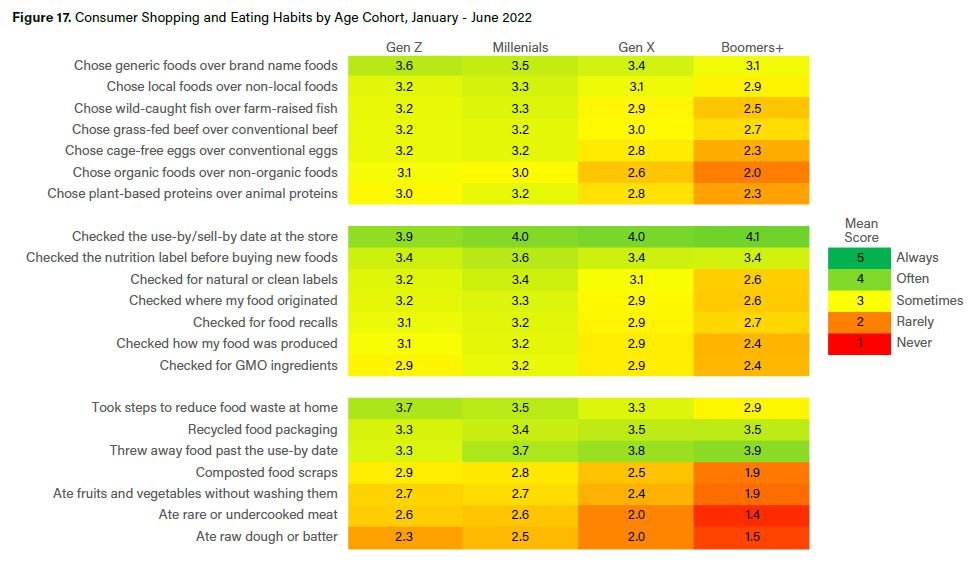
This month, we did a deep dive into impacts of age on consumer food behaviors and attitudes. There were significant age/generation gaps in several of our measures. For example, younger generations tended to place more important on environment and social issues when buying food compared to older generations.

It is also the case that food insecurity is highest among the younger households.

A corollary is that older consumers are more happy and satisfied with their food and diets than younger consumers. There are also differences in beliefs and purchase behaviors as the figure below illustrates.

Finally, we added a number of new ad hoc questions this month related to gardening, global food supply chain disruptions, and overall satisfaction with food issues relative to other issues in daily life. Seventy percent of respondents said they were worried or very worried about the Russia-Ukraine war affecting global food supplies; a smaller share, but still a majority (58%) thought the war had directly affected their food prices or availability. The most favored policy response was to increase U.S. food production.

There is a lot more in the full report. I encourage you to check it out at our Center for Food Demand Analysis (CFDAS) website.