Blog

Food Company Voluntarily Adds GMO Labels

This is a potential game changer (from the NYT):

Breaking from its industry rivals, Campbell Soup will become the first major food company to begin disclosing the presence of genetically engineered ingredients like corn, soy and sugar beets in its products.

A while back when writing about the duplicity of a many food companies on the issue of GMO labeling, I wrote

For now, food companies are not required to add labels indicating the presence of genetically engineered ingredients. But, it might ultimately be in their best interest to do it voluntarily, and in a way that avoids the negative connotations implied by the labels that would have been mandated in state ballot initiatives.

Some day in the near future, after concerted efforts to educate the public and create consumer-oriented biotechnologies, we may see food companies clamoring to voluntarily add a label that proclaims: proudly made with biotechnology.

Campbell's isn't going that far (and in fact they're supporting nationwide mandatory labels on foods with genetically engineered ingredients).  Nonetheless, this is an interesting move, and it will be fascinating to see how it plays out.

Thinking about risk

Consider this passage from a recent New York Times article

Mr. Portier, who led the center when the revision process was initiated, said he believed parents should have been presented “with enough information to say caution isn’t ill advised, because we really don’t know, and there are enough indicators to say we should be cautious.”

The quoted former CDC official is espousing a form of the precautionary principle.  What do you think he's referring to? GMOs?  A new pesticide?  Food irradiation?

Nope. He's talking about cell phones.   The article describes some squabbles at the CDC on whether using cell phones cause cancer (the same World Health Organization group that says bacon and the weed-killer glyphosate may be carcinogenic  have also said that cell phones are a possible carcinogen), and how to communicate with the public on the issue.

So, here he have an issue for which there is apparently some scientific uncertainty, for which some government officials want the public to proceed only with caution, and the the public response?  A big shrug.  

Why is it that people think about the risks surrounding cell phones so differently than they do the risks surrounding GMOs, glyphosate, irradiation or many other food and agricultural technologies?  One could write a whole paper on that topic.  In fact I have (along with Jutta Roosen and Andrea Bieberstein).

There are a variety of reasons.  For one, people tend to conflate benefits and risks.  If something is beneficial then, people tend to think of it as less risky (even though we can imagine some very beneficial products that are also risky).  People directly see the benefits of using cell phones every day and thus they are perceived as less risky than, say, a pesticide that they have never heard of and scarcely can imagine  using.  Then, there is the old risk perception literature that originated with folks like Paul Slovic that is still relevant today.  The idea is that risk perceptions aren't driven by objective probabilities of possible bad outcomes but by how familiar or unusual a product seems and by how much control we believe we have over the risk.  Cell phones seems relatively safe because they're now quite familiar and because we decide whether to pick it up or turn it off.  Many food and agricultural technologies, by contrast, seem foreign and have secretly been slipped into our food supply (or so the story goes; ever notice now many of the top-selling food books use words like "hidden" or "secret" in the subtitles?).  

Whether there are good reasons for these psychological biases is less clear, particularly when they run at odds with the best scientific evidence we have on relative risks.  I for one, am perfectly at ease eating a tortilla made from Roundup-Ready corn while chatting on my cell phone.  The biggest risk is probably getting salsa on my iPhone.      

What is a GMO anyway?

Yesterday on Twitter, Nathanael Johnson asked a good question, and got lot of good answers.

I couldn't figure out how to embed the whole Twitter conversation but there were scores of interesting responses.  The discussion is related to another important one: A GMO isn't a single thing, it's many, many possible things.  But, Nathanael's question is deeper, and philosophical.  Is this thing we've called "GMO" something that's only in our heads or is it something that exists independent of our minds.  Another way to look at it: if a Martian were to travel to earth and look at what's our dinner plate and is growing on our farm fields, could they - without knowledge of our history or social baggage - identify a class of things called "GMO" that would match up with the class of things we call a "GMO"?

Food Demand Survey (FooDS) - December 2015

The December 2015 edition of the Food Demand Survey (FooDS) is now out.

Some observations from the regular tracking questions:

  • Compared to last month willingness-to-pay for all products, particularly beef products, was up.
  • There was a sizable drop in the proportion of respondents who say they plan to eat out more in the next two weeks.
  • There was again a big spike in awareness and concern for E. Coli and Salmonella, likely as a result of the publicity surrounding the Chipotle outbreaks,
  • There was a large increase in visibility of GMOs in the news in the past two weeks.
  • The fraction of respondents who said they suffered from food poisoning doubled compared to last month.

Three new ad-hoc questions were added this month.

The first set of questions dealt with consumers perceptions of different animal welfare labels. Respondents were asked: “Which of the following labels, if seen on a meat or animal product in a grocery store, do you think would indicate and assure the highest and lowest levels of farm animal welfare?”

Participants were then shown images of nine different labels (randomly ordered across surveys) and were asked to click three labels and move them to a box indicating the highest level of animal welfare and then click three of the labels and move them to a box indicating the lowest level of animal welfare.

Here's what we found.


More than half the respondents put the following three labels in the highest welfare category: Certified Humane, Animal Welfare Approved, and American Humane Certified. Two labels, 100% natural and non-GMO verified had nothing to do with animal welfare and they were generally ranked neither high nor low. The largest percentage of respondents placed the Tyson brand label in the lowest animal welfare category, but it had more “highest welfare” category placements than Global Animal Partnership or Food Alliance Certified. The Global Animal Partnership label (which showed a Step 4 rating) was most likely to not be placed in either
the the highest or lowest welfare categories.

The next set of questions were added to investigate issues related to consumer aversion/acceptance of GMOs and perceptions of corporate involvement and control.  The questions came about as a result of a Q&A after a talk I game in Amsterdam last month at the Conference on Coexistence between Genetically Modified (GM) and non-GM based Agricultural Supply Chains.  In particular, Norbert Wilson from Auburn followed up and helped devise the following questions.  

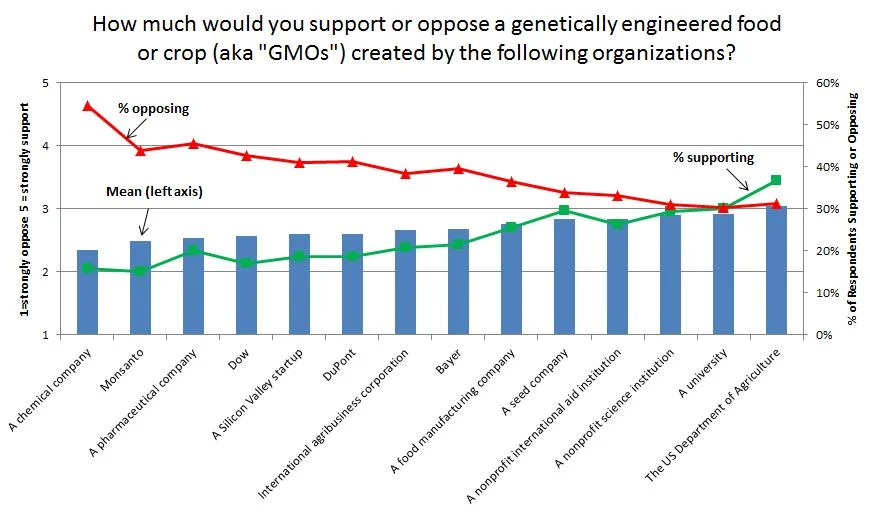
We first asked, “How much would you support or oppose a genetically engineered food or crop (aka “GMOs”) created by the following organizations?” Then, fourteen different entities were listed (in random order across respondents), some of which were specific company names and others that were generic entities.  Respondents replied on a 1 to 5 scale ranging from strongly oppose to strongly support.


GMOs from a chemical company, Monsanto, and a pharmaceutical company were the were least supported. GMOs from a non-profit scientific organization, a university, and the USDA were most supported. For the latter two categories the percentage of respondents supporting equaled or exceeded those opposing. 

Finally, the last question asked, “Of all the possible benefits that arise from the genetically engineered (or “GMO”) food and crops currently being produced, what percent of the benefits do you believe go to the following entities?” Eight different groups were listed (in random order), and respondents had to allocate 100 points across the groups.


Respondents thought seed, chemical and farm input suppliers received the largest share of the benefits (at 17.7%) followed by governments and food processors (each at about 15%). Farmers were next at almost 14%. At the bottom were consumers (10.6%) and universities (8.7%). 

Who consumers think benefits from GMOs appears to have some relationship with concerns and acceptance of GMOs.  Recall, one of our standard questions asked every month is how concerned that GMOs pose a food safety risk in the next two weeks.  When we calculate correlations between GMO concern and the distribution of benefits from above, there are some statistically significant correlations.  The larger the perceived benefits to consumers and farmers, the lower the perceived concern about eating GMOs.    

Similarly, the correlations between the average level of support for GMOS made from the 14 entities indicated above and perceptions of who benefits are shown in the following table.  People who think universities and consumers benefit more from GMOs are more likely to support GMOs.  By contrast, people who think seed, chemical, and farm input suppliers and governments benefit more are less likely to support GMOs.

On the Chipotle Food Safety Outbreaks

Much has been written in the past couple weeks about the foodborne illnesses contracted by Chipotle customers.  I've been a bit reluctant to weight in because, at least in some social media circles, there seemed to be some pleasure taken in Chipotle's misfortune.  From my perspective, however, I don't want to delight in someone else's misfortune (particularly some unsuspecting food consumer's foodborne illness) even if I've previously been critical of the vendor's marketing practices.   What I will say is that Chipotle engaged in a variety of marketing practices  (e.g., going non-GMO, no hormone, etc.) the best science suggests have no material impact on food safety, and yet the moves were likely aimed (at least in some part) to increase the perception (rather than the reality) of food safety.  

Marketing aside, there is a real trade-off to be made between selling "clean", fresh, food sourced from small-local vendors and food safety.  There are likely some taste benefits with fresh, unfrozen food and there is nothing inherently wrong with being willing to pay a bit more for wares from smaller more local providers.  But, choosing these options may make ensuring food safety a bit more challenging.  

That's the message I tried to communicate to the reporter Kimberly Leonard for this piece in US News & World Report.  She quoted me as saying:

“If you want to make products fresh, that means you’re not going to use a preservative or it’s going to be unprocessed,” says Jayson Lusk, president-elect for the Agricultural and Applied Economics Association, who has been critical of Chipotle’s marketing practices. “It does provide a real tradeoff in terms of providing a safe product for the consumer.”

and

Lusk says his research has shown that the increase in demand for all-natural, so-called “clean” food, is a “real challenge to food safety.”

“We tend to have this idea that small is clean and safe – it could be true but it’s not necessarily true,” Lusk says. “You’ll have more food waste and it will be more expensive, and your food safety is more of a challenge. … It’s just a trade off they make.”

I touched on this same topic for a chapter on technological improvements related to food safety I wrote for my forthcoming book, Unnaturally Delicious

The bigger problem, however, is what happens to the safety of food when seemingly unnatural ingredients are not used. Keeping food safe without using chemical additives is a big challenge for food manufacturers and retailers. Consumers are increasingly demanding fresher, more natural, “clean” food. Yet, as one food safety expert told me, “It’s a tremendous strain on the food-producing industry. If you take away growth inhibitors, what do you do?” One executive of a large food retailer remarked, “As consumers are asking for fresh and more natural food, we have to take out ingredients and preservatives, which makes food less safe.” Fresh foods might have taste advantages, but they also tend to have shorter shelf lives, increasing the likelihood of earlier spoilage and food waste. Moreover, research and development costs involved in reformulating preservatives to increase the perception of naturalness are passed on to the consumer in the form of higher food prices, even when the preservatives’ underlying chemical properties have not changed.

Here's another portion of the book related to a discussion I had with Frank Yiannas, the VP of food safety for Walmart (written well before news of the Chipotle outbreaks emerged):

I started by asking about the size of Walmart. More than 120 million Americans (more than a third of the U.S. population) shop at Walmart every week. Does the sheer scale of the operation make the U.S. food system riskier? If Walmart has an outbreak, multitudes would be sickened. Yiannas replied: “One out of every four dollars spent on food are spent at a Walmart. We can make a big difference. Large organizations like Walmart result in a safer food system.” He points out that when Walmart makes a change, it affects the whole system. Sure, smaller companies might have outbreaks that affect fewer people, but when lots of small companies are having lots of small outbreaks, the problem is more widespread. A downside to small companies, said Yiannas, is that they can’t easily invest in improving the system as a whole. While Walmart often attracts negative attention because of its size and scale (e.g., Do they pay workers fairly? Do they hurt local mom-and-pop busineses?), at least in the world of food safety, their size has significant benefits for its customers, and as I’ll soon discuss, even for non-customers.