Blog

Chicken Price Manipulation?

This article in the New York Times by Stephanie Strom argues that something may be fishy with chicken prices.  

The main focus of the article is about a widely used price index of chicken prices (the so-called Georgia Dock index) that is used by some retailers to negotiate prices with poultry producers.  Apparently the Georgia Dock price of chicken is higher than a couple of other price indices of wholesale chicken prices (one of which the USDA just created), and the Georgia Dock price hasn't fallen by as much as another index in recent months.  The article insinuates that something nefarious could be going on to artificially inflate the Georgia Dock price (and by extension the retail prices you and I pay for chicken).  

I have no deep insights into the allegations in the article.  However, I do want to push back just a bit on the broader issue of chicken prices relative to beef and pork.  Here is Strom: 

Beef prices at grocery stores are lower. So, too, are pork prices. But chicken? Steady as she goes.

A glut of corn and soybeans has led to lower prices for a variety of meats. But chicken in grocery stores has bucked the trend, leaving prices up for shoppers and buoying the fortunes of major chicken producers.

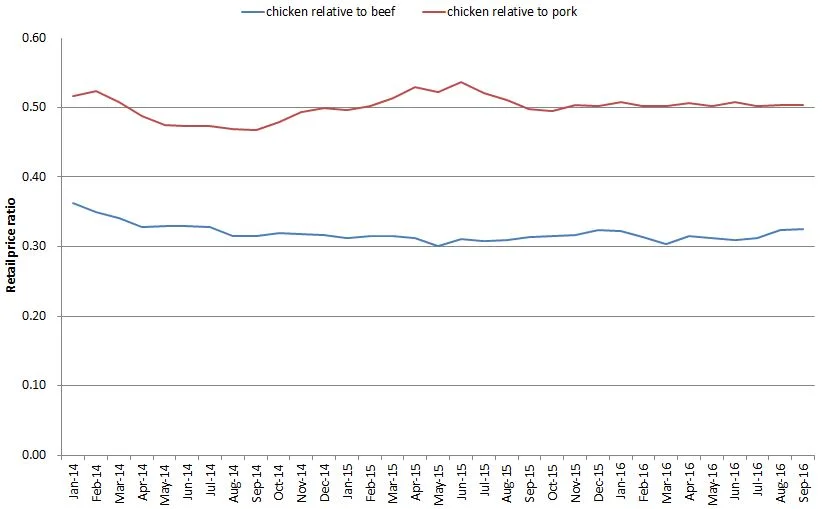
I'm not so sure about that first line - that beef and pork have become cheaper relative to chicken. Using data from the USDA-ERS on retail meat prices, I constructed the following graph showing the retail price of chicken relative to the retail prices of beef and pork.  Unfortunately, the last data point is September (the USDA bases it's calculations on retail prices reported by Bureau of Labor Statistics, but BLS hasn't released October prices yet), so it is possible that there have been some changes in recent weeks that aren't reflected in the graph below (but, even still, one might wonder why it's just now in the past month or two that the poultry producers figured out how to rig the wholesale price).  

Two broad points: 

1) As of September, the ratio of chicken to pork prices is essentially flat (i.e., chicken isn't getting more expensive relative to pork).  While chicken is a tad more expensive than beef in August and September relative to July, overall the trend looks pretty flat to me.  

2) Chicken is really cheap!  It is about half the price of pork and about a third the price of beef.

Moreover, if we take a step back and take the long view, chicken has progressively gotten cheaper relative to beef.  (note: the graph below uses the price for a whole chicken rather than composite retail prices as in the prior graph because the whole chicken data series goes back further in time).  Whereas whole chickens sold about 40% the price of beef in the 1970's, today they're about 25% the price of beef.

So, are poultry producers manipulating a price index leading us to pay more than we otherwise would have paid for chicken?  I don't know.  But, as the above graph shows, there's a whole lot of other things poultry producers have done over time (better genetics, better feed, better housing, etc.) to make chicken ever more affordably priced compared to other proteins.  

New Research on the Berkeley Soda Tax

You may remember the discussion surrounding a research paper released back in August that used interviews and survey data to suggest that the tax on sodas that went into place in Berkeley caused a significant reduction in soda consumption.  

As several other locales are considering new soda taxes in the upcoming election season, this sort of research is valuable in trying to sort out the potential effects of the policies.  

Now there is new research by Scott Kaplan, Rebecca Taylor, and Sofia Villas-Boas at UC Berkely.  The authors utilize a dataset on retail sales of various drinks in dining locations at "a large university" - presumably Berkeley.  Importantly, the authors do not actually look at the effect of the implementation of the tax, but rather they look at what happened to soda sales because of the publicity and information surrounding the vote.  That is, they look at soda sales surrounding the time of the vote but before the tax actually went into place.

Here is a figure from the paper summarizing the main findings: 

The authors write:

We find a 30% drop in soda sales relative to other product groups during the post-election
period. In a related and contemporaneous study using survey data, Falbe et al. (2016) find
an average 21% drop in SSB quantity sold. However, because the surveys were completed
only before the election and after the tax implementation, Falbe et al. (2016) are unable to
distinguish whether this effect was from the campaign and election or from the tax itself.
Our results show that soda sales fell on-campus after the soda tax election yet before prices
changed due to the tax. This suggests that comparing pre-campaign to post-implementation
consumption may confound a tax effect with an information effect. This has important
implications for external validity. If the Berkeley SSB tax is replicated elsewhere without
a proceeding campaign war and affirmative election outcome, its effects on consumption
may differ substantially. In other words, given the amount of money spent in the Berkeley
campaign on each side of the battle, it is important to understand how much behavioral
change was due to the election and how much was due to the tax itself.

My take on the results is that these soda tax policies may well have sizable "signaling" or "information" effects aside from whatever pecuniary effects exist.  I have found similar results related to animal welfare regulations: that the publicity surrounding a vote has a significant impact on what people buy aside from whatever impacts the policy actually has on the price or foods offered.  In short: information dissemination campaigns may be as important or more important than taxes or bans on products.  In my assessment, information policies are often far more justifiable than are more coercive policies that restrict choice. 

It will be interesting to see as future research emerges whether and how the actual implementation of the tax changes soda consumption and how long lasting are these information effects.  

Social Isolation and the Food Police

Last week on the Econ Talk podcast, Russ Roberts had Chris Arnade on as a guest.  Arnade is a former Wall Street trader who became disillusioned with his work and began (first as a way to just relieve stress) going on long walks to poorer neighborhoods in New York where he would meet people and take pictures.  He's since expanded the enterprise and has visited disadvantaged areas all across the U.S.  

There was a bit near the end of the discussion that hit home for me and helps explain a bit of the motivation that led me to write the Food Police several years ago.  

From the transcript, here is Chris:

They do see themselves as victims of policy decisions. They may not be actually informed about those policy decisions as people would like them to be. You know, I think what sticks out to me is the anger. The anger is kind of 3-pronged. One of it’s very much social. It’s a sense of feeling kind of diminished in terms of people caring about them, being made fun of: everything they do is laughed at. If they like NASCAR (National Association for Stock Car Auto Racing.), that’s made fun of. If they vape, then that’s considered wrong. They eat at McDonald’s, that’s cheap. So that’s kind of just—if they go to church, they are considered silly. So there’s a sense of just feeling like very much they are being mocked in terms of their lifestyle.

After a bit more discussion, Russ Roberts the asks:

I want to talk about the first one, because it interests me. I am constantly trying to remind economists that money isn’t everything. And that, although work is nice when it brings money, one of the things it also brings is meaning. And I think the problem of the lack of employment in the United States as we’ve recovered from this recession, especially among less educated Americans, is a huge problem, not because they are poor and unemployed—which is unpleasant, no doubt about it—but because their life is not as meaningful and worthwhile. So, I totally understand that. What I wonder about is this idea of respect. Certainly respect is hugely important to our sense of wellbeing. But when you say things like, ‘People don’t respect NASCAR,’ or church, they being—McDonald’s. And among my friends, that’s true. Among the people I hang out with generally, higher educated people, those are all the attitudes they hold. But are the people who are enjoying those things—McDonald’s, etc.—why do they—how do they perceive that they are not respected? I don’t hang out much with people on the Coast, say, who are telling them that—is this something they are perceiving on television? Is it something they are reading about?

And Chris responds:

I don’t want to get overly simplified but I guess I really do think there’s two Americas. And I think the America that’s doing well dominates the media, dominates the culture in terms of—you know, Sociologists always talk about there’s an in-culture and there’s an out-culture. And we signal [?] ways of being in the in-culture, in terms of the television shows, in terms of what’s on, movies, and what’s kind of made fun of. And I think there’s a fair amount of people who make fun of the culture of poverty, in terms of how people get by. If people go to church. If people, you know, go to NASCAR. Or those sort of things. I think it does filter across through the media. And I think some of it also is, comes from a place of being frustrated already and then taking any perceived slights, you know, magnifying them. So, you know, we may not be as—they may be more overly sensitive than they should be, but that comes from a place of also being just frustrated, economically—feeling very much like they are left behind.

There are not doubt many good people in the so-called "food movement" who care about the downtrodden and are motivated by the belief that the food system they envision will help poorer people.  But, I think this exchange also reveals that we need to also respect and look at things through the eyes of the people we're trying to help.  

More on soda taxes

A few days ago, the World Health Organization (WHO) came out with report, suggesting the use of food taxes and subsidies to encourage healthy eating.  They were particularly in favor of soda taxes.  Soda taxes seems to be picking up steam in the U.S..  After passage in Berkeley, they will now be on the ballot in several locales in coming weeks.  

I've written so much on these topics, it's hard to know what more to say.  So, I thought I'd just, for the record, tell you what I had to say on a recent Food Sommelier podcast when the host asked me about this topic (and revealed her support for soda taxes, which came about in part because she said she felt guilty for having worked for PepsiCo earlier in her career).  

I'm in episode 38 and the discussion on soda taxes starts at about the 20 minute mark.  Here is my lightly edited discussion on the issue. 

“I’m not a fan of soda taxes for a whole host of reasons . . . but let me first say, though, that it’s really not that big a deal.  And that’s probably one of the reasons I’m against it . . .  As much as I’ve written about it, you’d think I’d get my feathers ruffled a lot [over things like the Philadelphia soda tax], but I don’t have a dog in the fight really one way or the other.  It’s not a big deal in the sense that, number 1, it’s just not going to have much of an effect on obesity rates if you look at the best available research.  We are talking about taxes that will have very, very small effects on people’s weight, and there a lot of reasons for that.  

There are substitutes for sugar sweetened beverages.  People can switch to juices or even non-beverage alternatives that may have calories in them.  I’ve seen a number of studies that suggest that.  Just because we put a tax on something doesn’t mean people are not going to consume calories; they might instead switch to something else equally caloric.  . . . 

We have these intuitions . . . and little thumb rules like for every 3,500 kcal we cut out, we lose a pound.  The reality is that relationship is not linear at all.  It’s nonlinear . . .  When we’re thinking in a linear way, each calorie I cut out will cause a constant reduction in weight, but it doesn’t really happen that way.  There are diminishing returns.  You may lose a little bit initially but then it will really level off.  . . .

When you look at the burden of the tax, and this is really true of almost any food tax, its going to tend to be borne relatively (at least relative to income) more by people in the lower economic strata of society.  The reason for that is that if you look at the share of spending on food, it tends to go down as we make more money.  What that means is that poor people are spending a larger proportion of their income on food. So, anything we do to make food more expensive, that burden or that tax, is going to tend to fall more heavily on lower income populations. . . .

I’ve got a paper actually coming out . . . where we compare very low income to regular income consumers.  What we tended to find there is that is that, especially in the case of subsidizing healthy foods, the richer consumers benefit the most because they’re already, first of all, consuming relatively health foods.  And, because we found . . . that the poor tended to want to stick to their original diets. They were more habit prone, so they didn’t change quite as much either when it was a tax . . . or a subsidy trying to get them to eat something a little healthier.  

I would say lastly, I’m going to bring up this sort of elitism. . . . This sort of paternalism argument.  We feel like we know how other people should be eating.  . . . I think it’s really hard to put ourselves in the shoes of other people, and so for us to take a step back and say ‘you should be doing something different; you should be eating more like me’ presumes that we know what it’s like to have their life and have their kind of income and know all the other sorts of things they’re facing. . . .  I have a problem philosophically with that. . . .

And I do think it’s different than . . . cigarette taxes.  With cigarette taxes there really was this externality – the second hand smoke.  When you’re smoking, that really does have an effect on the people around you.  With the drinking of soda, it’s really less clear there’s that same kind of phenomenon at play.  Most of what’s happening here is some kind of redistribution within our healthcare system because of Medicare and Medicaid.  But, that’s much more complicated than most people realize.  Most of what’s happening here are subsidies flowing from relatively wealthy people to relatively poor people because relatively wealthy people pay more in taxes. . . . It’s not a popular solution but part of the argument is that if people know their health care expenses are going to be taken care of, they’re going to eat in an unhealthy way . . . Economists call that a moral hazard.  The answer for a moral hazard is that people need to have some skin in the game.  We need people to pay a little bit of the costs of their health care.  It doesn’t have to be the same for everybody, and maybe it’s just a small amount for people who don’t have much income, but I think if the concern is that if people are going to behave “irresponsibly”, there needs to be a bit of a price for that in terms of their health care costs.  But, of course, there is a real price for being obese.  That’s something we tend to forget – that there is a lot of social shame associated with being obese, wages can be lower especially for women, and there are all the attendant medical costs, some of which are shielded from the consumer because of our health care system but a lot of those are borne directly.  There is a real cost to being overweight and obese, and people bear a lot of that just through their own daily lives.  

I’m running on here, but one last point that is really important because I hear so many people get this wrong.  What they say is, ‘well our farm policy system subsidizes food and makes sugar cheaper.’  That is absolutely false.  I’m not a fan of farm subsidies, but that particular argument is false for two reasons.  One is that if you look at cane sugar.  Cane sugar has a set of really convoluted policies, but they essentially restrict supply. . . . What [sugar producers via policy] are able to do is keep out foreign competition and keep other producers from growing sugar cane.  . . . World sugar prices are much higher than they would be if we didn’t have our US cane sugar policies.  The other thing is high fructose corn syrup (HFCS).  Right now roughly 40% of our corn supply goes to ethanol.  Ten years ago, that was mostly going to livestock and food processing. . . .  It’s not exactly a farm policy, but the energy policies we’ve had over the past 10-20 years have dramatically shifted corn production from going to places like HFCS to instead ethanol production and our cars, and as a result has made HFCS more expensive than it would be otherwise.  

Should we tax sugar?  In some ways, we already do, it’s just not very transparent that we’re doing it."                                       
Food Spending

A colleague sent me a couple articles highlighting recent trends in spending on food at home and away from home.  Here's Ashley Lutz at Business Insider from back in July:  

Restaurant sales growth has stalled in America.

McDonald’s, which had previously executed a huge turnaround, saw a slowdown in the most recent quarter. Other chains ranging from Chipotle to Buffalo Wild Wings also reported sales declines.

And, here's a story from a couple days ago by Bob Bryan also at Business Insider:

Fast-food chains have watched their sales growth drop off a cliff.

Executives advance plenty of reasons for the slowdown — or, in the case of some brands, the outright decline in sales. Some blame politics, others blame the oil crash, and so on.

The real reason may be a bit simpler: It’s getting cheaper for Americans to eat at home.

The price of food at grocery stores has actually been on the decline since the end of 2015, based on the Consumer Price Index for food at home. In fact, in July (the most recent data available), the cost of food at home declined 1.55% from the same month a year ago.

On the other hand, the cost of food away from home — what you pay at restaurants — is still on the rise. In July, prices for food away from home rose 2.79% from same month last year.

I thought I'd track down the numbers myself and see what's going on.  Here is the CPI data from the BLS, confirming the decline in prices of food at home and the increase in prices of food away from home.

The difference in trends looks even more dramatic if plotted in relative terms.  Here is the CPI for food at home divided by the CPI for food away from home.  Clearly, food at home has become relatively cheaper (compared to food away from home) over the past year.  

If the price of food at home is falling compared to the price of food away from home, does that that mean consumers are spending less on food at home or away from home?  Not necessarily.  Lower prices for food at home will induce consumers to buy more food at home.  Whether they ultimately spend more or less on food at home depends on the magnitude of the own-price elasticity of demand for food at home, and the cross-price elasticities of demand for food at home and away from home (I've previously estimated these parameters as discussed here).  

My data suggests these relative price changes have had a more complicated impact on food spending than suggested by the Business Insider articles.  Here is data from my monthly Food Demand Survey (FooDS) on estimated weekly food spending.  Interestingly, it appears there is a bit of an upward trend in spending on food away from home (spending on food away from home has increased 22% since January 2016), but by contrast spending on food at home has remained relatively more stable (spending is only 0.8% higher than in January, although it is about 5% higher than it was in June).  Thus, the increase in the relative price of food away from home hasn't led to a big drop off in spending on food away from home.  

As a consequence of the above trends, the share of food spending directed toward food away from home has risen from about 0.34 at the first of the year to about 0.38 today, as shown in the graph below.

All this might seem a bit counter-intuitive.  Prices on food at home fall, and yet people spend a smaller share of their food dollar on food at home.  Why?  The answer is because: spending = price paid * quantity purchased, and the two variables on the right hand side of the equation tend to work in opposite directions of each other.  When prices are lower, people tend to buy more quantity.  Whether the effect of changing prices has a bigger effect on spending than the effect of changing quantities, again, depends on the underlying demand elasticities.