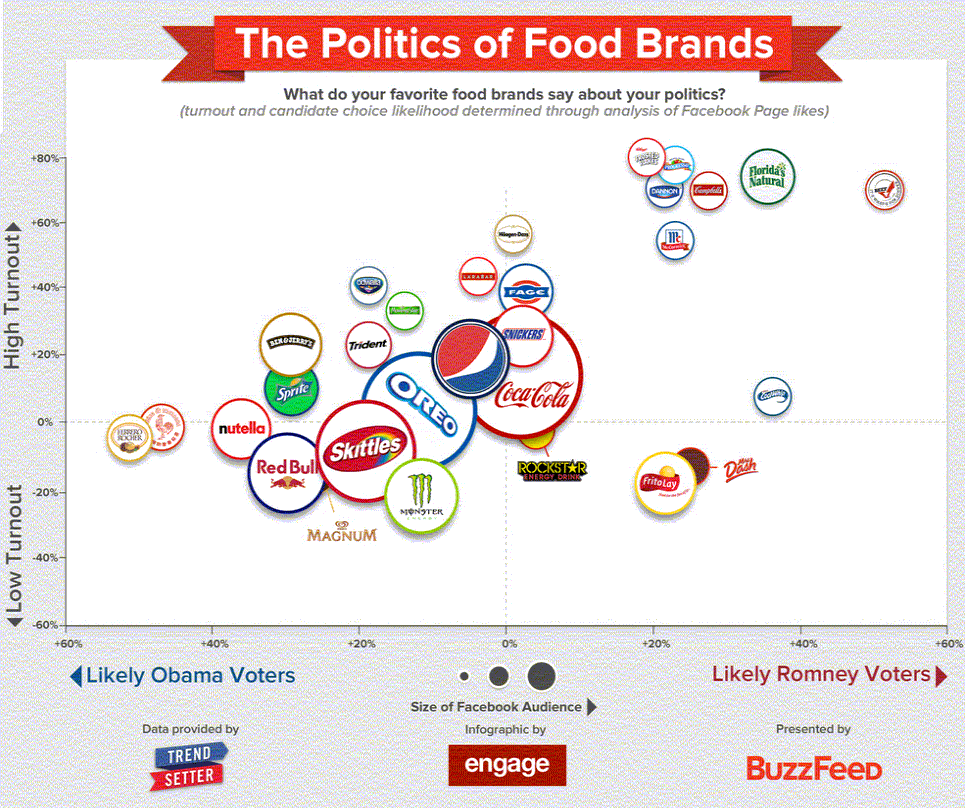
Apparently McDonald's is the most bi-partisan restaurant chain and Coca-Cola is the most bi-partisan food brand.
Which do you think are the most left- and right- leaning?
Check out the following charts from this web page
Apparently McDonald's is the most bi-partisan restaurant chain and Coca-Cola is the most bi-partisan food brand.
Which do you think are the most left- and right- leaning?
Check out the following charts from this web page

In a piece at Reason.com on "The Sorry State of Food-Related Public-Health Research and Journalism", Baylen Linnekin takes issue with the way the media reports on research in food and health science.
I was reading along when I was surprised (and pleased) to see this bit:
In spite of the current crop of mediocre research and reporting, there are a few bright counterweights.
Take Professor Jayson Lusk of Oklahoma State University, who I interviewed for Reason earlier this year.
Lusk had just published a study in the journal Food Policy, "The Political Ideology of Food," in which he concluded that the great majority of Americans support increasing the extent to which food is regulated.
Lusk, whose forthcoming book is The Food Police: A Well Fed Manifesto about the Politics of Your Plate, admitted he found his results “a bit disheartening” but published them anyways.
Me? I hate the results (and challenged him on his data in my interview).
But I love the fact Lusk displayed the intellectual honesty and courage to publish research that doesn’t simply reflect his own values and wishes.
For this alone, Lusk deserves a medal. But he’s on a very short list.
I don't know that I deserve medal, but I'm happy someone said so. It is easy to selective pursue research or selectively report results that only conform to your prior world view, especially when there are incentives from media, businesses and granting agencies to do so. All scientists face these pressures (even if it simply to protect their reputation and prior findings and statements).
I think a lot of the trouble comes in separating "what the data shows" from "this is what the results mean." The media is often much more interested in the second issue, but more often than not, there are many competing meanings that fit the data. But that doesn't make for compelling journalism that sells papers by creating a one-sided story that fits a headline.
This piece in Time on food labels is frustrating. In trying to help consumers “make sense” of food labels, they only confuse the situation – making several unsubstantiated claims and linking to dubious sources to support other claims.
For example, here is what they say on the label hormone free:
There is a long list of health concerns tied to hormone-filled meat, from prenatal developmental problems to early puberty and infertility. Though the evidence isn’t always reliable, some studies have shown growth hormones from certain foods can disrupt human hormones and can even contribute to breast and prostate cancer.
If you click through to all three of the links they provide above, none actually shows what the piece purports they show. The first link is to an advocacy website for “sustainability,” which in turn mainly references some European Union reports but not any actual studies published in peer-reviewed journals. The second link is to a website about cancer, which discusses the correlation between meat eating and cancer, but says nothing about how added growth hormones used in meat production relates or does not relate to cancer. The final link is to a scientific study that has nothing to do, as far as I can tell, with the use of subtherapeutic hormones given to cattle in feedlots. Ironically, the scientific paper is about chicken meat, but broilers in the US are not given added growth hormones, so I’m not sure what the link has to do with what the authors are claiming.
Now, I’m not saying there are no problems with hormone use. For example, there is evidence that growth hormones can lead to less tender beef. But, generally these are concerns about eating quality not safety.
Another example is when the piece discusses pesticide use it says:
If a food product has the USDA Organic certification, it’s usually pesticide-free, too.
That statement is absolutely false. Organics can use a long list of “natural” pesticides, many of which are just as toxic as synthetic pesticides.
Why is it so hard for Time to put out on objective piece on food labels? It goes to show how much misinformation there is on food floating around that even when one wants to “set the record straight” they can’t find a good place to turn.
That’s the title of an article that appeared in Science 2.0. The article points out that “anti-science” attitudes are a bipartisan issue. Biotechnology is emerging for the left what climate change has been for the right.
Here are a couple of key paragraphs:
AAAS was likely also considering something only Science 2.0 had considered during the last presidential election, since the tale spun by science media during the Bush administration days was that Republicans took some sort of blood oath against science while Democrats were born being rational and super-smart and science-y, even if they were poetry majors; you can't expect people to trust the science consensus on global warming if you tell them to deny the science consensus on biology. It's as simple as that. Doing so just makes science look like an opinion.
Every American left-wing activism group tells its members that science is on their side when it comes to global warming but scientists are out to kill us when it comes to food and energy. From the Union of Concerned Scientists to Greenpeace to Sierra Club, they are all tripping over each other to declare that 'the science is not settled' on those things. The reason is because they are not in the science business, they are in the fundraising business and they are competing for the same demographic that is both scared of biology and inclined to believe global warming caused a hurricane.
Friday Forbes.com published an article written by Nicholas Kalaitzandonakes and me. Here are a couple key paragraphs:
Lower income households across the United States spend a larger portion of their income on food than higher income households. Lower income households also spend most of these dollars for food at home. High income individuals spend more at restaurants and eateries. Similar trends exist for older relative to younger consumers.
And
Proposition 37 calls for mandatory GMO labeling of foods bought at the grocery store and consumed at home, but does not require the same for foods consumed in restaurants, cafeterias, catering, schools, and the like. It also excludes all organic foods from mandatory GMO labeling irrespective of where they are consumed and of their GMO content.
Given these rules and exclusions, younger and more affluent consumers who spend more on organics and on food away from home would be less affected by Proposition 37. Poorer and older consumers could instead be called to foot the bulk of the bill implied by the Proposition while spending a larger portion of their limited income in doing so.
David Zilberman at UC Berkeley put out a blog post the same day covering some of the same themes.