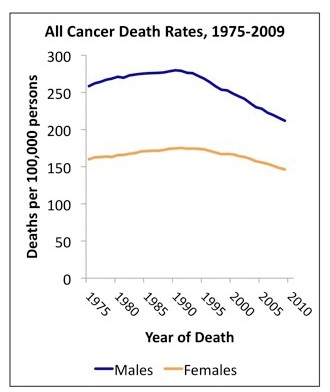
Good news. According to the National Cancer Institute, overall cancer death rates appear to be in decline.
Blog
Pollan's Advice and Kahneman's Warning
I enjoy reading Michael Pollan’s books, such as The Omnivore’s Dilemma. He is a great writer and story teller - so much so, in fact, that his arguments sort of sneak up on you. I often find myself agreeing with his premises and conclusions without the conscious stepping in to argue the points. In fact, a few years ago when I finished reading The Omnivore’s Dilemma, I only had a nagging feeling that something was amiss, but it took several months of reflection to systematically figure out what it was (The Food Police boils down my thoughts on it – primarily chapters 2 and 9).
I see that Pollan recently gave an address to the American Historical Association. He asked the audience:
Why do people like me who use your work end up selling more books than you do?
His advice?
Write in a human voice, he encouraged. Embrace storytelling techniques like scene-setting, suspense, and personification.
Almost everyone more enjoys reading a good story to an academic treatise. But one should take caution. A good story does not equate to a true story. I recently finished reading the book by Nobel Prize winner Daniel Kahneman, Thinking Fast and Slow. Kahneman routinely points out that we humans are suckers for a good story. We fit together (sometimes spurious) facts to create a coherent account that is pleasing to the mind – not because the facts actually fit together this way but because that’s how we are psychologically wired. Here are a couple quotes from Kahneman (pg. 239):
We are confident when the story we tell ourselves comes easily to mind, with no contradiction and no competing scenario. But ease and coherence do not guarantee that a belief held with confidence is true. The associative machine is set to suppress doubt and to evoke ideas and information that are compatible with the currently dominant story . . . It is therefore not surprising that many of us are prone to have high confidence in unfounded intuitions
And (pg. 199):
In The Black Swan, Taleb introduced the notion of narrative fallacy to describe how flawed stories of the past shape our views of the world and our expectations for the future. Narrative fallacies arise inevitably from our continuous attempt to make sense of the world. The explanatory stories that people find compelling are simple; are concrete rather than abstract; assign a larger role to talent, stupidity, and intentions than to luck; and focus on a few striking events that happen rather than on the countless events that failed to happen. . . . Good stories provide a simple and coherent account of people’s actions and intentions. You are always ready to interpret behavior as a manifestation of general propensities and personality traits – causes that you can readily match to effects.
My take: if you’re trying to write a book to convince readers and gain sales, you’d better try to tell good stories. However, if you’re a reader, you have to beware that good story telling can mask weak arguments and hide important relevant facts that should be considered. The more one becomes engrossed in a story, the more they should be on guard for the narrative fallacy or, as Kahneman puts it, the biases associated with associative coherence.
Assorted Links
Are Fruits and Veggitable Subsidized?
To hear food pundits talk you'd think that growers of fruits and veggies don't receive subsidies from the government. Indeed, the pundits often argue vegetables should receive subsidies because they don't receive them now. Just to give one example, here is Mark Bittman writing in the New York Times:
Simply put: taxes would reduce consumption of unhealthful foods and generate billions of dollars annually. That money could be used to subsidize the purchase of staple foods like seasonal greens, vegetables, whole grains, dried legumes and fruit.
It might come as a surprise, then, to hear that many fruits and vegetable growers already receive (implicit and explicit) subsidies of one form or another. Here is an issue, for example, that came to light during the fiscal cliff debate:
Many folks have picked out the extension of "market loss assistance" for asparagus farmers, for example, but this dates back to the farm bill from the last year of the Bush administration. Senator Patty Murray (D-WA) brags about it on her website and Senator Maria Cantwell (D-WA) was talking about fighting for it back in 2007, so I think we can gather than a lot of asparagus is grown in Washington State.
This is said to be needed because American asparagus farmers have been "devastated" by cheap imported Peruvian asparagus.
The reality of farm and food policy and its impacts is much more complicated than is often made to appear in foodie books and blogs.
Better Hope Your Child Isn't Obese
Jerri Gray may spend the next fifteen years of her life in a South Carolina prison. She is not a drug dealer or a serial rapist. She has not robbed anyone or committed grand theft auto—she simply has an obese son
Those are the opening sentences of this article by Elizabeth Ralston in the Seton Hall Law Review entitled KinderLARDen Cop: Why States Must Stop Policing Parents of Obese Children