Blog

Organic vs Conventional Crop Yields

The other day, I was asked whether I thought the price of organic foods would fall as the market share for organic increased.  The answer is: it depends.  If increases in consumer demand outpace supply, prices will rise.  By contrast, if supply increases at a faster rate than consumers' willingness-to-pay for organic, prices will fall.  I suspect that as Wal-Mart and other large retailers become bigger players in the organic market, it will bring about some cost efficiencies that are likely to lead to a reduction in organic price.

That said, organic will never be as inexpensive as non-organic (generally speaking, as I'm sure it might be possible for a particular crop in a particular location in a particular year to experience a price inversion).

Statements such as this normally invoke a debate about whether organic yields and costs are higher/lower than conventional yields and costs.  For example, the following was written after a Twitter conversation on the subject

Again, the available data offers conflicting results: there’s evidence that organic yields can match conventional yields over the long-term, especially in less-than-ideal conditions. Other studies point to lower organic yields, especially in crops with high fertility requirements. The primary challenge in extrapolating these results to a “feeding the world” scenario is the issue of context.

Invariably, the evidence given in support of the argument that organic yields can surpass conventional yields is taken from organizations like the Leopold Institute (the paper referenced in the above quote was a proceedings paper, not one that went through the typical submission process) or the Rodale Institute that advocate on behalf of organic.  That's why it is instructive to turn to larger scale literature reviews, like this one in the journal Agricultural Systems summarizing 362 studies, which shows that organic yields are 80% of conventional on average.  Or turn to the top science journals, like Nature, where a recent paper showed that organic yields are typically 25% lower than non-organic.  (note: these review studies show a lot of variability in the organic-conventional yield gap; sometimes the gap is large and sometimes is is almost non-existent).

The quality and quantity of the evidence quite clearly points to the fact that organic yields tend to be lower than non-organic.  Yet, it seems, this never actually convinces anyone who believes the opposite.  Thus, rather than a show-me-your-study-and-I'll-show-you-mine discussion, sometimes it is useful to make a conceptual argument.

The reason I would never expect organic yields to typically surpass non-organic is summarized in the following figure.   
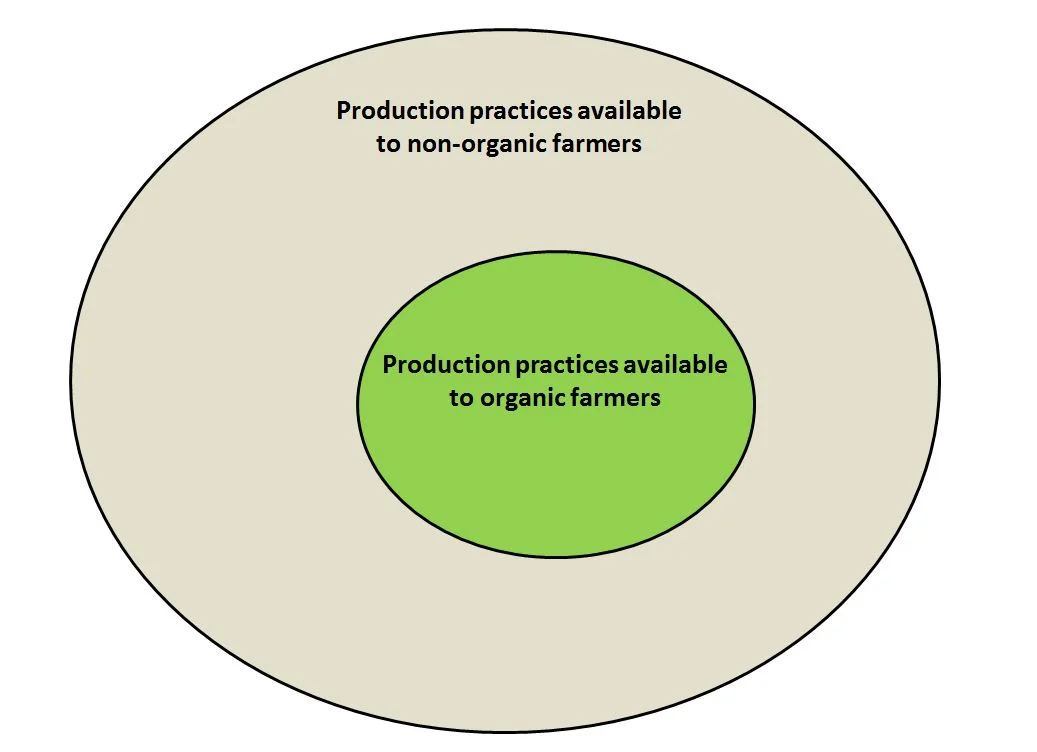
Here is the basic point conveyed in the picture above: a non-organic farmer is free to use any of the practices available to an organic farmer (e.g., no-till or low-till farming, cover crops, etc) but an organic farmer can only use some of the practices that are available to a non-organic farmer.  Thus, the range of possible production practices, costs, and outcomes for organic must be a sub-set of that of non-organic.  

Being an organic farmer implies following a set of rules defined by the USDA.  These rules restrict the practices available to an organic farmer relative to a non-organic farmer.  Organic farmers cannot use "synthetic" fertilizer, Roundup, biotechnology, atrazine, certain tillage practices, etc., etc.  It is a basic fact of mathematical programming that adding constraints never leads to a higher optimum.

I suspect I know what an organic advocate will next argue: well in the long-run organic soils will build up nutrients and organic matter and will eventually achieve higher yields than non-organic.  That may be (or may not be) true, but that does nothing to nullify my point.  If it turns out that, say, 10 years down the road, organic farmers begin routinely experiencing higher yields, then non-organic farmers can copy those practices (assuming they're not higher cost) and again match organic yields, and eventually surpass them - because - yet again- they will have options available to them that organic farmers don't.  Like biotech.  Like ammonium nitrate. 

Now, maybe organic better reduces environmental or human health externalities.  I'm not particularly persuaded by the evidence on that front, but that is a reasonable debate worth having.  But, arguing that organic yields can (generally) exceed non-organic yields is not supported by the best empirical evidence or by logic.       


Does eating chicken on the bone make children more violent?

That is the finding of a study published in the journal Eating Behaviors.  I have a lot of admiration for the study's lead author, Brian Winsink (I highly recommend his book Mindless Eating), but I'm going to have to file this one under "I don't believe it."  

I thought it was worth weighing in on since I'd seen the study reported on in several major media outlets.  I'm not saying that it isn't possible that eating chicken on the bone (vs. in chunks) doesn't cause aggression, I'm just saying that my priors are such that it will take a lot more than this to convince me.  

Why would we even expect that eating chicken on the bone causes aggression?  The authors suggest the following hypothesis:

Showing teeth is a common sign of aggression in the animal world. Dogs retract their lips and bare their teeth as a sign that they are willing to fight (Galac, & Knol, 1997). The baring of teeth may have similar meaning in intuitive human behavior

So, the authors ran an experiment.  

They took 12 children participating in a 4-H summer camp (yes, N=12), and split them in two groups, 6 in one and 6 in another.  On day 1, one group was fed chunks and the other group was fed chicken on the bone.  On day 2 , they reversed the foods fed to the groups.  On both days, the children's behavior was monitored and recorded.  For example, the children were asked to stay in a circle and the monitors counted the number of times the children left the circle (glad I didn't go to that 4-H camp!).  Paired t-tests were used to test whether behavior differed on the day the child got the bone vs. the chunk.

Here are some shortcomings of the study that make the results a bit hard to believe:

  • The small sample size.
  • Each child was only observed on 2 days (one with bone one with chunk).  However, on one day, the temperature was 97 degrees and on the other it was 76.  Lots of prior research has posited a link between temperature and aggression (hot = more aggressive).  Suppose you had a couple kids in a group with a tendency toward aggression who got assigned chunks on the colder (76 degree) day and bones on the hotter (97 degree) day?   The difference in their behavior may be due to temperature not bones.  It would be nice to see tests for within-day differences in bone vs. chunk.  If one had a large sample with random assignment to treatments on multiple days this wouldn't be as much of a concern, but it certainly is here.
  • Children assigned to the same group sat at the same table together.  This may have produced some sort of group dynamic.  Suppose, for example, the kids assigned to bone started arguing at the table and the conflict spilled over to the playground.  The current study cannot separate group-day effects from the treatment effect (bone vs. chunk).
  • Given the small sample size, really all it takes is one or two kids changing behavior from day 1 to day 2.  How do we know this wasn't due to something at home that carried over to the camp?  With such a small number of observations, I don't know why the authors didn't just report the entire data set in one table.  That way, we could see whether the difference was from a small increase in aggression of every child or a large increase in aggression of 1 o 2 kids.  
  • The counselors who kept the kids in the circle and who rated behavior were "blind" as to the treatment and control groups each day. That's good.  However, the study doesn't tell us whether the people who subsequently watched the videos and rated behavior were also blinded.
  • Maybe the effect exists but for very different reasons than those hypothesized in the paper.  I've already mentioned a temperature explanation.  What if children like to eat chicken on the bones more than they do in chunks (my kids certainly do).  Maybe they get more excited and rambunctious when they get a "treat" or something they like, which the current authors attribute to "aggression."  Perhaps when the counselors give the kids a food that the kids perceive as more generous or benevolent, it signals to the kids that the counselors will subsequently be more permissive.  To control for this, you'd want some treatments where the bone-in food was less desirable than the boneless food.

At the end of their article, the authors suggest a number of lines of additional research that are interesting and worthwhile.  But, they also give some advice.   The authors suggest

school cafeterias may reconsider the types of food they serve if it is known that there are behavioral advantages to serving food in bite-size pieces

and

it may not be wise to serve young children chicken wings shortly before bedtime, or to serve steak and corn-on-the-cobb in the company of dinner guests.

That may be good advice in general, but this study alone is insufficient reason to re-engineer lunch lines or dinner plans in an effort to reduce child aggression.  


A new way to stop food waste?

Food waste has been in the news quite a bit recently. As I've previously mentioned, it is unlikely economically optimal to completely eliminate food waste.  That said, one thing that most folks can probably agree on is that we do not want to enact government policies that encourage more food waste.  

Yet, according to a couple recent papers by Cornell economists, the school lunch program is doing just that.  

The first study, in the journal Public Health Nutrition, the authors (Just and Price) used in-school experiments and found that requiring schools to place additional servings of fruits and vegetables on kids' plates in a school lunch line (as is required by new standards), causes a small increase in fruit and vegetable consumption but also a huge increase in waste.   The authors report (from one of their two studies) that:

However, as more items were served the fraction of items being thrown away more than doubled for those students taking just one serving (from 39 % up to 82 %) and also increased for those students taking two or more servings (from 45 % up to 60 %).

Some of the media discussion surrounding the article suggests that:

For every one to two children who eat fruits or vegetables under the new federal guidelines, five throw them away, the researchers said.

Which results in $3.8 million being thrown away each year.  The authors other research suggest that it may make more economic sense to provide financial incentives for kids to eat fruits and veggies rather than simply requiring more be placed on a tray. 

In another study by David Just (this time with co-authors Andrew Hanks and Brian Wansink) appearing in PLoS ONE, looked at the effects of another school lunch policy: banning chocolate milk.  Again, the authors compared treatment and control schools that had different policies (or before and after policy changes) and found the following:

Removing chocolate milk from school cafeterias may reduce calorie and sugar consumption, but it may also lead students to take less milk overall, drink less (waste more) of the white milk they do take, and no longer purchase school lunch. 

Although more students took white milk after the chocolate milk ban, they wasted about 29% more than before the ban.   

David Just and his colleagues at Cornell have been studying all kinds of ways to increase fruit and vegetable consumption among school children by doing things link re-orienting lunch lines, placing kid-friendly stickers on fruits and veggies, providing economic incentives, changing payment methods, etc.  I like this experimental approach to seeing what works - particularly when paired with research on cost-effectiveness.  But, as their research shows, simply banning foods or mandating that schools plate more fruits and veggies is largely ineffective and wasteful.  

Food Demand Survey (FooDS) - The First Year

The Food Demand Survey (FooDS) has now been ongoing for a full year!  

We've pulled together summary statistics on the key variables we've tracked over time.

For example, here is an index of awareness (how much people have heard or read about an issue in the preceding two weeks) and concern over the past year, for the four issues that seem to top the lists each month (in total, we track 17 items). 

Awareness is much more variable over time than is concern.  

The spike in awareness for Salmonella in October, 2013 corresponds with a widely publicized Salmonella outbreak from a California poultry processor (Foster Farms).  

It interesting to compare the Salmonella spike in awareness with external data sources.  I searched the term "Foster farms" (shown in blue below) and "Salmonella" (shown in red below) in Google trends over the past year.  Google trends, according to Wikipedia,  "shows how often a particular search-term is entered relative to the total search-volume."  The volume of searches measured by Google, both the October spike and the smaller rise in January and February, match up quite will with our measure of awareness shown in figure 2 above.  

Of course, the thing we have that Google analytic doesn't, is information on concern for issues on on willingness-to-pay for chicken and other meat products.

Curiously, despite the spike in awareness of Salmonella in October, we did not observe big changes in concern for Salmonella  or huge changes consumer willingness-to-pay or plans to buy chicken.  

Of course, our survey is more than just about this single incident or issue, but the preceding discussion is an example of the kinds of insights we hoped FooDS would deliver.

Read the whole summary here