Blog

Impact of Academic Journals

Dan Rigby, Michael Burton, and I just published an article in the American Journal of Agricultural Economics on the impact of academic journals - as seen through the eyes of the academics who write journal articles.  

Motivating the work is the fact that more emphasis is being placed on the "impact" or our academic work.  This can be see most directly in places like the UK where funding directly follows measures of impact.  At my own University, we have to write annual "impact statements", and it is commonplace in promotion and tenure decisions for candidates to have to document "impact."  One of the most common metrics used to identify impact is the Impact Factor of the journal in which an author's article appears.  This impact factor is calculated by measuring citations to articles published in a journal in the two years following the publication date.  There are many critiques of the use of the Impact Factor, and my own research with Tia Hilmer shows that using the impact factor of a journal to measure the impact of a particular article is potentially misleading: some articles published in low Impact Factor journals receive many more citations than some articles published in high Impact Factor journals.

In our current research, we wanted to know what academics themselves think of the impact of different journals, were "impact" can mean several different things.  We surveyed agricultural and environmental economics who were members of at least one of the seven largest agricultural economics associations throughout the world.   We asked respondents to tell us which (of a set of 23 journals) they thought 1) would "most/least enhance your career progression, whether at your current institution or another at which you would like to work" and 2) "The journal whose papers you think have most/least impact beyond academia (i.e., on policy makers, business community, etc.).”  We compared the journal rankings based on these two measures of impact to each other and to the aforementioned Impact Factor based on citations data. 

We find:

We find no significant correlation between the journal scores based on the two criteria, nor between them and the journals’ impact factors. These results suggest that impact beyond academia is poorly aligned with career incentives and that citation measures reflect poorly, if at all, peers’ esteem of journals.

My favorite part of the paper are a set of graphs Dan put together plotting the various measures of impact against each other.  Here's one showing a journal's Impact Factor vs. respondent's perception of the career impact of publishing in the journal.

Woman A Leading Authority On What Shouldn’t Be In Poor People’s Grocery Carts

Yes, it's from the Onion.  But, as most stories from the Onion, they're funny because they hold a glimmer of truth.

NORTHAMPTON, MA—With her remarkable ability to determine exactly how others should be allocating their limited resources for food, local woman Carol Gaither is considered to be one of the foremost authorities on what poor people should and should not have in their grocery carts, sources said Thursday.

As verified by multiple eyewitness reports from supermarkets across the Northampton area, the real estate agent and mother of three is capable of scanning the contents of any low-income person’s basket and rapidly identifying those items which people like that don’t need to be buying, based on the products’ nutrition and cost. Additionally, Gaither, 48, is widely regarded as a leading expert in determining which groceries they would purchase instead if they had any common sense or restraint.

Do farm subsidies prop up rural communities?

A new paper in the journal Applied Economic Perspectives & Policy by Jeremy Weber, Conor Wall, Jason Brown, and Tom Hertz asks whether farm subsidies boost the rural economy.  The abstract:

Policy makers in the United States often justify agricultural subsidies by stressing that agriculture is the engine of the rural economy. We use the increase in crop prices in the late 2000s to estimate the marginal effect of increased agricultural revenues on local economies in the U.S. Heartland. We find that $1 more in crop revenue generated 64¢ in personal income, with most going to farm proprietors and workers (59%) or nonfarmers who own farm assets (36%). The evidence suggests a weak link between revenues and nonfarm income or employment, or on population. Cuts to agricultural subsidies are therefore likely to have little effect on the broader rural economy in regions like the Heartland.

Assorted Links

Food Demand Survey (FooDS) - December 2014

The December 2014 edition of the Food Demand Survey (FooDS) is now out.

Results suggest steady to slightly increasing demand for most meat products this month compared to last, particularly for steak.  Awareness of various controversial issues in the media was similar to last month, but was, across the board, compared to this time last year.  

Three new ad hoc questions were added to the survey this month.  

The first question asked: “Scientists are currently working to develop food products that might become available in the future.  If it were possible, would you be willing to eat or drink the following foods?” Respondents were asked to select “Yes, I would eat/drink this”, “No, I would not eat/drink this”, or “I don’t know” for each item. 

64.81% of respondents stated they would be willing to eat rice with a higher level of vitamin A.  Just under half the respondents stated they would eat an apple that does not turn brown after peeling and they would drink milk in a carton that changes color according to freshness.  Only about 20% of respondents said they’d eat a hamburger from meat grown in a lab, eat a pizza from a 3D food printer, or eat a protein bar made with insect flour.

The results are similar to those from a Pew Foundation poll conducted earlier this year, which posed the following, "Here are some things that people might be able to do in the next 50 years. For each, tell me if this were possible, would YOU PERSONALLY do this... ".  For the item "Eat meat that was grown in a lab" 20% said they would, 78% said they wouldn't, and 2% said "don't know" (in their phone survey, "don't know" wasn't mentioned as an explicit option, it has to be volunteered by the respondent". 

Secondly, participants were asked “Thinking about the future, which of the following food and agriculture challenges are you most concerned about?” Participants were shown nine items (randomly ordered across respondents) and were asked to rank these items from most to least concerned.  The rankings were used in a statistical model to estimate scores for each issue that sum up to 100%.  The issue of largest concern was “Having affordable food for me and my family,” with a concern score of 23.3%.  By contrast, the issue of least concern was “Inequitable distribution of food throughout the world.”  Affordable food was 23.3/8.1= 2.87 times more important than inequitable distribution.  The second and third most concerning issues were “Changing the type and quantity of food eaten to address obesity, diabetes, and heart disease” and “Producing enough food to meet the demands of a growing world population.”

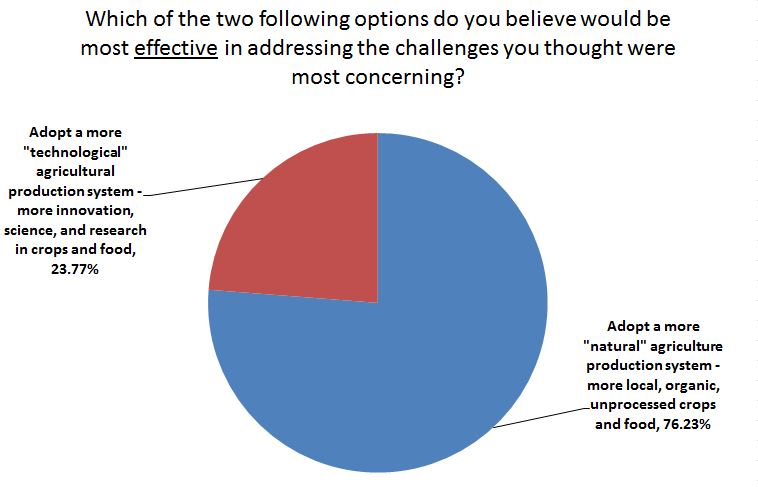
Immediately following the previous question, participants were asked “Several challenges facing the food and agricultural sector were mentioned in the previous question.  Which of the two following option do you believe would be most effective in addressing the challenges you thought were most concerning?”  76.23% of respondents chose the option that stated “adopting a more ‘natural’ agricultural production system – more local, organic unprocessed crops and food” would be most effective in addressing these challenges.  Only 23.77% chose the other option which read: “adopt a more ‘technological’ agricultural system – more innovation, science, and research in crops and food”.  I must say I'm a bit depressed by this last finding.