Blog

A farmer attends the food for tomorrow conference

Blake Hurst, a farmer from Missouri, attended the NYT Food for Tomorrow conference a couple months ago.  His entertaining take on the event is the subject of this article in The Weekly Standard.  A few snippets:

I may be walking around, but I’m actually dead. I’m a zombie farmer.

I came to this conclusion after spending a couple of days at the Food for Tomorrow conference last November, held at the Stone Barns Center for Food and Agriculture, a farm, restaurant, and conference center a few miles north of New York City. Stone Barns is surrounded by a “working” farm, a self-described showplace for the “sustainable agriculture” that more than one speaker at the gathering referred to in reverential tones. The farm was built by the Rockefeller family and is now a sort of Potemkin village with geese. The first and most important rule of sustainable farming is to be sustained by one of the world’s largest charitable foundations.

He turns the tables with the following jest:

Recently, the New York Times announced another 100 layoffs. The New Republic has essentially committed public suicide. Rolling Stone is enduring a rough patch. Subscription and advertising revenues are crashing all across journalism.

Perhaps those of us in agriculture could help out. Maybe convene a conference on the future of journalism? We could ask a few nutrition professors, a biochemist or two, maybe a plant breeder, some cattle feeders, a pig farmer, and, as our token journalist, the guy who gives the cattle markets four times a day on the radio. Our conference could call journalists names, damn everything they’ve done for the past 50 years as corrosive of the health of our culture, and recommend that the New York Times go back to using typewriters in a recreated newsroom from The Front Page.

Farm of Tomorrow (from the perspective of 1954)

Here's a cartoon from Tex Avery in 1954 on the "Farm of Tomorrow" (skip to the 19:30 mark).  Interesting how we have changed in many of the ways suggested by the video, and how unhappy some people are about it.

Assorted Links

The less kindly view is that as federal dietary guidance has failed to resonate with Americans, the strategy has been simply to repeat the same messages—only louder and with more chastising.

she sensibly recommends:

nutrition-policy leaders must acknowledge that their utopian grocery cart looks nothing like the average American’s practical cart. The Dietary Guidelines must reflect the experience of how people really eat and what they can change versus how experts wish they would eat. Advice should be given in terms the public can understand and reinforce the tenets of sensible eating: balance, variety and moderation. We must also collaborate with the food industry to help produce and market healthy food and beverage choices.

This piece in Wired discuses the FOIA requests by an anti-GMO group aimed at several University scientists (one of the scientists, Kevin Folta, while complying with the FOIA request, is fighting back)

Dawn Thilmany McFadden asks, "What do we mean by local foods?"

Controversy over the new dietary guidelines

Yesterday I filmed a piece on Fox Business about the new dietary recommendations and the call to reduce meat consumption to improve health and the environment (I couldn't get the video to embed, but you can view it here).  I suppose I had at least a couple good points to make because the clip was featured for most of yesterday on the main web page for Fox News.  

One of the hosts mentioned a Cambridge study showing that vegetarians and vegans have substantially lower environmental impacts than meat-eating diets.  A written piece at foxnews.com about the recommendations also mentions the same study.  I'm not sure how representative that cited study is.  My own analysis suggests that vegetarians spend about the same amount on food as do meat eaters.  To the extent prices reflect resource use, that stat would suggest both diets are "using up" similar levels of "stuff."  I've also written on the argument that the grain fed to livestock is "wasted."

But, perhaps more importantly, what evidence is cited in the new report of the dietary guidelines committee?  The papers they cite seem to suggest small improvements in greenhouse gas (GHG) emissions and improved health outcomes (but more on that in a minute) from a move to vegetarian diet.  Here are some selected quotes of the review in Chapter 5 part D where quantitative impacts on environment were mentioned (note: there are many other cited studies, some of which suggest higher impacts).

Peters et al. examined 42 different dietary patterns and land use in New York, with patterns ranging from low-fat, lacto-ovo vegetarian diets to high fat, meat-rich omnivorous diets . . . although meat increased land requirements, diets including meat could feed more people than some higher fat vegetarian-style diets

and

Aston et al. assessed a pattern that was modeled on a feasible UK population in which the proportion of vegetarians in the survey was doubled, and the remainder adopted a diet pattern consistent with the lowest category of red and processed meat (RPM) consumers. They found . . . the expected reduction in GHG for this diet was ~3 percent of current total carbon dioxide (CO2) emissions for agriculture. De Carvalho et al. also examined a high RPM dietary pattern with diet quality assessed using the Brazilian Healthy Eating Index.They found . . . that excessive meat intake was associated not only with poorer diet quality but also with increased projected GHG emissions (~ 4 percent total CO2 emitted by agriculture).

This one is most interesting references:

a report from Heller and Keoleian suggests that an isocaloric shift from the average U.S. diet (at current U.S. per capita intake of 2,534 kcals/day from Loss-Adjusted Food Availability (LAFA) data) to a pattern that adheres to the 2010 Dietary Guidelines for Americans would result in a 12 percent increase in diet-related GHG emissions. This result was modified, however, by their finding that if Americans consumed the recommended pattern within the recommended calorie intake level of 2,000 kcal/day, there would be a 1 percent decrease in GHG emissions.

My take?  Eating too many calories likely has as much an impact on GHG as eating meat.  Reducing meat consumption would lower GHG emissions, but I would characterize the effects as "small" (3 to 4% of the GHG emissions from agriculture, or likely less than 1% of the total of all GHG emissions), particularly if people move toward pork and poultry, which have far fewer GHG emissions than ruminants like cattle.  Moreover, if we want to improve environmental impacts of livestock production, I think we're likely to get a bigger bang for our buck by improving productivity and researching new ways to reduce impacts than we will be cajoling people to eat less meat (see this paper on the reduction in environmental impact of beef production brought about over the past 40 years due to technological advancement).

What about the health impacts of meat consumption?  It is true that many observational, epidemiological studies show a correlation between red meat eating and adverse health outcomes (interestingly there is a fair amount of overlap on the authors of the dietary studies and the environmental studies on meat eating).  But, this is a pretty weak form of evidence, and much of this work reminds of the kinds of regression analyses done in the 1980s and 90s in economics before the so-called "credibility revolution." 

There have been many, many books written on the topic of whether meat eating is good or bad for you, and I won't try to adjudicate them all here.  However, I will point you to this really interesting exchange (see the comments section) on Marion Nestle's website where she mentions the new guidelines and takes a swipe at Nina Teicholz's book, Big Fat Surprise.  Nina responds, as do her critics.  

What happens when we ban the slaughter of horses?

One of my former Ph.D. students, Mallory Vestal, sought to answer that question in a paper that we just published in the Journal of Agricultural and Applied Economics.  Mallory is a horse-lover, a former graduate assistant coach of the Oklahoma State University Equestrian team, and is now an assistant professor at West Texas A&M University. Here's the abstract of the paper:

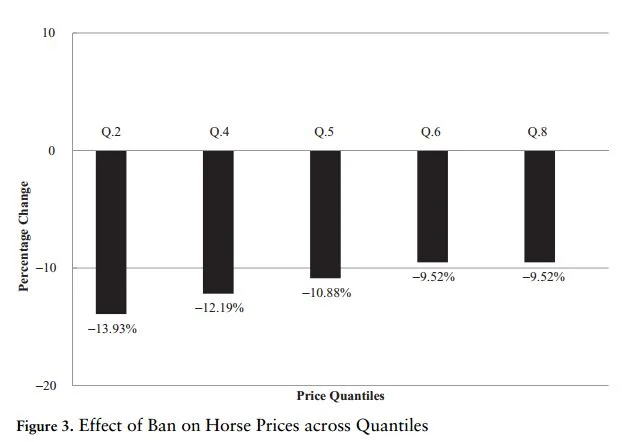
As a result of several judicial rulings, processing of horses for human consumption came to a halt in 2007. This article determines the change in horse prices resulting from elimination of horse-processing facilities. As expected, lower-valued horses were more affected by the ban than higher-valued horses. The analysis suggests the slaughter ban reduced horse prices, on average, by about 13% and resulted in a loss in producer surplus to sellers of approximately 14% at the sale we analyzed. We also show horse prices are affected by a myriad of factors including breed, gender, age, coat color, and sale catalog description.

Because "lower value" horses were those most likely to (eventually) head to the slaughter house, we anticipated that their prices would be most affected by the slaughter ban, and that's indeed what we found.  Here's the impact of the ban on horses priced in the upper 20$, 40% . . and 80% of the price distribution.  

There were a number of interesting side-results, like these . . .

The indicator variables related to the horse catalog descriptions were significantly
associated with horse prices. Consistent with Levitt and Dubner (2005), an ambiguous description such as “nice” was shown to negatively impact prices by −5% to −10% across all models. A more objective descriptive variable such as “finished” was significant in several of the quantiles examined and in the OLS model. Including the word “finished” in the horse’s description was associated with increased prices from 26% to 68%. This result is intuitive as it indicates the horse has specialized training and will be ready to show in the specified discipline. Another descriptive and informative variable, “100% sound,” positively impacted prices from 8% to 11%, whereas “athletic” and “quiet/gentle” negatively impacted higher-quantile prices by −10% and −8% respectively.

Want to know my own view on eating horse meat?  I hinted at it in this editorial.