Blog

Food Journalists are Pollanized

This piece by Hermione Hoby in the Guardian is a prototypical example of uncritical food journalism that fully accepts the narrative and philosophy of the so-called food movement.  The article is a quasi-interview with Michael Pollan and discusses his forthcoming Netflix series based on Pollan's 2013 book, Cooked.  

In a testament to Pollan's influence on food-types, Hoby says that he and others have been "Pollanized."   

Perhaps the most remarkable claim in the piece is this one:

[Pollan] is also uncomfortable at being thought of as evangelical (one magazine called him “America’s high priest of food”); his mode is investigative, not prescriptive.

To say that Pollan's "mode" is investigative, not prescriptive is wholly at odds with the facts.  And, the authors inability to discern that truth probably represents one reason why Pollan has been so influential. People read Pollan's stories (he is a great writer) and don't realize the implicit persuasion and moral the stories are attempting to instill.   Journalists don't bother to get the other side of the story and they often don't bother to read/watch what he says when not writing books.   I previously touched on this:  

One challenge is that many popular food books (by folks like Pollan, Moss, Warner, etc.) often refrain from specifically mentioning much about policy in the book. But, then when your see these authors out on the interview circuit, they often talk a lot about policy and advocate all kinds of things. This has the consequence of their writing appearing more centrist and “ideologically neutral” than is actually the case, and it also lets the authors off the hook by rarely putting them in a position of having to seriously defend their policy proposals.

The truth, of course, is that Pollan has repeatedly offered prescriptive advice for policy makers and for food consumers.  He wrote a 2008 article for the New York Times Magazine entitled Farmer in Chief and was a co-author of a 2014 editorial in the Washington Post outlining a "national food policy." These are chock full of prescriptive policy proposals.  And, he constantly gives prescriptive dietary advice (just google "Pollan quote"). Here is perhaps his most well known: “Eat food. Not too much. Mostly plants.” (without any hint of irony, Hoby offers this very quote later in the piece).

You can agree or disagree with Pollan's policy or eating advice, but to say his mode is "not prescriptive" is frankly absurd.  

The author also seems to miss the irony of Pollan claiming:

I’m uncomfortable with the foodie label, it gets stuck to me all the time.

This is all said while Pollan eschews the salmon because it's farm raised, changes his mind on an order of squid ink tagliatelle because it is from the "the Rohan duck’s provenance - a farm in upstate New York", and then finally dines on a $53 lunch of butternut squash soup, duck leg, and cheeses with names like Moses Sleeper, the Bayley Hazen and Ascutney Mountain .  If this doesn't describe a foodie, then I don't know what does. There's nothing wrong with being a foodie*, and it stretches credulity to believe Pollan is anything but.  To claim otherwise is to render the word "foodie" meaningless.

*I consider myself a "skeptical foodie", which is the title of the first chapter of my 2013 book The Food Police.   

False Beliefs about Food Stamps

In this post on the University of Illinois Policy Matters blog, Craig Gundersen tries to lay to rest a few false beliefs (or misconceptions) that may people (and policy makers) have about the Supplemental Nutrition Assistance Program (SNAP, also known as "food stamps").

Does SNAP participation lead to obesity obesity?  Gundersen writes:

It is not clear why people would think SNAP leads to increases in obesity insofar as one doesn’t generally think that increasing someone’s ability to purchase food leads to higher weights. For example, one doesn’t usually think that a pay raise leads to increases in someone’s weight. Along with common sense, virtually all studies indicate that SNAP recipients are no more likely than eligible SNAP non-recipients to be obese, after controlling for selection into the program and other issues.

Does SNAP participation cut down hunger?  Gundersen writes:

the central goal of SNAP is to alleviate hunger and, in this role, SNAP has been enormously successful. (See Kreider et al., 2012, and references therein.) Along with these direct impacts on food intakes, SNAP has also been found to improve well-being over other dimensions including reductions in poverty (e.g., Tiehen et al. 2012), improvements in birth outcomes (Almond et al. 2011), lower mortality (Krueger et al. 2004), and better general health (Kreider et al. 2012). Moreover, by reducing food insecurity, the negative impacts of food insecurity on various health outcomes are diminished. (See Gundersen and Ziliak, 2015 for a review of these impacts on health.)

If you've got a relatively decent income, it might be hard to imagine how SNAP could have such dramatic hunger and health effects, but it is important to keep in mind Engel's Law: the poor spend a larger proportion of their income on food than the rich.  That phenomenon is alive and well in the US, and I can see it in my Food Demand Survey (FooDS) data, which measures food expenditures.  Here's how estimated spending on food varies with household income, as measured by FooDS.

If you're on the right tail of the income distribution spending only about 5% of your income on food, then it is probably hard to imagine how food spending and eating will change when you're on the left tail of the distribution where food consumes almost 25% of the household's budget.

Finally, Gundersen takes on the idea that various health restrictions on SNAP spending will have much impact.  He writes: 

If restrictions are imposed, there is unlikely to be any change in obesity in the U.S. Instead, the main consequence will be a reduction in the number of SNAP participants. This reduction is due to two factors, stigma and transaction costs. (I concentrate on the former here, for a discussion of the latter, see Gundersen, 2015.) Stigma would increase as participants would feel singled out as being irresponsible and incapable of making well-informed food purchases. More broadly, through its message that adults receiving SNAP are not responsible enough to make their own food choices, recipients would be further stigmatized. After all, the federal government doesn’t tell, say, government employees how to spend their earnings; why do some feel it is fine to tell SNAP recipients what they can purchase? This stigmatization due to restrictions is the central reason why the USDA has rejected proposed restrictions.

Due to increased stigma and increased transactions costs, participation in SNAP will decline as recipients leave the program and potential recipients are less likely to enter the program. (For at least some advocates of SNAP restrictions, this may be their central goal for imposing restrictions.) As a consequence, the positive benefits of SNAP will be realized for fewer Americans and, in particular, there will be an increase in food insecurity and, therefore, increases in negative health outcomes and subsequent health care costs (Tarasuk et al., 2015).

To that I'll add that most SNAP participants can easily get around the restrictions on what they buy by rearranging what they buy with SNAP and what they buy with non-SNAP dollars (see my explanation of that phenomenon here).  

One might reasonably ask whether SNAP spending is too low or too high, and alternative variations on the program might be worth considering.  Either way, decisions about SNAP's future should be ideally based our our best understanding of the program's impacts rather than false beliefs. 

Consumer Uncertainty about GMOs and Climate Change

A lot of the debate and discussion surrounding public policies toward controversial food and agricultural issues like GMOs or climate change revolves around public sentiment.  We ask people survey questions like "Do you support mandatory labeling of GMOs?"  However, as I've pointed out, consumers may not even want to have to make this sort of decision; they would prefer to defer to experts.  Thus, we're presuming a level of understanding and interest that consumers may not actually have.  This is related to the recent discussion started by Tamar Haspel in the Washington Post about whether the so-called food movement is large or small.  Are "regular" people actually paying much attention to this food stuff that occupies the attention of so many journalists, researchers, writers, and non-profits?

I had these thoughts in mind as I went back and looked at this post by Dan Kahan who took issue with Pew's survey on public opinions about GMOs (this was the survey that attracted a lot of attention because it showed a large gap in public and scientific opinion on GMOs).  Kahan wrote:

the misimpression that GM foods are a matter of general public concern exists mainly among people who inhabit these domains, & is fueled both by the vulnerability of those inside them to generalize inappropriately from their own limited experience and by the echo-chamber quality of these enclaves of thought.

and

That people are answering questions in a manner that doesn’t correspond to reality shows that the survey questions themselves are invalid. They are not measuring what people in the world think—b/c people in the world (i.e., United States) aren’t thinking anything at all about GM foods; they are just eating them.

The only things the questions are measuring—the only thing they are modeling—is how people react to being asked questions they don’t understand.

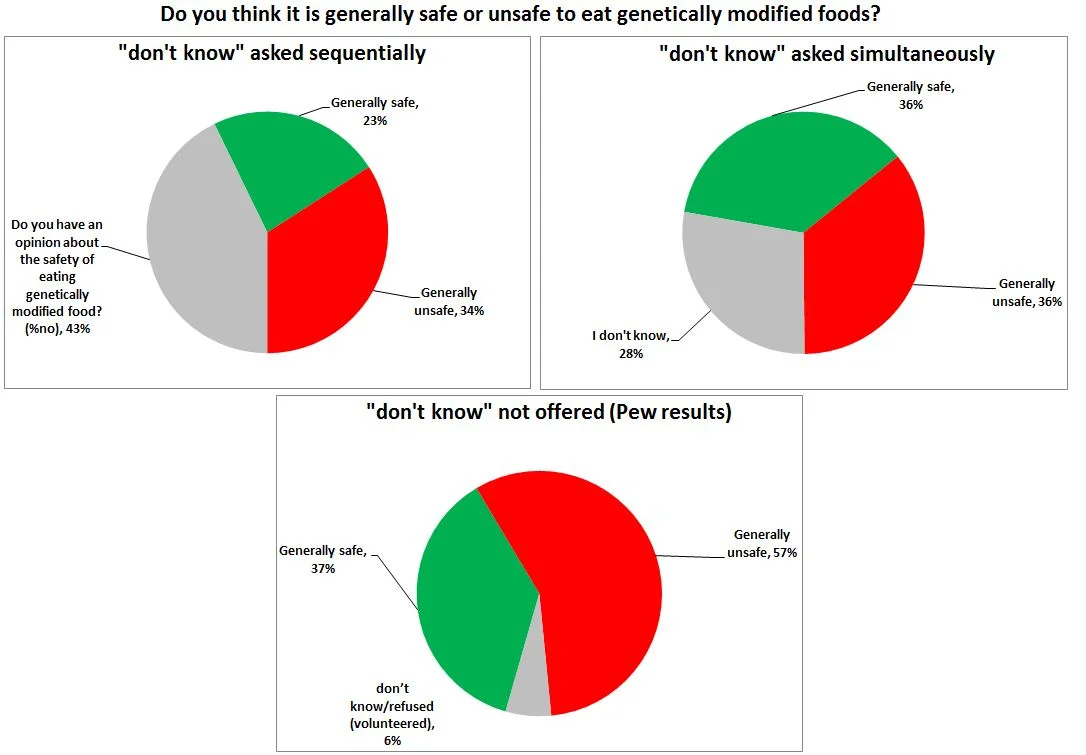
This let me to think: what if we asked people whether they even wanted to express an opinion about GMOs?  So, in the latest issue of my Food Demand Survey (FooDS) that went out last week, I did just that.  I took my sample of over 1,000 respondents and split them in half.  For half of the sample, I first asked, "Do you have an opinion about the safety of eating genetically modified food?"  Then, only for people who said "yes", I posed the following: "Do you think it is generally safe or unsafe to eat genetically modified foods?" For the other half of the sample, I just asked the latter question about safety beliefs and added the option of "I don't know".  This question, by the way, is the same one Pew asked in their survey, and they didn't even offer a "don't know" option - it had to be volunteered by the respondent.  So, what happens when you allow for "I don't know" in these three different ways? 

When "don't know" is asked 1st in sequence before the safety question, a whopping 43% say they don't have an opinion!  By contrast, only 28% say "don't know" when it is offered simultaneously with the safety question.  And, as the bottom pie graph shows, only about 6% of respondents in the Pew survey voluntarily offer "don't know".  Thus, I think Kahan's critique has a lot of merit: a large fraction of consumers gave an opinion in the Pew survey, when in fact, they probably didn't have one when this option was allowed in a more explicitly matter.  

Moreover, allowing (or not allowing) for "don't know" in these different ways generates very different conclusions about consumers' beliefs about the safety of GMOs.  Conditional on having an opinion, the percent saying "generally safe" varies from 40% in the sequential question to 50% in the simultaneous question to 39% in the Pew format which didn't offer "don't know."  That support can vary so widely depending on how "don't know" is asked is hardly indicative of stable, firm, beliefs about GMOs among the general public. 

In last week's survey I also carried out the same exercise regarding Pew's questions on climate change.  For half of my sample, I first asked whether people had an opinion about the causes of changes in the earth's temperature; for the other half, I included "don't know" as an option simultaneous with the question itself.   Here are the results compared to Pew's, which again did not explicitly offer a "don't know."  

Again, we see big differences in the extent to which "don't know" is expressed depending on question format, varying from 37% in the sequential version to only 2% in Pew's survey.  In this case, it appears that people who would have said "don't know" in the sequential question format are more likely to pick response categories that disagree with scientists, when they are given questions where "don't know" isn't so explicitly allowed.  

What can we learn from all this?  Just because people express an opinion on surveys doesn't mean they actually have one (or at least not a very firmly held one).  

Food Demand Survey (FooDS) - February 2016

The February 2016 edition of the Food Demand Survey (FooDS) is now out.

A few highlights:

  • Willingness-to-Pay for most meat products was relatively steady except for an increase in WTP for ground beef and pork chops and a decrease for chicken wings (note: the timing of the survey fell after the Super Bowl weekend).
  • There was a large change in price expectations.  Consumers expect lower meat prices than they did a month ago.  In fact the expectations are as low as they've been since the survey started in May 2013.   
  • There was an increase in awareness of bird flu in the media over the past couple weeks.
  • There was lower concern expressed about both "pink slime" and "lean finely textured beef."

Several new ad hoc questions were added to the survey this month. Some questions related to GMO safety beliefs, and how they varied with the ability of consumers to express uncertainty.  There's a lot to discuss on that topic, so these questions will be discussed separately.

The other ad hoc question was added for a bit of fun.  Given the busy election season, we asked respondents, “Who do you plan to vote for in the presidential primary election?” A list of 16 options was then provided.


The majority of respondents replied “I don’t know”. Donald Trump (R) and Hilary Clinton (D) were the two candidates with the most planned votes, followed closely by Bernie Sanders and “I do not plan to vote.” After Trump, all other listed Republican candidates garnered a cumulative 16% of the anticipated vote.

Out of curiosity , we took a look at how some of the answers to other survey questions varied with anticipated presidential voting (recognizing of course that the sample sizes are relatively small for each candidate, and thus the margins of errors wide).

Donald Trump supporters had the highest concern for E. Coli and placed the lowest relative importance on the food values of naturalness and the environment; Trump supporters were the biggest beef, pork, and overall meat eaters (but ate the least chicken breast). Sanders supporters eat the least beef, pork, and total meat.

Clinton and Sanders supporters placed the least relative importance on food prices. Clinton supporters were the most concerned about GMOs, and placed the highest relative importance on naturalness, nutrition, and environment when buying food. 

Effects of Crop Insurance Subsidies

The journal Applied Economics Perspectives and Policy just published my paper entitled, "Distributional Effects of Crop Insurance Subsidies."  Farmers of the major commodity crops (and increasingly even minor crops including fruits and vegetables) are eligible to buy subsidized crop insurance.  The insurance is, in principle, priced at actuarial fair rate (i.e., the price of the insurance is equal to the expected loss), but the government subsidizes the insurance premium paid by the farmer (in addition to some of the costs of the insurers).  The average subsidy is around 65% of the premium amount.  If there were a similar program for your car insurance, and the annual premium you pay for your car is $1000/year, you'd get back $650 in subsidy.  In addition to this premium subsidy, the latest farm bill also has provisions to subsidize the deducible in the case of a loss.  All this begs the question: what impact do these subsidies have on food prices and production?  

From the abstract:    

Results indicate that the removal of the premium subsidy for crop insurance would have resulted in aggregate net economic benefits of $622, $932, and $522 million in 2012, 2013, and 2014, respectively. The deadweight loss amounts to about 9.6%, 14.4%, and 8.0% of the total crop insurance subsides paid to agricultural producers in 2012, 2013, and 2014, respectively. In aggregate, removal of the premium subsidy for crop insurance reduces farm producer surplus and consumer surplus, with taxpayers being the only aggregate beneficiary. The findings reveal that the costs of such farm policies are often hidden from food consumers in the form of a higher tax burden. On a disaggregate level, there is significant variation in effects of removal of the premium subsidy for crop insurance across states. Agricultural producers in several Western states, such as California, Oregon, and Washington, are projected to benefit from the removal of the premium subsides for crop insurance, whereas producers in the Plains States, such as North Dakota, South Dakota, and Kansas, are projected to be the biggest losers.

Because producers in different states grow different crops, the effects of the subsidies aren't equally dispersed.  I write:

Take for example the comparison of California, which generated about $32.6 billion in annual food-related agricultural output from 2008 to 2012 and Kansas, which generated about $11.2 billion over the same time period. Despite the fact that California generates about three times more agricultural output than Kansas, Kansas farmers received 2.65 times the amount of crop insurance subsidies and attributed overhead ($618 million vs. $233 million) in 2013. Moreover, the states are radically different in terms of the types of agricultural commodities grown. Just under 70% of the value of all food-related agricultural output in California comes from fruits, vegetables, and tree nuts; for Kansas, the figure is only 0.04%.

These differences in commodities produced lead to differences in the uptake of crop insurance subsidies and the prices paid in each location.

To illustrate how this heterogeneity comes about, again consider California and Kansas and the results from 2013. Removal of premium subsidies is projected to increase vegetable (a major California crop) prices by 1.4% and wheat (a major Kansas crop) prices by 7.9% (aggregate reductions in quantities are 0.2% and 3.1%, respectively). The implicit subsidy lost by California producers of vegetables is only 0.16%, whereas the implicit subsidy lost by Kansas producers of wheat is 12%. Thus, California vegetable producers gain an effective price advantage of 1.4% −0.16% = 1.24% whereas Kansas wheat producers experience an effective price change of 7.9% −12% = −4.1%. Therefore, California vegetable producers sell about the same amount of output at about 1% higher effective prices, but Kansas wheat growers sell less output at about 4% lower effective prices. As a result, California producers benefit and Kansas producers lose from the removal of food-related crop insurance premium subsidies.

Even the results in figure 4 mask within-state heterogeneity. For example, despite the fact that Kansas wheat farmers are net losers, California wheat farmers are net winners. Why? Because the implicit price subsidy to California wheat farmers is much lower than the one to Kansas (3.6% vs. 12%). But, not all California producers benefit. California barley, hog, poultry, and egg producers are projected to be net losers from the removal of crop insurance subsidies. Within Kansas, wheat producers lose about $86 million but cattle producers gain about $12 million annually from the removal of the premium subsidy for crop insurance