Blog

Why Do Farm Programs Exist?

Even though the last farm bill was passed only a couple years ago, I've already started to hear rumblings of lobbying groups jockeying for position in anticipation of the next farm bill which will likely be debated and go into place sometime in 2018 or 2019.  Some of the discussion has come about because of the low commodity prices which are leading to lower farm incomes.  Discussion is also spurred on by the presidential campaign and talk of the candidates' agricultural advisers.  There are also various groups lining up to try to reform farm policy.

Given that backdrop, now's probably as good a time as any to ask: why do farm programs and farm subsidies exist? The question (for this post at least) isn't whether they should they exist, but rather what explains their existence and persistence?  Also note I'm not talking about the reasons or justifications farm groups provide for why they say they need subsidies.  Rather I'm interested in why they actually exist in the first place.  What are the economic and political considerations that lead to the set of farm policies we see?

I touched a bit on this in a paper that was released this summer.  Here's a summary (see the paper for the references and more discussion).

A common explanation for agricultural subsidies is a model of concentrated benefits and diffuse costs: the costs of agricultural subsidies go relatively unnoticed by the general public because they are spread across all taxpayers, but the payouts are concentrated among a smaller group of farmers who are well organized and who lobby for the redistributive policies. While this explanation can go part of the way to explaining agricultural subsidies, there are many more considerations and empirical insights offered in the academic literature.  

One important fact to note is that farmers aren't subsidized in every country.  In fact, farm subsidies mainly exist in relatively rich, relatively urban countries with small numbers of farmers; in poorer, more rural countries with many farmers, subsidies tend to flow in the other direction - from the farms to the cities.  

This “puzzle” can be explained by political economy (or "public choice") models. For example, in 1994 Swinnen published a political economy model of farm support to explain why policies often differ markedly across countries, commodities, and time. His model views politicians as utility-maximizing actors who seek election in return for redistribution policies that increase political support. His model leads to a number of interesting predictions, such as (1) politically optimal farm subsidies will increase as agriculture’s share of total economic output falls, and (2) transfers to agriculture will increase if agricultural income falls relative to income outside agriculture.

In a seminal work on the topic in 1987, Bruce Gardner conceptualized agricultural support as arising from an attempt at efficient redistribution (i.e., minimizing the deadweight loss of transfers) given a weight assigned to the rents accruing to agricultural producers, which depends on political and economic characteristics of commodity interest groups. Gardner analyzed how agricultural support varied over time and across agricultural commodities and hypothesized that the weight given to agricultural producers depends on economic factors that convey political power. Groups that have more common economic interests and that are able to reduce the cost of lobbying are likely to garner greater redistribution.

Analyzing data on subsidies paid to 17 farm commodities from 1909 to 1982, Gardner found that redistribution to a given commodity fell (1) as the absolute value of the elasticities of supply and demand for the commodity increased, (2) when the number of producers exceeded one million, (3) the more production a commodity shifted geographically over time, (4) for commodities whose production was more geographically diffuse (rather than concentrated in a given region), (5) as farm income increased, and (6) for commodities that were imported less frequently.  Subsequent research by other authors has analyzed the relationship between political donations, lobbying, and congressional voting, and the general finding is that these activities increase subsidies and protection for agricultural groups. 

Finally, I'll mention an issue I rarely hear discussed among economists who have studied the political economy of farm support. Often ignored is the influence of another important interest group: voters and food consumers. A growing body of empirical literature has revealed that the US public is surprisingly interventionist when it comes to farm and food policy. As described by economist Bryan Caplan, voters are able to hold onto a variety of antimarket biases because they provide psychological benefits but are unlikely to impose significant costs (at the individual level). Thus, one possible explanation for why inefficient agricultural subsidies exist is that voters elect politicians who favor them. That is, one reason agricultural subsidies exist because a majority of voters want them. 

Assorted Links

  • I had a nice discussion with Ron Hayes on the Oklahoma Farm Report on what we've learned from the Food Demand Survey (FooDS) and we also covered several other issues affecting agricultural producers.
  • My blog post on the Berkeley soda tax has prompted some reaction from Parke Wilde at US Food Policy blog and Marion Nestle at the Food Politics blog. Despite what is implied by these posts, I haven't changed my stance on the issue: acknowledging a reduction in soda consumption from a soda tax isn't the same as saying a soda tax causes a substantive change in weight or public health or that it improve's people's overall well-being.  
  • The podcast Missed in History had a recent episode on Butter vs. Margarine, and it is an interesting account of how protectionists tendencies can often hinder new food innovation, and it outlines the often grey area between consumer protection and producer protectionism

Berkeley Soda Tax

There have been a number of news stories about this new paper in the American Journal of Public Health that studied the impact of Berkeley's new sugar-sweetened beverage tax (aka "soda tax").  The authors surveyed residents of Berkeley before and after the implementation of the tax and asked about beverage consumption.  They also surveyed people in Oakland and San Francisco (who were presumably not affected by the tax) before and after the tax.  By comparing these two groups before and after, the authors can calculate something like a difference-in-difference estimate of the impact of the tax.

What did they find?

Consumption of SSBs decreased 21% in Berkeley and increased 4% in comparison cities (P = .046). Water consumption increased more in Berkeley (+63%) than in comparison cities (+19%; P < .01).

The results have been largely heralded as indicating that the taxes "work".  Here is a bit from the organization Healthy Food America:

this study provides another key piece of evidence that sugary drink taxes work, not just to raise revenue for important community priorities, but also to reduce consumption and shift sales from an unhealthy product to healthier drinks, such as bottled water,” said Jim Krieger, MD, MPH, executive director of Healthy Food America. “As four other communities consider their own taxes this fall, the Berkeley findings join those from Mexico and elsewhere to show that sugary drink taxes have great benefits – especially in low income communities.”

We shouldn't be too surprised that a tax reduces consumption - more confirmation that the demand curve slopes downward.  Yay Econ 101!  The real question about soda taxes hasn't been "whether" but "how much" consumption falls when prices rise.  

First, I'll touch on some conceptual issue related to the interpretation of the study then offer a few thoughts on the study methods.  

As indicated, I've seen numerous studies showing that this paper "proves" that soda taxes "work."  I'm not sure what "work" means.  There have been scores of studies projecting impacts of soda taxes, and virtually all suggest the taxes will lower soda consumption by some amount (though curiously the evidence is much less clear if you look at studies that have looked at actual sales data before and after taxes).  But the goal isn't to reduce soda consumption for the sake of reducing soda consumption.  The goal, presumably, is to make people's lives better - to reduce obesity or other dietary related diseases.  On this front, the evidence is much less clear that soda taxes will have a substantive effect on body weight.  Moreover, as other studies have shown, we need to be cognizant of what people eat and drink instead when they substitute away from higher-priced soda, and many of these options could have adverse health impacts as well.

The largest conceptual issue in all this is whether a tax can actually make people better off.  Yes, a tax can reduce consumption.  But, does that mean people are happier?  Even if people switch to a lower-priced alternative after a tax, it doesn't follow that they're necessarily better off.  After all, consumers could have chosen the lower-priced alternative before the tax if that's what they really preferred.  Thus, the tax causes people to choose a lesser-preferred option.  This is a standard economic result: consumer welfare falls when prices rise.  Here's what I wrote in a piece for the Canadian Journal of Diabetes

More fundamentally, one must ask what conceptual basis is being used to assert that SSB taxes will increase consumers’ welfare? Presumably, some consumers already consider health impacts when they choose what to eat and drink. More generally, taxing food or SSBs is analogous to reducing consumers’ real income, which almost certainly harms the consumers (9). Perhaps consumers suffer from lack of information or other cognitive biases, but even so, Lusk and Schroeter (10) show that only in very limited cases would a tax increase consumers’ long-term welfare. Sugden (11) further points out the philosophical (not to mention political) problems encountered when attempting to base public policy on the presumption of consumers’ behavioural biases. In particular, asserting that someone else consumes “too much” SSBs presumes that the nutrition expert or politician knows better which factors most impact an individual’s ultimate well being than the individual herself or himself. Such paternalism may be justifiable in the case of children or the mentally impaired, but it is less compelling when considering the general population. It is likely the case that excess consumption of SSBs will lead to health problems; however, people care about tasty, satisfying foods and beverages in addition to health. Life is full of difficult tradeoffs, and it is conceptually problematic for a third party to deem another person’s choices wrong or incorrect, given that different people have different preferences, incomes and constraints (assuming that people are making decisions with accurate information about the risks they face). If the argument is that people do not understand the risks of SSBs, then the appropriate policy response is information provision, not a tax.

I went on to tackle the argument that rising public health care costs justify the tax, but I won't belabor the point: showing a tax "work" involves much more than showing that it reduces consumption.  

Now on to the Berkeley study's methods.  Overall, this is a nicely designed study that uses a difference-in-difference approach to try to tease out a causal effect.  My biggest beef with the study is that it relies on consumers' stated consumption behaviors.   The Berkeley tax has been a high profile event, and no doubt many Berkeley residents were aware of the debate and policy change.  It is possible that what we're picking up is some form of social desirability bias: Berkeley residents know they and their neighbors passed a tax on soda, and now here's this researcher asking about soda consumption.  The social pressure is clear: I don't want to be the kind of person who consumes the product everyone else wants to tax.  I don't want to look like some kind of social outcast, so I'm going to hedge and give a lower level of consumption than I actually consume.  

Why didn't the authors do this study using scanner data based on actual grocery sales?  These data are easily attainable from companies like Nielsen and IRI and can't be much more expensive than the surveys the authors conducted.  Even still, there would be other questions about the longevity of the effect, the substitution toward other food and beverages after the tax, the degree of substitution across city boundaries, and so on.

All that said, I'm more than willing to accept the finding that the Berkeley city soda tax caused soda consumption to fall.  The much more difficult question is: are Berkeley residents better off?  

What do meat eaters and vegetarians spend on food?

Bailey Norwood and I have a new paper forthcoming in the journal Ecological Economics that seeks to identify how much money vegetarians spend on food relative to meat eaters.  This issue is of interest because food costs are often a reason touted for reduced meat consumption.  The argument is that meat is expensive and thus eschewing meat (or participating in meatless Monday, for example) will save you money.  Here additional motivation for the work:

The implications of the dietary costs of vegetarians goes beyond the impacts on one’s wallet—it will help determine the carbon footprint of meat, dairy, and eggs. If a vegetarian spends less on food, what do they do with their remaining income? And do those other purchases have higher or lower carbon impacts? If vegetarian diets have both a lower carbon footprint and a lower price-tag, then one cannot really determine the carbon impact of becoming a vegetarian without accounting for how those food savings are spent. If vegetarians spend 15% less on food but use those savings on a plane flight, then their overall carbon footprint might rise. Indeed, Grabs (2015), who labels this a “rebound effect”, found that half of the carbon footprint reduction attributable to a vegetarian diet actually disappeared after accounting for the carbon effects of the remaining expenditures. Like Berners-Lee, Grabs infers the expenditure patterns of vegetarians using an amalgamated dataset using inferred (rather than observed) prices paid by each individual, where US data on the differences between the diets of vegetarians and omnivores based on Haddad and Tanzman (2003) is assumed to hold true for Swedish citizens.

Even if the cost of food isn’t a prime reason typically given to adopt vegetarianism, environmental impacts are, and what Grabs shows is that the two items are related. A better understanding on the relationship between vegetarian diets and food expenditures is thus warranted not just because it helps us understand the monetary consequences of altering our diets, but the environmental consequences as well.

We used data from my monthly Food Demand Survey (FooDS) to determine how much vegetarians report spending on food at home and away from home compared to meat eaters. The analysis is complicated by several factors.  First, many of the people in our survey who say they are vegetarian or vegan actually choose a meat item in a prior portion of the survey that simulates a shopping experience (perhaps because someone else in their household eats meat).  Thus, we conduct our analysis separately for "true" vegetarians (about 2.2% of the sample) and "partial" vegetarians (about 3% of our sample).  Secondly, vegetarians/vegans differ from meat eaters in a variety of ways, such as gender, political ideology, income, etc.  This raises the question of whether differences in gender, income, etc. explain differences in spending patterns or whether it is dietary choices.  Moreover, while one can change from from a meat eater to vegetarian, one cannot (easily) change from male to female, very conservative to very liberal, or black to white.  Thus, we conduct several counter-factual simulations where we ask what happens if one converts to vegetarianism but retains their prior demographic characteristics vs. someone who differs in both regards.  

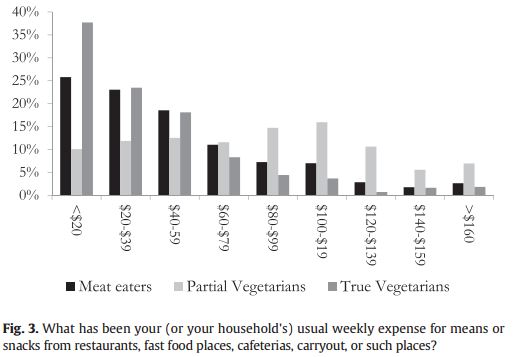
Here are some summary statistics on distribution of spending by meat eating status (not controlling for demographic or income differences)

It appears "partial vegetarians" spend more on food than the other two groups, however, when one looks at the demographics this group is also a bit richer, is more likely to have children in the household, and has larger household size - all things that are correlated with higher food expenditures.  

After adjusting for differences in demographics, we continue to find differences in spending patterns, though the differences are typically smaller.  Here are some graphs I constructed using the estimates in the paper. The figure shows spending for each consumption group assuming each group has demographics equal to the mean demographics in the sample (i.e., each group has the same demographics) for different levels of income.  

In general, richer households spend more on food than poor households regardless of whether one eats meat or not.  However, at every income level, partial vegetarians spend more than meat eaters while true vegetarians spend less (assuming same gender, household size, etc.).  For example, for households earning between $60,000 and $79,000 per year, weekly spending on food for meat eaters is $156, for partial vegetarians its $196, and for true vegetarians its $116.

Here is the same result expressed as a share of income (these are the so-called Engel curves).

Meat eaters in households earning between $60,000 and $79,000 per year spend about 11.6% of their income on food for partial vegetarians at the same income level it's 14.5%, and for true vegetarians it 8.5%.

Of course, these three groups don't have the same incomes.  The percent of respondents living in households making more than $100,000/year is 11.3% for meat eaters, 18.3% for partial vegetarians, and 14.4% for true vegetarians.  Thus, if one adjusts for differences in household income, some of the differences shown in the above graphs disappear.

Here is a summary of what we found.

To the extent that self-reported food expenditures are reliably correlated with actual expenditures, true vegetarians spend less money on food than meat eaters and partial vegetarians spend more. Although this result might be used to suggest that meat eaters could replace their meat with vegetables and save around $20 per week in food, this is deceiving. Roughly half of these savings are not due to the change in types of food purchased, but demographic differences. There are certain demographics that one can change in an effort to better mimic true vegetarians. Two of these are body mass index and political attitudes, but although they can be modified by the individual, their impact on food expenditures is small if not zero. The demographic traits that help true vegetarians save money must then reside with more fixed factors like household size, gender, and the like.

Changes in Meat Consumption

There's been a lot of discussion lately about changes in meat consumption over the last year or two.  Much of it seems to have been generated by a Rabobank report (based on USDA's data and projections).  For example here's a representative tweet.

There were headlines like: "America Cannot Kick Its Meat Habit".  Yesterday there was a story at Vox.com (in which I am quoted) that summarizes now dated cheers by animal advocates that meat consumption was falling.  This new news seems to contradict those claims.  

So what's going on with meat consumption?  I think it's useful to take a step back and take a longer view.  Here's USDA quarterly data on per-capita meat consumption (it's technically a measure of "disappearance" not consumption) going back to 1980.  Note: these are the same underlying data driving all the headlines.

Over this long time period, there has been a general decline in beef consumption, falling or steady pork consumption, and the big story is rising chicken consumption.  "Yes" it appears over the past few quarters or so there has been increasing total meat consumption, but that's mainly a result of eating more chicken.  Moreover the total consumption levels in 2016 are lower than they were in 2002-2006.

What caused the total meat consumption decline from roughly 2006 to early 2015?  Most journalists seem to want to focus on demand-side factors.  The typical story was that consumers were more concerned about health, environment, animal welfare, etc.  These might have played some role, but the much bigger driver is likely supply-side issues.  I noted these issues back in 2014 (see here and here for longer discussions).  In short, consumption was down because prices were high.  Prices were high because of supply-side issues like drought, high feed prices, a disease issue in pork, etc.  

Why is consumption starting to tick back up?  The answer is same as it was before: prices.  Here are changes in relative meat prices over the same time period as the previous graph.

Here's what I wrote back in July 2014 near the price peaks

Ultimately, the old adage is likely to hold: the cure for high prices is high prices. The high meat prices we’re seeing today will eventually encourage larger beef and pork supplies, which eventually will put downward pressure on prices. When will that day come?

Looks like the answer is "now."  

The long term price trends shown above also help explain the rise in chicken consumption over time.  While all meats are today more expensive than in 1980s (some of this is due to inflation - the prices changes above haven't been adjusted for inflation), today chicken is "only" about 200% more expensive than it was in January 1980 whereas beef and pork are both about 264% more expensive than in January 1980.  

Here's a graph of the price changes just since 2010 (January 2010 = 100).  These graph show relative changes, but if you look at actual price levels, it's also apparent why chicken consumption is up.  In July 2016, the USDA reported prices for beef, pork, and chicken were $6.09/lb, $3.78/lb, and $1.44/lb.  

The main message here is that we don't need to grapple for complex, convoluted stories to explain  recent changes in meat consumption.  The prices of meat have fallen (because feed is less expensive and because there are larger inventories), and lower prices encourage consumers to buy more.  It's just basic economics at work.