Blog

What is Natural Food Anyway?

At little over a month ago, I discussed some of the ongoing legal challenges that are swirling around "natural" claims on foods.  One of the big challenges is that the word "natural" is nebulous and is vaguely defined by regulators.   

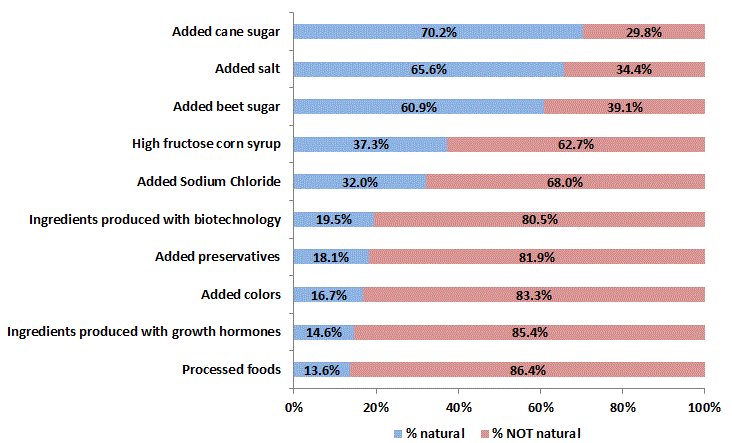
I thought I'd try to shed a little light on the subject by making use of the survey project I just started and asking consumers what they think the word means.  In June, I added two questions to the survey.  The first question listed 10 statements and individuals had to place them in a box that said "I believe foods containing this ingredient are natural" or one that said "I DO NOT believe foods containing this ingredient are natural."  The order of items was randomized across respondents (sample size is 1,004, demographically weighted to match the US population, sampling error is about +/- 3%).  
naturalfig.GIF

The results indicate that most people think added cane sugar, salt, at beet sugar are "natural" but HFCS, sodium chloride, and biotechnology are not.  Interestingly, salt and Sodium Chloride are the same thing!  Yet, using the technical/scientific name reduces the % perceiving salt as natural from 65.6% to 32%!

Processed foods are seen as least natural.  "Processed food" is also a vague term.  Is cheese a processed food?   

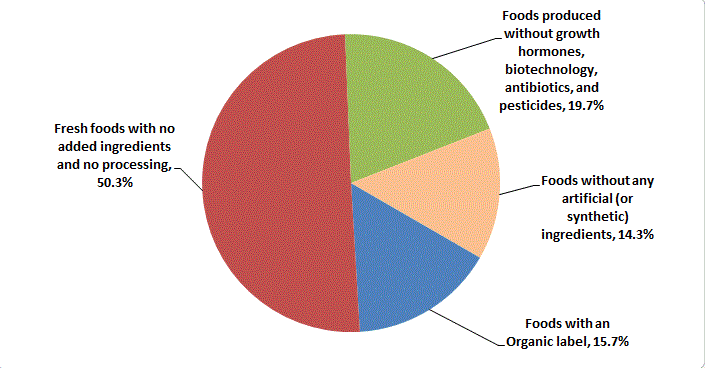
The second question I asked was the following, "Which of the following best fits your definition of 'natural food'?"  I gave four options, and here is the % of respondents choosing each option.
nafig2.GIF

The majority of respondents thought that the best definition (at least among the four I included) was, "fresh foods with no added ingredients and no processing."  

I suspect many of the foods sitting on a grocery store shelf that use the word "natural" do not meet this definition consumers found most descriptive.  

Stossel teaches the kids

Last night, I talked about biotech and GMOs on the John Stossel show.  I haven't yet been able to find a link to the entire show, but it is summarized here.   They edited down the segment I was in but overall, I was pleased with how it turned out.  

 I was particularly pleased when my older sister sent me the following picture of her kids (my niece and nephew) watching the show.  I suppose the lesson here is that if you want your kids (and nieces and nephews) to pay attention to you - get on TV.  Hey, they might have actually learned something!   

grantraylee.JPG

Debating GMOs

I'm scheduled to participate in a debate on GMOs on John Stossel's shown on Fox Business Network (we'll tape this Thursday and it will air next Thursday).  When I see videos like the one below, it makes me wonder how one can even prepare for such a depate.  This protester in the recent "occupy Monsanto" protest a few days ago somehow seems to muddle Bengazi, the flu shot, Monsanto, and Fast and Furious.  ​So many accusations, so little time . . .

Sunstein on GMO labeling

At Bloomberg.com, Cass Sunstein sensibly weighed in on the ongoing state and federal proposals to mandate labeling of GMO foods.  He argues that mandatory labels are a bad idea.  His reasoning is that ​the science shows biotechnology to be safe with few unique environmental concerns; however, requiring a label would "signal" that something is unsafe.  

Here is Sunstein:​

GM labels may well mislead and alarm consumers, especially (though not only) if the government requires them. Any such requirement would inevitably lead many consumers to suspect that public officials, including scientists, believe that something is wrong with GM foods -- and perhaps that they pose a health risk.

His arguments are virtually identical to those I published in a paper with Anne Rozan in the Journal of Agricultural and Resource Economics back in 2008 entitled "Public Policy and Endogenous Beliefs: The Case of Genetically Modified Food."  We wrote then:

Our argument is that policy can serve as a signal about the safety of GM food

and, conceptually:

Believing the government imposes a mandatory labeling policy on GM food could be consistent with a belief that GM food is perhaps not as safe as traditional food, but it is not so unsafe that GM food should be completely banned. Depending on a consumer's prior beliefs about the safety of GM food, the imposition of mandatory labeling could be taken to imply GM food is safer than previously thought (in the case where one's prior was that GM food is so unsafe it should be banned) or might be taken to imply GM food is riskier than previously thought (in the case where one's prior is that GM food is safe enough to warrant no labeling at all).

​Empirically, we found:

that individuals who believed the government imposed a mandatory labeling policy for GM food believed GM food was less safe and were less willing to eat and buy GM food than consumers who either believed no policy was in place or were uncertain on the matter

As we discussed in that paper, and as I've discussed elsewhere, such findings make cost benefit analysis really complicated.  How much would consumers "benefit" from a mandatory GMO label?  That depends on how much they are willing to pay for non-GMO food.  But, if our arguments are right, willingness-to-pay for non-GMO food depends on which policy is in place.  Thus, the benefits (and costs) of the policy are not independent of whether the policy is in place.  The act of passing (or failing to pass) the policy changes the benefits and benefits.  Thus, there are no "objective" or "true" benefits and costs.

Although I agree with Sunstein on this point, I find it a little ironic coming from him.  He has advocated using government "nudges", for example to change defaults or opt-in/opt-out options, to get people to make "better" choices that presumably the citizens themselves would prefer.  But if his theory on GMO labeling is right, a "nudge" might very well serve as a signal about what is the appropriate behavior.  Thus, a "nudge" isn't simply changing the default.  It is changing people's preferences, and presumably toward that desired by the regulator/nudger.  Thus, nudges aren't just getting people to make choices that presumably better match their "preference" - it might be very well changing their preference.  I find that problematic both from a philosophical standpoint but also from a public choice perspective.  You can get a sense of why in chapter 4 on behavioral economics in The Food Police.  

GMO labeling goes federal

From the Huffington Post:

On Wednesday, Sen. Barbara Boxer (D-Calif.) and Rep. Peter DeFazio (D-Ore.) introduced bills to the Senate and House of Representatives that would require food manufacturers to clearly label any product containing genetically engineered ingredients -- or risk having that product classified "misbranded" by the FDA.
Boxer and DeFazio have both previously sponsored bills that would have mandated GMO labeling -- Boxer in 2000 and DeFazio on numerous occasions in concert with former Rep. Dennis Kucinich (D-Ohio). But the new "Genetically Engineered Food Right-To-Know Act" is the first genetically modified organism (GMO) labeling bill to be introduced with both bicameral and bipartisan support. Its nine co-sponsors in the Senate include Alaska Republican Sen. Lisa Murkowski, while Rep. Don Young, also a Republican from Alaska, is among its 22 cosponsors in the House.

​I've written on this topic a good deal in the past (see here or Wall Street Journal
Forbes.comFoxnews.com, and the Huffington Post).  

I'm sure I'll have more to say if this heats up.​