Blog

Potential Impacts of GMO Cowpeas in Africa

The journal Agricultural Economics recently published a paper I co-authored with Sika Gbègbèlègbè who now works for the International Livestock Research Institute (other coauthors are Jess Lowenberg-DeBoer, Razack Adeoti, and Ousmane Coulibaly).  

The abstract:

Genetically modified (GM) crops could increase economic growth and enhance living standards in Africa, but political issues have slowed the use of biotechnology. This is the first study that assesses the potential impact of GM crops in Africa while considering the preferences of producers and consumers towards GMOs as well as the income and price risks they face. The study uses a choice experiment to estimate the ex ante economic impact of a novel technology, Bacillus thuringiensis (Bt) cowpea, on producers and consumers in Benin, Niger and northern Nigeria. The experiment involves the simulation of a market transaction similar to those in open air markets in West Africa. During the market simulation, respondents are informed about the advantages and disadvantages, including health risks, of Bt cowpea. The results from the study suggest that cowpea growers and consumers in Benin and northern Nigeria prefer Bt to conventional cowpea for health safety reasons. The results estimate that social welfare in Benin, Niger and northern Nigeria would increase by at least US$11.82 per capita annually with Bt cowpea, if seed sectors are operating smoothly. With inefficiencies in seed sectors and the potential for cowpea acreage increase, the estimated social welfare increase in the region would be about US$1.26 per capita annually.

Anti-GMO propaganda in most unlikely of places

The internet can be a dangerous place for kids.  That's why I was a bit worried when my son said to me today on the way to school: "you won't believe what I saw on Mom's computer."

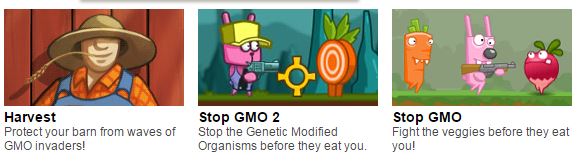
I was only slightly relieved to hear that he had headed over to a web site a friend had told him about called bigdino.com that links to a bunch of kid's games.  Having talked with me several times about GMOs, he thought I'd be interested to know there were at least three games  at the website on the topic.   You can play the game "Harvest" - the goal of which is to "protect your barn from waves of GMO invaders" or play the games "Stop GMO" or "Stop GMO 2" (the later games seem to be made by a company called MyPlayYard games).

There are insightful images, such as this one of a rabbit pouring some toxic substance on carrots before you're thrown into a game where you're being chased by scary looking radishes and carrots where you must kill or be killed.  

Precondition a generation of kids to be fearful of GMOs, to learn to shoot first and ask questions later, and we wonder why it sometimes so hard to have reasonable discussions about biotechnology . . .

End of Doom

Ronald Bailey has an excellent piece in the October print edition of Reason Magazine entitled, "The End of Doom" and a recently released book with the same title.  It's a nice counterweight to the oft-heard refrain that the world is going to hell.  

Here are a a few quotes I found particularly interesting.  In critiquing Rachel Carson's Silent Spring:

At its heart is this belief: Nature is beneficent, stable, and even a source of moral good; humanity is arrogant, heedless, and often the source of moral evil. Carson, more than any other person, is responsible for the politicization of science that afflicts our contemporary public policy debates.

In discussing our out-sized fears of cancers from synthetic chemicals and of biotechnology:

It should always be borne in mind that environmentalist organizations raise money to support themselves by scaring people. More generally, Bonny observes, “For some people, especially many activists, biotechnology also symbolizes the negative aspects of globalization and economic liberalism.” She adds, “Since the collapse of the communist ideal has made direct opposition to capitalism more difficult today, it seems to have found new forms of expression including, in particular, criticism of globalization, certain aspects of consumption, technical developments, etc.”

He ends with some choice words about the precautionary principle.  

Why does it matter if the population at large believes these dire predictions about humanity’s future? The primary danger is they may fuel a kind of pathological conservatism that could actually become a self-fulfilling prophecy.

and

The precautionary principle is the opposite of the scientific process of trial and error that is the modern engine of knowledge and prosperity. The precautionary principle impossibly demands trials without errors, successes without failures.

...

”An indirect implication of trial without error is that if trying new things is made more costly, there will be fewer departures from past practice; this very lack of change may itself be dangerous in forgoing chances to reduce existing hazards.”

GMO regulations in the US and EU

There is a myth going around that GMO crops are banned in Europe.  That's simply untrue.  This group of grad students out of Harvard (going by Science in the News - SITN) put together a nice post on the difference in US and EU regulation of GMOs.  

As this graphic from their piece shows, The EU has approved many of the same crops as in the US (though they are slower and haven't approved as many yet).

One way to look at this is to say the EU was more prudent and cautions.  Another view is that the more bureaucratic process cost the EU 10 years or more before they could have access to Bt corn and round-up ready beets, and that for a decade US farmers were able to reduce insecticide use and transition to no-till because our regulatory process was more expedient.    

Yesterday I taped a segment with CBC radio in Canada (I'll post to it when it airs) that involved  a discussion between several people on genetic engineering in animals.  One of the panelists on the anti-GMO side was very critical of the US and Canadian regulatory processes, and there seemed to be an implicit argument that these crops/animals wouldn't be approved if our regulator process were different.  However, as the above graph shows, some of these crops can indeed be approved under very different regulatory regimes - though at a much slower rate.

Here's another nice graphic from the piece on differences in US and EU regulatory processes for GMOs.