Blog

Consumer Uncertainty about GMOs and Climate Change

A lot of the debate and discussion surrounding public policies toward controversial food and agricultural issues like GMOs or climate change revolves around public sentiment.  We ask people survey questions like "Do you support mandatory labeling of GMOs?"  However, as I've pointed out, consumers may not even want to have to make this sort of decision; they would prefer to defer to experts.  Thus, we're presuming a level of understanding and interest that consumers may not actually have.  This is related to the recent discussion started by Tamar Haspel in the Washington Post about whether the so-called food movement is large or small.  Are "regular" people actually paying much attention to this food stuff that occupies the attention of so many journalists, researchers, writers, and non-profits?

I had these thoughts in mind as I went back and looked at this post by Dan Kahan who took issue with Pew's survey on public opinions about GMOs (this was the survey that attracted a lot of attention because it showed a large gap in public and scientific opinion on GMOs).  Kahan wrote:

the misimpression that GM foods are a matter of general public concern exists mainly among people who inhabit these domains, & is fueled both by the vulnerability of those inside them to generalize inappropriately from their own limited experience and by the echo-chamber quality of these enclaves of thought.

and

That people are answering questions in a manner that doesn’t correspond to reality shows that the survey questions themselves are invalid. They are not measuring what people in the world think—b/c people in the world (i.e., United States) aren’t thinking anything at all about GM foods; they are just eating them.

The only things the questions are measuring—the only thing they are modeling—is how people react to being asked questions they don’t understand.

This let me to think: what if we asked people whether they even wanted to express an opinion about GMOs?  So, in the latest issue of my Food Demand Survey (FooDS) that went out last week, I did just that.  I took my sample of over 1,000 respondents and split them in half.  For half of the sample, I first asked, "Do you have an opinion about the safety of eating genetically modified food?"  Then, only for people who said "yes", I posed the following: "Do you think it is generally safe or unsafe to eat genetically modified foods?" For the other half of the sample, I just asked the latter question about safety beliefs and added the option of "I don't know".  This question, by the way, is the same one Pew asked in their survey, and they didn't even offer a "don't know" option - it had to be volunteered by the respondent.  So, what happens when you allow for "I don't know" in these three different ways? 
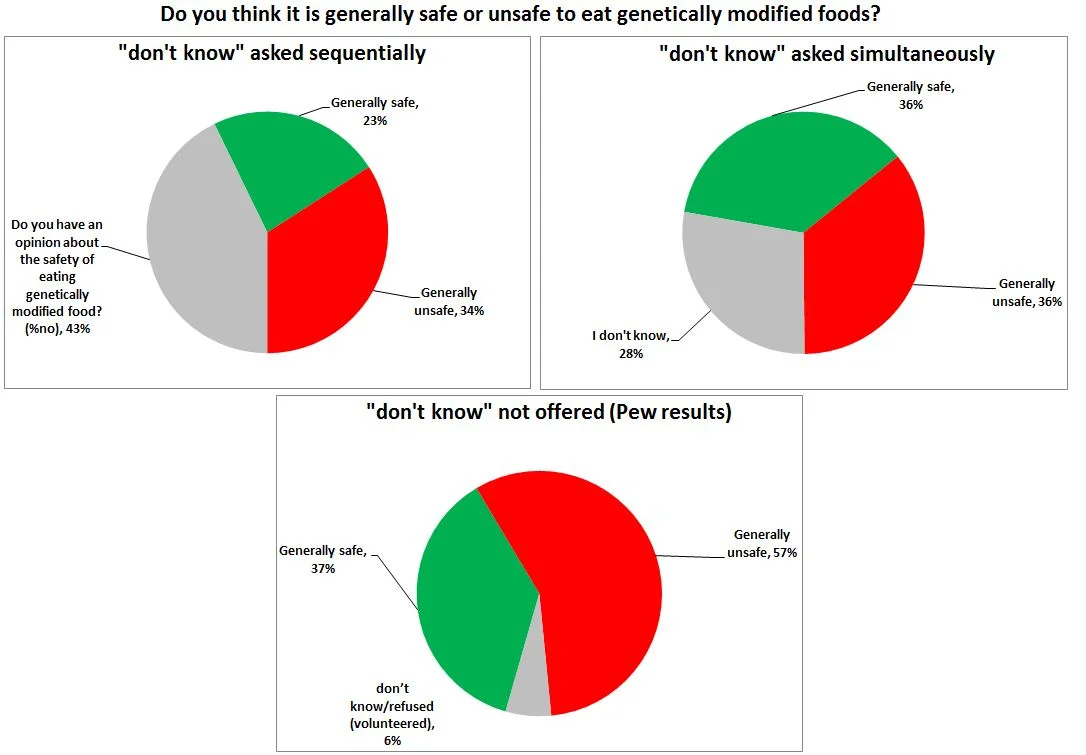
When "don't know" is asked 1st in sequence before the safety question, a whopping 43% say they don't have an opinion!  By contrast, only 28% say "don't know" when it is offered simultaneously with the safety question.  And, as the bottom pie graph shows, only about 6% of respondents in the Pew survey voluntarily offer "don't know".  Thus, I think Kahan's critique has a lot of merit: a large fraction of consumers gave an opinion in the Pew survey, when in fact, they probably didn't have one when this option was allowed in a more explicitly matter.  

Moreover, allowing (or not allowing) for "don't know" in these different ways generates very different conclusions about consumers' beliefs about the safety of GMOs.  Conditional on having an opinion, the percent saying "generally safe" varies from 40% in the sequential question to 50% in the simultaneous question to 39% in the Pew format which didn't offer "don't know."  That support can vary so widely depending on how "don't know" is asked is hardly indicative of stable, firm, beliefs about GMOs among the general public. 

In last week's survey I also carried out the same exercise regarding Pew's questions on climate change.  For half of my sample, I first asked whether people had an opinion about the causes of changes in the earth's temperature; for the other half, I included "don't know" as an option simultaneous with the question itself.   Here are the results compared to Pew's, which again did not explicitly offer a "don't know."  

Again, we see big differences in the extent to which "don't know" is expressed depending on question format, varying from 37% in the sequential version to only 2% in Pew's survey.  In this case, it appears that people who would have said "don't know" in the sequential question format are more likely to pick response categories that disagree with scientists, when they are given questions where "don't know" isn't so explicitly allowed.  

What can we learn from all this?  Just because people express an opinion on surveys doesn't mean they actually have one (or at least not a very firmly held one).  

11 things to know about GMOs

Over the past year, I'd received a large number of inquiries about GMOs.  Some of the questions were from moms, others from farmers, and sometimes from the media.  It seems a common set of questions continued to come up, so I got together with my colleagues Eric and Cheryl Devuyst to put to together this University Fact Sheet to provide some succinct answers.

We answer the following 11 questions as best we can in a mere two pages.

  • What is a GMO?
  • Why are crops genetically modified?
  • Are GMOs safe to eat?
  • What crops in the U.S. are genetically modified?
  • What are the environmental effects of GMOs?
  • Do farmers need to use more pesticides with GMOs?
  • How are GMOs regulated?
  • Are GMOs banned in Europe?
  • Should food companies be required to label foods with GMOs?
  • What are the economic effects of farmers using GMOs?
  • What are the potential downsides of GMOs?

You can find our answers here.

Food Company Voluntarily Adds GMO Labels

This is a potential game changer (from the NYT):

Breaking from its industry rivals, Campbell Soup will become the first major food company to begin disclosing the presence of genetically engineered ingredients like corn, soy and sugar beets in its products.

A while back when writing about the duplicity of a many food companies on the issue of GMO labeling, I wrote

For now, food companies are not required to add labels indicating the presence of genetically engineered ingredients. But, it might ultimately be in their best interest to do it voluntarily, and in a way that avoids the negative connotations implied by the labels that would have been mandated in state ballot initiatives.

Some day in the near future, after concerted efforts to educate the public and create consumer-oriented biotechnologies, we may see food companies clamoring to voluntarily add a label that proclaims: proudly made with biotechnology.

Campbell's isn't going that far (and in fact they're supporting nationwide mandatory labels on foods with genetically engineered ingredients).  Nonetheless, this is an interesting move, and it will be fascinating to see how it plays out.

Thinking about risk

Consider this passage from a recent New York Times article

Mr. Portier, who led the center when the revision process was initiated, said he believed parents should have been presented “with enough information to say caution isn’t ill advised, because we really don’t know, and there are enough indicators to say we should be cautious.”

The quoted former CDC official is espousing a form of the precautionary principle.  What do you think he's referring to? GMOs?  A new pesticide?  Food irradiation?

Nope. He's talking about cell phones.   The article describes some squabbles at the CDC on whether using cell phones cause cancer (the same World Health Organization group that says bacon and the weed-killer glyphosate may be carcinogenic  have also said that cell phones are a possible carcinogen), and how to communicate with the public on the issue.

So, here he have an issue for which there is apparently some scientific uncertainty, for which some government officials want the public to proceed only with caution, and the the public response?  A big shrug.  

Why is it that people think about the risks surrounding cell phones so differently than they do the risks surrounding GMOs, glyphosate, irradiation or many other food and agricultural technologies?  One could write a whole paper on that topic.  In fact I have (along with Jutta Roosen and Andrea Bieberstein).

There are a variety of reasons.  For one, people tend to conflate benefits and risks.  If something is beneficial then, people tend to think of it as less risky (even though we can imagine some very beneficial products that are also risky).  People directly see the benefits of using cell phones every day and thus they are perceived as less risky than, say, a pesticide that they have never heard of and scarcely can imagine  using.  Then, there is the old risk perception literature that originated with folks like Paul Slovic that is still relevant today.  The idea is that risk perceptions aren't driven by objective probabilities of possible bad outcomes but by how familiar or unusual a product seems and by how much control we believe we have over the risk.  Cell phones seems relatively safe because they're now quite familiar and because we decide whether to pick it up or turn it off.  Many food and agricultural technologies, by contrast, seem foreign and have secretly been slipped into our food supply (or so the story goes; ever notice now many of the top-selling food books use words like "hidden" or "secret" in the subtitles?).  

Whether there are good reasons for these psychological biases is less clear, particularly when they run at odds with the best scientific evidence we have on relative risks.  I for one, am perfectly at ease eating a tortilla made from Roundup-Ready corn while chatting on my cell phone.  The biggest risk is probably getting salsa on my iPhone.      

What is a GMO anyway?

Yesterday on Twitter, Nathanael Johnson asked a good question, and got lot of good answers.

I couldn't figure out how to embed the whole Twitter conversation but there were scores of interesting responses.  The discussion is related to another important one: A GMO isn't a single thing, it's many, many possible things.  But, Nathanael's question is deeper, and philosophical.  Is this thing we've called "GMO" something that's only in our heads or is it something that exists independent of our minds.  Another way to look at it: if a Martian were to travel to earth and look at what's our dinner plate and is growing on our farm fields, could they - without knowledge of our history or social baggage - identify a class of things called "GMO" that would match up with the class of things we call a "GMO"?