Blog

Growing Flintstones

That's the title of Chapter 5 of Unnaturally Delicious, which discusses a variety of efforts to combat malnutrition in the developing world by breeding crops with higher vitamin and mineral content.  

Providing vitamin supplements (think Flintstones Vitamins on a global scale) has indeed produced positive outcomes in many parts of the world. The approach, however, has proved less beneficial than the optimists had predicted. Vitamin supplements present a number of challenges. First, you’ve got to deliver them to where they’re needed—some of the most remote, unpaved, undeveloped places in the world. Then you’ve got to convince people to take them. Regularly. Then you’ve got to do it all over again. Every year. In perpetuity. Supplements are a one-off, partial solution to an ongoing problem. . . .

A more innovative, bottom-up approach is starting to challenge this top-down approach to ending malnutrition. One of the root causes of malnutrition is lack of dietary diversity, caused by both a lack of access and the inability to afford different foodstuffs. . . .

In this conundrum may lie a solution. If the staple crops of these farm families were more nutrient dense, some of the problems of malnutrition could be solved. Biofortification is the science of breeding crops to increase nutritional content.

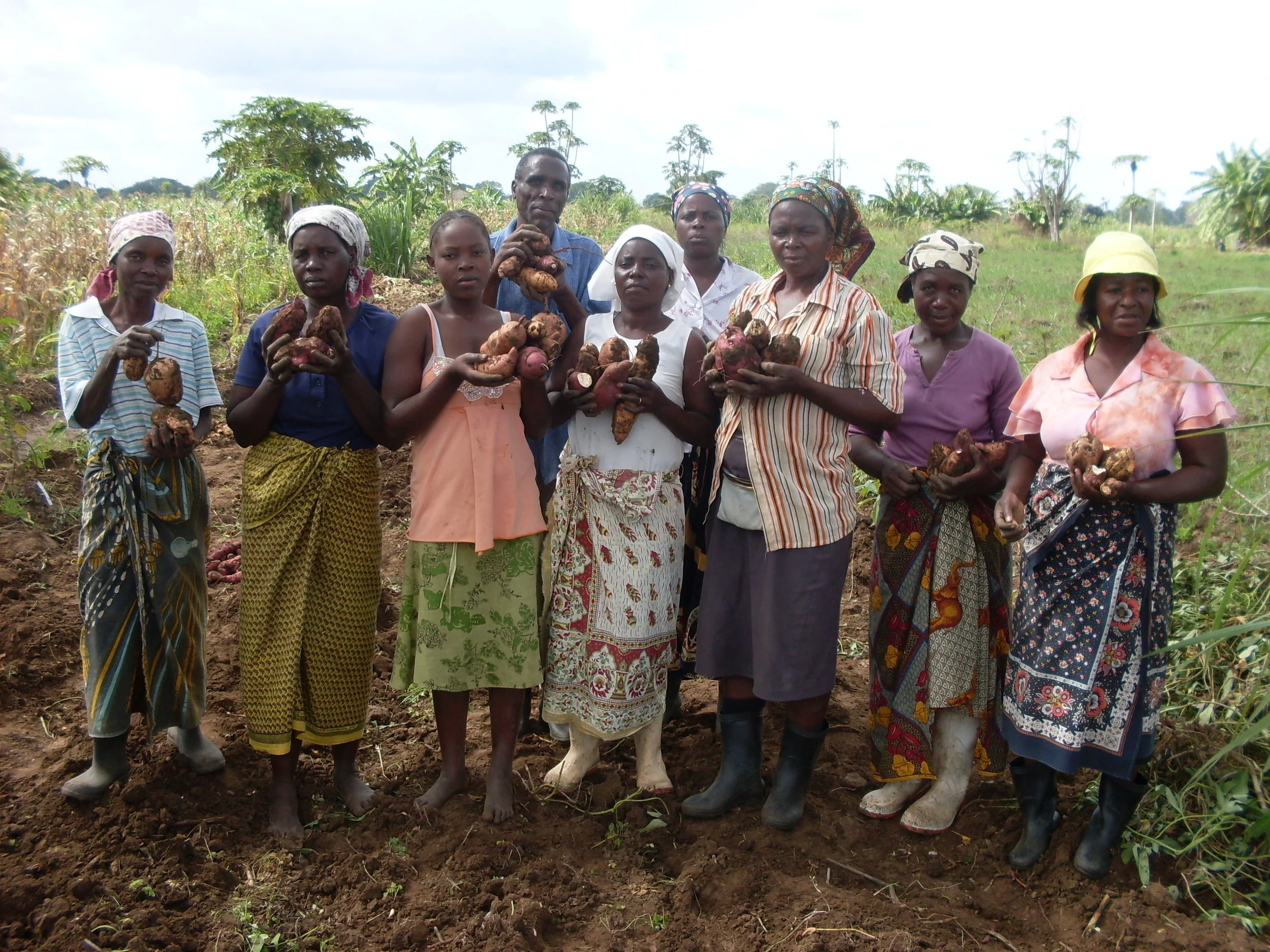
I talk about the organization Harvest Plus, and about one of my former students Abdul Naico who's back home in Mozambique working to increase adoption of sweet potatoes that are higher in beta carotene.  Here are a couple pictures he sent me.
While the efforts of Harvest Plus and other organizations have utilized conventional breeding techniques to create, for example, "high iron beans" in Rwanda, others have used biotechnology.  The most famous example is the work of Ingo Potrykus, who graciously answered some questions for me about golden rice, which contains a daffodil gene so that the rice produces beta carotene (which the body converts to vitamin A).  

The initial varieties of rice createdby Potrykus and colleagues expressed only a small amount of vitamin A. Further iterations of golden rice have resulted in a twenty-threefold increase in the carotene content. Current varieties can produce 55 to 77 percent of recommend daily intake of vitamin A by eating a mere hundred grams of uncooked rice (or about half a cupful), and human research has found it safe and as effective as vitamin A supplements

The Golden Rice Humanitarian Board shared the following photos with  me.

Synthetic biology

This is the third installment in my effort to share some photos associated Unnaturally Delicious (by the way, I noticed today that the book was reviewed by Nadia Berenstein for Popular Science).

In the fourth chapter, I talk about synthetic biology.

If yeast can convert sugar to alcohol, what else can it do? As it turns out, yeast is more than just an alcohol factory. Yeasts can eat up sugars to make flavors, fats, and fuels. And more. Yeast can make whatever its instructions tell it to make. By instructions, I mean the yeast’s genetic code, or DNA.

When people think about biotechnology and "GMOs" they tend to think about big chemical and pharmaceutical companies, but as I reveal, even teenagers and young adults are getting in on the action.  

Some of the most exciting developments in food bioengineering aren’t even among the Silicon Valley–like start-ups. They’re being conceived by kids who haven’t even finished high school or college. For more than a decade students around the globe have been assembling for an annual competition once hosted by MIT but now put on by the nonprofit International Genetically Engineered Machine (iGEM) Foundation. iGEM has become the premier competition in synthetic biology for graduate, undergraduate, and high school students

I talked to a team from the City University of Hong Kong who made a pro-biotic to fight obesity (the modified bacteria "eats" undesirable fat and turns it into more desirable omega 3 fatty acid).  I also talked to the prize winning team from UC Davis who created a bacteria to test for rancid olive oil.  

According to Ritz, as much as 70 percent of the olive oil imported into the United States is rancid by the time it reaches the consumer. Rancid oil has gone stale. It isn’t necessarily harmful or even bad tasting to the average consumer. In fact, the UC Davis team conducted some blind tastes with consumers and found that many people actually preferred the rancid oil to fresh oil—perhaps because it is what they have become so accustomed to eating. Ritz said that fresh olive oil creates a tingling feeling in the throat—a phenomenon unfamiliar to many American consumers. Being habituated to blander, stale oil has its costs. Rancid oil does not have the same healthy compounds—like antioxidants—that are associated with fresh olive oil.

Here are some photos of that taste test and the entire UC Davis team.  

NYT Editorial on My Food Policy Study

Yesterday, the New York Times ran an editorial on the political fight over GMO labeling.  In the piece, the editorial board cited one of my studies (with Marco Costanigro) in the following passage:

There is no harm in providing consumers more information about their food. A study published in the journal Food Policy in 2014 found that labels about genetic modification did not influence what people thought about those foods.

I want to add a clarification and caveat to that statement.   What we found (in the context of an internet survey), is that the addition of GMO labels didn't make people more concerned about GMOs than they already were.  That is, the addition of a label didn't seem to send a signal that GMOs were more risky than consumers already thought they were.  

However, we did find that consumers would attempt to avoid foods with a GMO label.  Consumers' choices in our studied implied they were willing to pay as much $1.98/lb to avoid an apple that has a mandatory "genetically engineered" label relative to an unlabeled apple.  As I discussed just yesterday, it is precisely this issue that is the big potential driver of the costs of mandatory labeling.  That is, if some segment of consumers tries to avoid GMO labels, retailers and food manufacturers may respond by trying to source more costly non-GMO crops.    

Finally, I'll note that despite the above quote, that different types of GE labels in fact had very big effects on what people "thought" or were willing to pay for GE foods.  In particular, we compared how willingness-to-pay (WTP) for an unlabeled apple varied when there were apples with mandatory labels (i.e., "genetically engineered) vs.  voluntary labels (i.e., "not genetically engineered").

We found that the WTP premium for the unlabeled apple relative to the apple labeled "genetically engineered" was the aforementioned $1.98/lb.  However, the WTP premium for apples labeled "not genetically engineered" relative to the unlabeled apple was only $0.81/lb.  Thus, the implied willingness-to-pay to avoid GE was [(1.98–0.81)/0.81] ∗ 100 = 144% higher in the mandatory labeling treatment as compared to the voluntary labeling treatment.  In the paper, we write:

The differences in responses to mandatory vs. voluntary labels may result from the asymmetric negativity effect, which may in turn result from differences in what these two labels signal about the relative desirability of the unlabeled product. The differences in the “contains” vs. “does not contain” may also send different signals and change beliefs about the likelihood that the unlabeled product is GE or non-GE.

One more point that I just can't led slide.  The editorial also mentions the following:

Various polls have found that about 90 percent of Americans favor mandatory labels for genetically modified foods.

Yes, but about the same percentage of consumers say they want mandatory labels on foods with DNA.  And, when you directly ask people, the vast majority say they don't want the issue decided by state ballot initiatives but rather by the FDA.  And, we've had real-life ballot initiatives in five states now, and all have failed to garner more than 50% support.  Whatever positive reasons may exist for mandatory labeling, the cited "90% of people want it" reason is the most dubious and misleading.

An often forgotten benefit of biotech crops

Discussions on the environmental benefits (or costs) of genetically engineered crops tend to focus on relative volumes and toxicities of herbicides applied, effects of Bt, and possibilities of cross pollinating native plants.  In so doing, what is often missed is an important environmental benefit of herbicide resistant crops.  In particular, if a farmer can control weeds by spraying the entire field with a herbicide like glyphosate, that means they don't have to use other methods of weed control (like plowing) that may lead to soil runoff.  

A new paper just released by the American Journal of Agricultural Economics by Edward Perry, GianCarlo Moschini, and David Hennessy tackles this issue. Here's a portion of the abstract:

We find that glyphosate tolerant soybeans and conservation tillage are complementary practices. In addition, our estimation shows that farm operation scale promotes the adoption of both conservation tillage and glyphosate tolerant seed, and that all of higher fuel prices, more droughty conditions, and soil erodibility increase use of conservation tillage. We apply our results to simulate annual adoption rates for both conservation tillage and no-tillage in a scenario without glyphosate tolerant soybeans available as a choice. We find that the adoption of conservation tillage and no-tillage have been about 10% and 20% higher, respectively, due to the advent of glyphosate tolerant soybeans.

It should be noted that herbicide tolerance isn't unique to biotechnology.  There are several "non GM" crops on the market that are tolerant to certain herbicides but are not genetically engineered, at least as the term normally used.

Cost of Vermont's GMO labeling law

Back in 2014, the Vermont legislature passed a law mandating labels on certain foods produced with genetically engineered ingredients.  The law is set to go into effect this summer, and it has prompted a lawsuit and at least a couple federal attempts at a GMO labeling law to provide uniform standards across all states (the most recent is a bill by senator Pat Roberts from Kansas).

Against this backdrop comes a new study on the potential costs of Vermont's law.  According to Agri-Pulse:

A new study funded by the Corn Refiners Association concludes that if Vermont’s mandatory labeling law were allowed to go into effect and spread nationwide, the increased cost of producing food in the U.S. would reach about $82 billion per year, or about $1,050 per family.

That's a sizable sum, and one that's somewhat larger than the often-cited $500/family from  William Lesser of Cornell who estimated the costs of such a policy in New York.  We can add this new study to other previous ones like that of Julian Alston and Dan Sumner of UC Davis who estimated a $1.2 billion cost on California food processors when  that state had a ballot initiative back in 2008.  Tom Marsh and other economists estimated the costs (just of monitoring and oversight) in Washington State of over  $700,000/year when that state had a ballot initiative in 2012.  Here's a nice discussion of labeling effects by some Colorado State University agricultural economists produced with that state held a ballot initiative.

Of course a lot of pro-labeling groups dispute these estimates, and have written their own reports to "debunk" them, (though I find it curious that none of the de-bunkers have much economics training, while each of the authors of the above reports are respected and well known agricultural economists).  The organization Just Label It, for example says

there’s no evidence that requiring food manufacturers to label products that contain genetically modified (GMO) ingredients will increase food prices at the supermarket.

So, where's the truth?  All the studies (by pro- and anti-labeling groups alike) rely on assumptions.  One assumption often made by pro-labeling groups is that the government costs of monitoring and enforcement are essentially nonexistent.  As the Washington study suggests, however, that's unlikely to be true and these extra costs will either manifest themselves in higher taxes or higher food prices, depending on how they're funded and people respond.  Pro-labeling groups are right to suggest that the physical costs associated with changing the label are relatively small and close to the "cost of ink."  The much bigger question, and where most the controversy arises, is how food companies will respond to the label.  If they respond by seeking to source non-GM crops, the cost implications could be quite significant, and this is how we arrive at numbers like $1050/family (the new Vermont study also assumes manufactures will have to comply in all states not just Vermont because of possibility of liability if one of their unlabeled products sold elsewhere unwittingly finds itself on a store shelf in Vermont).  If instead food companies shrug their shoulders and just slap the label on all their products, the costs are likely closer to just the physical re-labeling costs and the government oversight and regulatory costs.  

So, how will retailers respond to the label?  My guess is that the answer is somewhere between the extremes: some will dis-adopt GM and others won't.  Thus, the expected cost should be calculated by multiplying the costs of disadoption by the anticipated likelihood of disadoption.   I find it a bit hard to believe that all retailers will fully move away from GM content to avoid the label (i.e., that the probability of full disadoption is 1).  Why?  A lot of consumers are unconcerned about GMOs and many more have no opinion on the issue, and thus there will remain an incentive for food companies to remain cost competitive.  Also, the US is going to produce a lot of GMO corn no matter the labeling policy because around 40% of the corn crop goes into our gas tanks as ethanol and most of the remaining corn crop is used for animal feed (and animal products are typically exempted from the label).  These much larger demanders of corn, as opposed to comparatively small demands for high fructose corn syrup or corn starch, are likely to drive the market for corn.  

So, all this would suggest that $1,050/household/year is an upper-bound estimate associated with the mandatory labeling law.  And, I think that's true, except for one thing.  The potentially much larger (and admittedly more speculative) costs could come about if we create a culture and market environment that is hostile to the introduction of biotech crops and crop technologies.  What future innovations will we forego if retailers chose to disadopt?  We may never know, but it would be a mistake not consider these opportunity costs.