Blog

Mandatory GMO Labeling Closer to Reality

I've written a lot about mandatory labeling of genetically engineered foods over the past couple years, and given current events, I thought I'd share a few thoughts about ongoing developments.  Given that the Senate has now passed a mandatory labeling law, and discussion has moved to the House, it appears the stars may be aligning such that a nationwide mandatory GMO labeling will become a reality.  

The national law would preempt state efforts to enact their own labeling laws, and it would require mandatory labeling of some genetically engineered foods (there are many exemptions and it is unclear whether the mandatory labels would be required on only foods that contain genetic material or also those - such as oil and sugar - which do not).  Food manufacturers and retailers can comply with the law in a variety of ways including on-package labeling and via QR codes.  Smaller manufacturers can comply by providing a web link or phone number for further information.  

Many groups that have, in the past, advocated for mandatory labeling are against the bill because, they say, it doesn't go far enough (e.g., this group is upset because it doesn't "drive Frankenfoods . . . off the market."). Other anti-mandatory labeling folks also don't like the bill because of philosophical opposition to signalling out a technology that poses no added safety risks.  

I suppose this is how democracy works.  Compromise.  Neither side got everything they wanted, but at least from my perspective, this is a law that provides some form of labeling, which will hopefully shelve this issue and allow us to move on to more important things in a way that is likely to have the least detrimental economic effects.   

I'm sympathetic to the arguments made by folks who continue to oppose mandatory labeling on the premise that our laws shouldn't be stigmatizing biotechnology.  Because a GMO isn't a single "thing" I agree the law is unhelpful insofar as giving consumers useful information about safety or environmental impact.  The law is also a bit hypocritical in terms of exempting some types of GMOs and not others.  One might also rightfully worry about when the government should have the power to compel speech and when it shouldn't.  And, I think we should be worried about laws which potentially hinder innovation in the food sector.  

But, here's the deal.  The Vermont law was soon going into effect anyway. The question wasn't whether a mandatory labeling law was going into effect but rather what kind.   The Vermont law was already starting have some impact in that state and would likely have had nationwide impacts.  Moreover, there didn't seem to be a practical legal or legislative way to prevent the law from going into effect in the foreseeable future.  

The worst economic consequences of mandatory labeling would have come about from those types of labels that were most likely to be perceived by consumers as a "skull and cross bones".   In my mind the current Senate bill avoided this worst case scenario while giving those consumers who really want to know about GMO content a means for making that determination.  That doesn't mean some anti-GMO groups won't use the labels as a way of singling out for protest companies that use foods and ingredients made with the technology, but at least the motives are more transparent in this case.  For some groups it was never about labeling anyway - it was about opposition to the technology.  That, in my opinion, is a much less tenable position, and is one that will hopefully be less successful in the long run.    
Support for GMO Labeling a Left-Wing Phenomenon?

Much has been written about whether aversion to biotechnology and GMOs has ideological dimensions rooted in the left.  I've written about this before, as have many others (this paper in Food Policy extends the discussion to a whole host of food regulations beyond biotechnology).  Most of the studies I've seen (including my own data) suggest only small differences in the left and the right in terms of beliefs about safety of eating GMOs.  However, as I previously argued:

One distinction, which I think is missing, is the greater willingness of those on the left to regulate on economic issues, such as GMOs, than those on the right. Stated differently, there are questions of science: what are the risks of climate change or eating GMOs. And then there are more normative questions: given said risk, what should we do about it? Even if the left and the right agreed on the level of risk, I don’t think we should expect agreement on political action.

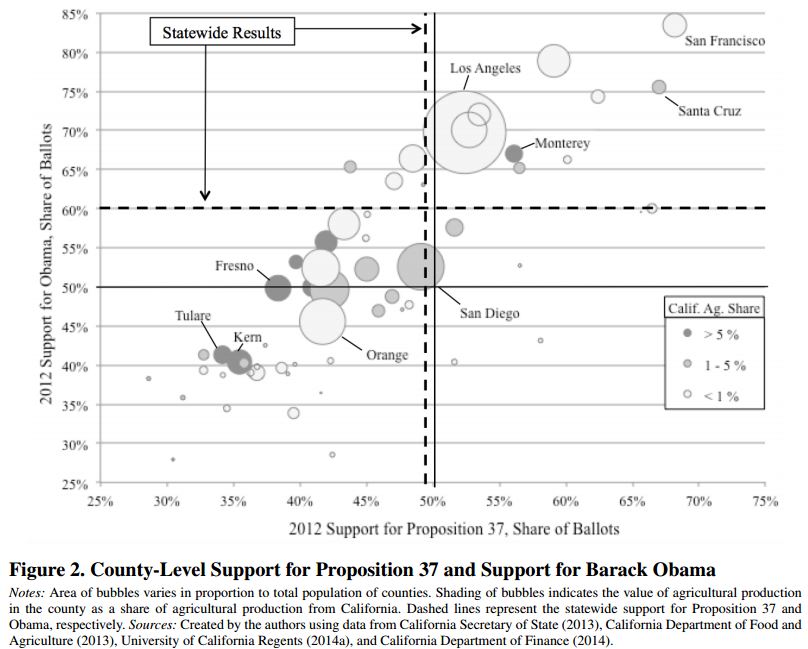
Perhaps the clearest demonstration of this difference in willingness to regulate comes from a new paper by John Bovay and Julian Alston in the Journal of Agricultural and Resource Economics. They look at precinct-level voting data on the Prop 37 mandatory labeling initiative in California in 2012. One of the best predictors of support for Prop 37?  The share of people in the precinct voting for Obama. Here's a telling graph from their paper.   It's an almost perfect positive, linear relationship. 

The authors went on to use these results to predict what would have happened in other states if they'd had an opportunity to vote on Prop 37 (I should note we did something very similar in a paper on for votes on California's Prop 2 related to animal welfare in 2008).  Bovay and Alston found the following:

Projections using our estimated model imply that a majority of voters in only three of fifty states (Hawaii, Rhode Island, and Vermont) plus the District of Columbia would have passed Proposition 37 had it been on their ballots in 2012

What Consumers Don't Know about GMOs

Yesterday the Journal of the Federation for American Societies for Experimental Biology (FASEB) published a paper I co-authored with Brandon McFadden from the University of Florida.  We surveyed a representative sample of over 1,000 US consumers and probed the depth of their knowledge about GMOs.  

We asked questions about the number of genes affected by different plant breeding techniques, prevalence of use of GMOs for different crops and foods, true/false questions about genetics and GMOs, knowledge of the length of time biotech crops have been grown, regulatory approval times for GMOs, views on public policies directed toward GMOs.  Before and after asking these questions, we asked respondents to rate their self-assessed knowledge of GMOs and to indicate their belief that GMOS are unsafe or safe to eat.  

The overall finding is 1) consumers, as a group, are unknowledgeable about GMOs, genetics, and plant breeding and, perhaps more interestingly, 2) simply asking these objective knowledge questions served to lower subjective, self-assessed knowledge of GMOs (i.e., people realize they didn't know as much as they thought they did) and increase the belief that it is safe to eat GM food.  

The implications are two fold: 1) using consumer opinions about GMOs to guide public policy is problematic given the low levels of knowledge, and 2) using something like the Socratic Method may as effective at changing safety beliefs than simply providing information.    

An Unusual Proposal

A reader who read my WSJ editorial on GMO labeling emailed me the following proposal.  

The arguments in support of mandatory labeling largely fall in the “consumers have a right to know what’s in their food” category, which in theory is hard to argue with. On the flip side, there are no proven scientific based concerns regarding GMOs in the foods we eat and this is the basis (in general) for the position for those who oppose mandatory labeling of GMOs. Therefore, the solution seems very simple: make labeling of non-GMOs mandatory. If those in support of mandatory GMO labeling truly are interested in transparency, then mandatory labeling of non-GMOs provides the same amount of transparency (if you’re only going to mandate labeling for one side of the argument, why not the non-GMO side?). In addition, this should ease the concern of those who fear that mandatory labeling of GMOs will scare the public into thinking they are unsafe. Another great aspect of this solution is the cost to implement is almost zero because the food industry, in general, already labels non-GMO products.

Can I get that with an extra GMO?

That's the title the editors of the Wall Street Journal gave to my piece that was published today.  I touched on the issue of GMO labeling, but also tried to elevate the discussion a bit to delve into the broader issues at play.  

Here are a few snippets:

Lost in the politics is a deeper debate about the future of our food system. At the core of many anti-GMO arguments lies a romantic traditionalism, a desire for food that is purportedly more in line with nature. Perhaps we should eat only the food that God gave us. Yet manna rarely falls from heaven.

The truth is that what we eat today differs radically from the food eaten even a few hundred years ago. Carrots used to be purple. Random mutations and selective breeding led to their signature color during the 16th century in the Netherlands, where it later was claimed the new varieties honored the King William of Orange. Broccoli, kale, cauliflower and Brussels sprouts all emerged from the same wild plant. Potatoes and tomatoes originated in the Americas and were never eaten in Europe and Asia until after the New World was discovered. Today we eat more and better than ever, precisely because we did not accept only what nature provided.

and, in conclusion, after discussing the host of new biotech innovations coming to market:

Food manufactures today may be reluctant to label foods made using biotechnology. But one day soon, when the fad against GMOs fades, they might be clamoring to add the tag: proudly produced with genetic engineering.