Blog

FDA's New Effort to Educate about GMOs

AgriPulse recently ran an article about a new Congressionally mandated effort to educate consumers about biotechnology.  According to the article:

The fiscal 2017 spending bill enacted at the end of April includes $3 million earmarked for the FDA to coordinate with the Agriculture Department on a consumer outreach and education effort. The stated goal under the legislation is to educate consumers “on the environmental, nutritional, food safety, economic, and humanitarian impacts of such biotechnology, foodstuffs, and feed.”

The article includes several quotes from yours truly.  I was asked whether the spending will make any real difference with consumer attitudes based and whether the effort could harm FDA’s credibility as a regulator.  Here is the (slightly edited) responses I gave to the article's author.  

On the second question: can information affect public perceptions?  The answer is yes - at least a bit.  Most of our research shows consumers remain highly uniform (and often misinformed) about the technology.  As a result, subtle changes in wording, descriptions of benefits of the technology, etc. can be persuasive.  I think this can be seen most directly in the various state ballot initiatives on mandatory GE labeling.  Early polling in all the states showed that voters approved of the laws by a wide margin.  But as the vote neared and biotech companies and others started running ads, support eroded to such a point that the mandatory GE labeling laws failed in every state where they were put on the ballot.  This is fairly strong evidence that information mattered in the "real world."  That said, the USDA and FDA have communicated on these issues in the past, and it is unclear what effects they had.  

All this suggests that the form of the communication matters.  Information that is scientifically accurate but focused on the perspective of the farmers/consumers who benefit is likely to be most persuasive.

Could credibility be harmed?  Well, I don't believe the government should promote a particular company or industry per se (though of course it already does that in a variety of direct and indirect ways such as encouraging conversion to organic, facilitating labeling programs and marketing orders, etc), but providing the public with accurate, scientific information on matters of public concern seems a legitimate role for government.  Focusing on the wide range of applications in the private, public, and nonprofit sectors is one way of perhaps avoiding perceptions of impropriety.  Also being honest about possible downsides and trade-offs is important. Also, not overselling - biotech is a tool but it's not a universal savior.
Solar Radiation and Crop Yields

My last post discussed some recent research we conducted on the impacts of biotechnology adoption on corn yields.  A reader forwarded a link to a recent paper in the journal Nature Climate Change raising an issue I hadn't yet heard about.  Using some simulations, the authors argue that increased solar radiation, which led to brighter skies, has had a big impact on recent increases in corn yields.  

Here's the abstract:

Predictions of crop yield under future climate change are predicated on historical yield trends, hence it is important to identify the contributors to historical yield gains and their potential for continued increase. The large gains in maize yield in the US Corn Belt have been attributed to agricultural technologies, ignoring the potential contribution of solar brightening (decadal-scale increases in incident solar radiation) reported for much of the globe since the mid-1980s. In this study, using a novel biophysical/empirical approach, we show that solar brightening contributed approximately 27% of the US Corn Belt yield trend from 1984 to 2013. Accumulated solar brightening during the post-flowering phase of development of maize increased during the past three decades, causing the yield increase that previously had been attributed to agricultural technology. Several factors are believed to cause solar brightening, but their relative importance and future outlook are unknown, making prediction of continued solar brightening and its future contribution to yield gain uncertain. Consequently, results of this study call into question the implicit use of historical yield trends in predicting yields under future climate change scenarios.

I don't know enough about the issue to speak to the credibility of the authors' findings.  However, I not sure that this is much of a confound for our study on biotech adoption because our estimated effects are (partially) identified by using variation in yields across states that have differential adoption rates (and yet are presumably exposed to the same solar radiation).  To the extent that identification our effects of biotech adoption come about from comparisons of yields in the same counties over time (where solar radiation varied over time), this could be an issue, but again, the time trend included in our models should pick up this effect as well.  

The Adoption of Genetically Engineered Corn and Yield

Many readers of this blog will probably remember the article by Danny Hakim (and the associated infographics) that ran in the New York Times back in October about the "broken promises" of GMOs.  The article prompted some cheers and some legitimate criticisms.  

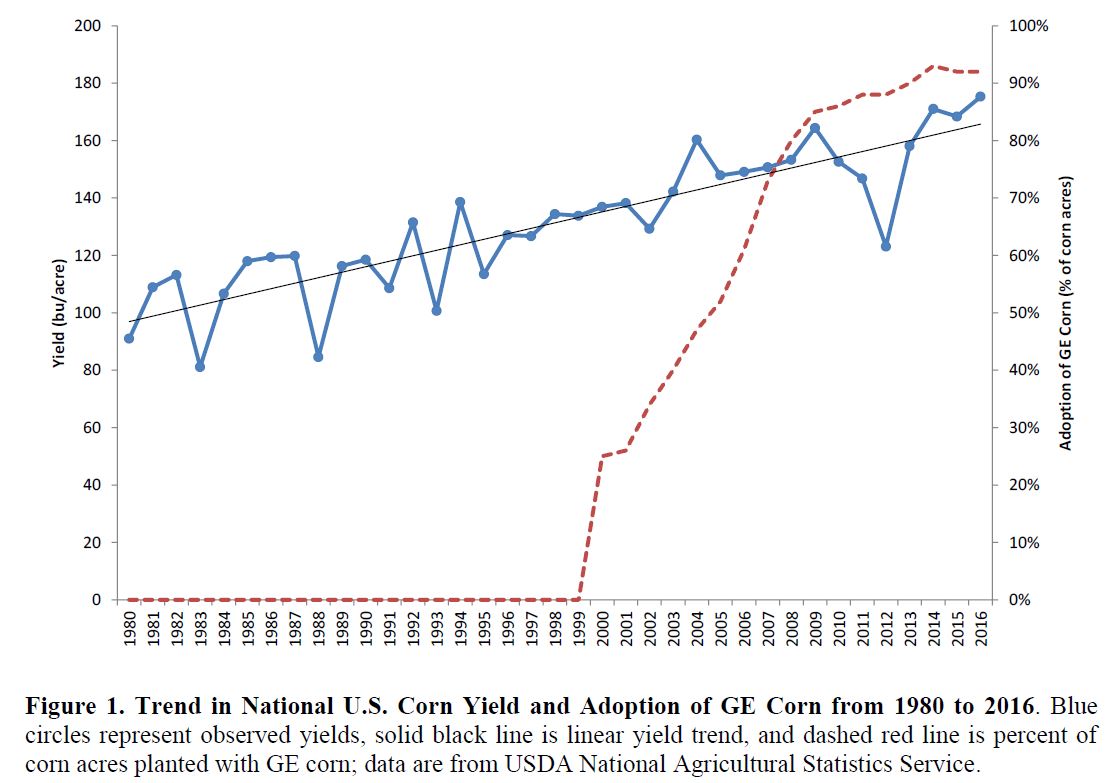
After that article came out, one thing bugged me a bit.  We have scores of experimental studies showing GMOs (particularly the Bt varieties) increase observed yield, so why don't we see a pronounced effect on aggregate, national yield trends?  At about the same time these thoughts were swirling around in my head, I received a note from Jesse Tack at Kansas State University asking the same.  As it turns out, we weren't the first to wonder about this.  The most recent, 2016, National Academies report on GMOs noted the following:

the nation-wide data on maize, cotton, or soybean in the United States do not show a significant signature of genetic-engineering technology on the rate of yield increase

Here is a figure illustrating the phenomenon (from our paper I'll discuss more in a moment).  Despite the massive increase in biotech adoption after 2000, national trend yields don't appear to have much changed.

So we began speculating about possible factors that could be driving this seeming discrepancy between the national, aggregate data on the one hand and the findings from experimental studies on the other, and wondered if aggregation bias might be an issue or whether the lack of controls for changes in weather and climate might be a factor.  One of Jesse's colleagues, Nathan Hendricks, also suggested variation in soil characteristics, which when matched up with different timings of adoption in different areas, might also be an explanation.  

To address these issues, Jesse, Nathan, and I wrote this working paper on the subject, which will be presented in May at conference put on by the National Bureau of Economic Research (NBER).  Here are some of the key findings:

In this paper, we show that simple analyses of national-level yield trends mask important geographic-, weather-, and soil-related factors that influence the estimated effect of GE crop adoption on yield. Coupling county-level data on corn yields from 1980 to 2015 and state-level adoption of GE traits with data on weather variation and soil characteristics, a number of important findings emerge. First, changes in weather and climatic conditions confound yield effects associated with GE adoption. Without controlling for weather variation, adoption of GE crops appears to have little impact on corn yields; however, once temperature and precipitation controls are added, GE adoption has significant effects on corn yields. Second, the adoption of GE corn has had differential effects on crop yields in different locations even among corn-belt states. However, we find that ad hoc political boundaries (i.e., states) do not provide a credible representation of differential GE effects. Rather, alternative measures based on soil characteristics provide a broad representation of differential effects and are consistent with the data. In particular, we find that the GE effect is much larger for soils with a larger water holding capacity, as well as non-sandy soils. Overall, we find that GE adoption has increased yields by approximately 18 bushels per acre on average, but this effect varies spatially across counties ranging from roughly 5 to 25 bushels per acre. Finally, we do not find evidence that adoption of GE corn led to lower yield variability nor do we find that current GE traits mitigate the effects of heat or water stress.

To get a sense of the heterogeneity in yield effects, here is a graph of the estimated impacts of adoption of GMOs for counties that differ in terms of their soil's water holding capacity.   

There's a lot more in the paper.

Twitter conversations about GMOs

Last week, an organization called Right Relevance, put out a fascinating post analyzing Twitter interactions surrounding the topic of GMOs during a single month - January 2017.  I don't claim to fully understand all the methods they used or precisely how to interpret the figures they generated, but here's one of their conclusions:

The retweets-only graph (Fig 2) is even more stark in bringing out the partisanship. It visualizes the echo-chamber like nature of the partisan groups. Also, it shows higher diversity and broader participation on the anti-GMO side.

The go on to document and rank popular themes, topics, and individuals.  I was a bit curious about the graphs, and even though I didn't recall tweeting much about GMOs in January of 2017, I though I saw my name in tiny font next to NYT Science in the above graph, so I emailed the author of the post asking for a higher resolution figure.  Instead, they sent me the following two graphs focused specifically on my Twitter account (the second one I believe is only based on re-tweets). 

I suppose I shouldn't be at all surprised to recognize most of the names in these figures since they're the same people I'm interacting with on Twitter.  Still, there are many names I don't recognize but who are apparently in my "network".  I'm not sure whether I should be frustrated that my Twitter network on this topic isn't bigger and more diverse or just be thankful for the network I have.  It would also be interesting to see these same figures at different points in time.  From personal experience, I can tell you that when I've had articles on GMOs in the New York Times or Wall Street Journal, I get a lot of people tweeting at me that have widely opposing views.  

Food Demand Survey (FooDS) - February 2017

The February 2017 edition of the Food Demand Survey (FooDS) is now out.  

From the regular tracking portion of the survey, we find that (compared to one month ago) willingness-to-pay (WTP) decreased for all food products, but most especially for chicken wings and the two non-meat products.  For some historical context, I thought I'd also show changes in WTP for steak and ground beef over time and show how they compare with changes in retail prices as reported by the Bureau of Labor Statistics (BLS).  

The above graphs reveals three things.  First, WTP is not the same thing as a price.  WTP is (at least in theory) a "pure" measure of demand, but prices can be affected by demand and by supply-side factors.  Second, despite the above statement, it appears there is some relationship between the two measures as the correlations between WTP and prices are 0.44 for ground beef and 0.55 for steak.  Third, WTP as measured by FooDS is much more volatile from month-to-month than are prices.  

You can read the whole report for the results from the other tracking portions of the survey.

Several new ad hoc questions were added this month to investigate how consumers respond to information about the herbicide glyphosate.  Working with one of my Ph.D. students, Trey Malone, we picked this topic because it is one we thought consumers were unlikely to have much knowledge about but for which there had been many news stories written.  We were interested, in particular, about forms of confirmation bias - where people seek out information that may confirm their prior beliefs, and by the research in cultural cognition, which suggests we choose information to believe based on our "tribe."  

We asked respondent’s willingness-to-pay for organic vs. non-organic apples and granola bars before and after receiving information about glyphosate at GMOs. Respondents were randomly
allocated to one of five treatments. Respondents in the first four treatments were provided an article to read from one of four sources: The Pulse of Natural Health Newsletter, Food Babe, National Review, or Science Magazine. So far this would be a pretty standard study on the effects of information.  Then, in the fifth treatment, respondents were allowed to pick which of the four sources of information they wanted to read (they were given the name of the source and the title of the article).

We will report the full results associated with the effects of information on willingness-to-pay later, however, I will note that the “negative” information about glyphosate from Natural Health and Food Babe had a much bigger effect than the “positive” information from National Review and Science Magazine.

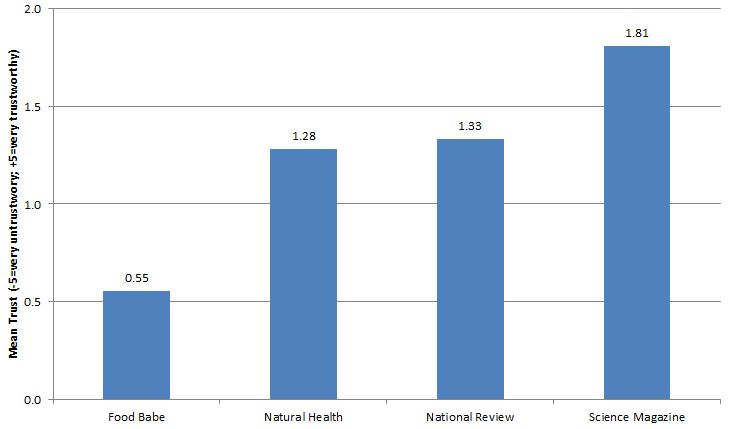
We asked all respondents, “How trustworthy or untrustworthy do you consider each of the following news sources for information regarding food?” They responded on a scale from -5=very untrustworty to +5=very trustworthy. Science Magazine was the most trusted with a mean response of 1.8. Next was National Review at 1.33 followed by Natural Health at 1.28. Far behind (and statistically significantly lower) was the Food Babe at 0.55.


Despite the fact that the Food Babe was the least trusted source of information, in the treatment where individuals could chose which information they wanted to read, 25.4% chose to read the article from the Food Babe. The only source chosen more often was Science Magazine (picked by 40.5% of respondents). Natural Health was picked by 19% and National Review by 15.1%.