Blog

Looking for a Faculty Position? Agricultural Economics vs Economics

‘Tis the season for economics job hunters.  The annual ASSA meetings kick off tomorrow, brining together, for a few days, what is probably the largest collection of economists in the world (scary, I know!).  The meeting also marks the start of the job market for academic economists.  For a variety reasons, agricultural economics departments have increasingly moved hiring to coordinate with the ASSA meetings, and agricultural economics departments appear to be more apt these days to hire new faculty from general economics programs.

There is ample advice for prospective job market candidates online (this paper by John Cawley is among the best), and I won’t attempt to add to it here.  Rather, the purpose of this post is to provide a bit of perspective for job market candidates from traditional economics departments who may be considering jobs in agricultural economics. 

There are two main factors that create different incentives for faculty in agricultural economics departments compared to faculty (often just down the hall) in general economics programs. 

The first is funding.  The existence of separate agricultural economics departments stems from federal and state monies specifically allocated for agricultural research and education.  Unlike general economics departments, where revenues to the department primarily flow from general university revenues, agricultural economics departments have federal dollars for research (these are often referred to as “Hatch” or “experiment station” funds”) and extension or outreach activities (these are often referred to as “Smith-Lever” or “extension service” funds), which are then matched with funds from the state government where the university resides.  This is what people are referring to when they talk about “Land Grant” universities – the dedicated, funded, missions not just for teaching, but for applied research and outreach and extension. 

The second differentiating factor is the promotion process.  Typically, faculty seeking tenure and promotion in an agricultural economics department must ultimately be evaluated by a committee made up of faculty and administrators in a college of agriculture or natural resources.  This can be contrasted with assistant professors in general economics programs who go on to be evaluated by other faculty in colleges of business or colleges of arts and science.  This distinction implies that faculty in agricultural economics departments, when going up for promotion, are more likely to be evaluated by “bench” scientists running labs.

These two combined factors go on to create different outcomes and incentives for faculty in agricultural economics departments than in general economics departments.  Here are a few that come to mind:

  • In general, faculty in agricultural economics departments teach less than in general economics department.  The reason is straightforward: agricultural economics faculty are literally paid to spend their time doing other things (research or outreach). 

  • The expectations to bring in grants is higher in agricultural economics departments than in general economics departments.  This differential incentive stems from the aforementioned evaluation by “bench” scientists at the college level but also from greater availability of funding for agricultural research, the differential incentives to focus on applied problems, and the closer connection to companies, farm groups, and NGOs in the agricultural sector that fund research. 

  • In the “quality”-quantity tradeoff, agricultural economists will normally face greater incentives to generate “quantity” than will a faculty member in a general economics department.  The reasons are multi-faceted including the need to show productivity and returns on grant dollars, the greater interest from immediate stakeholders (think farmers, policy makers, agribusinesses) in applied research results, and the evaluation by “bench” scientists who tend to have many more publications.  By the way, this incentive shows up in salary differentials (see this paper by Gibson and Burton-McKenzie showing salaries in agricultural economics departments are positively related to the quantity of journal articles, but numbers of papers (after adjusting for “quality”) have no independent effect in general economics departments; see also my co-authored paper with Tia and Mike Hilmer comparing salary structures between econ and ag econ programs).

  • In the previous bullet “quality” is in scare quotes because in general economics programs “quality” often means only one thing: publication in one of the so-called top five journals.  I won’t get into the tyranny of the top five, except to say that quality has a broader definition in many agricultural economics departments.  Part of the reason is that an agricultural economist often has a broader audience for their work, including non-economists, policy makers, farmers, agribusinesses, etc.  Sometimes this results in greater impact.  For example, general interest science journals, and interdisciplinary science journals, often have much higher impact factors than do the “top five” economics journals, and this is considered differently in agricultural economics departments that, on the margin, are more focused on applied results with real-world impact (at least in our narrower domain).

  • In agricultural economists, it is relatively more common to have journal articles with many co-authors, and to include graduate students in publications, than is the case in among general economists.  Again, this partially stems from the closer connection to “bench” scientists, who include everyone in the lab who worked on the project on the publication.  Another incentive at play is that agricultural economists are more likely to work on multidisciplinary problems with ecologists, animal scientists, agronomists, etc. who bring different expertise to problems, resulting in papers with more co-authors. 

  • In agricultural economics departments, there is often greater incentive to focus on more local issues relevant to the region and state where the university resides.  Federal monies must be matched with state dollars, and the political support for providing the state dollars indirectly relates to the willingness of faculty to work on issues deemed relevant to local stakeholders.

  • The extension mission in agricultural economics departments can often be among the most mystifying difference to students coming out of general economics departments, which typically have no such explicit mission.  One way to think about it is that faculty with extension appointments have class as well, it’s just that their students are farmers, local government officials, agribusiness managers, etc. and agricultural economists reach these “students” in non-traditional ways by going out to their meetings or writing newsletters or doing podcasts or media interviews. Another potential way to think about extension or outreach work is the model of economist as consultant, where the goal isn’t to publish an academic paper, but to take the academic knowledge and convert it into decision aids, tools, white papers, etc. that improve managerial and policy decision making.

I hope these few thoughts help add some clarity for folks from general economics programs who may be considering employment in an agricultural economic department.  Agricultural economics departments are a great place to work, where there are tangible rewards to working on real-world issues affecting a sector of our economy that touches every living person through our dinner plates.   Good luck with the job hunt!   
2019 in Review

Happy New Year!

In keeping with tradition, I thought I’d review a few highlights from last year, 2019.

2019 marked the first year in almost a decade when I didn’t have significant service responsibilities with the Agricultural and Applied Economics Association (AAEA). Nonetheless, time seemed to fill up with new responsibilities. Last year, I served on advisory boards or committees for organizations such as U.S. Department of Agriculture; Manna Partners; Council for Agricultural Science and Technology (CAST); National Pork Board; Noble Research Institute; and Veylinx, among others. I gave a large number of outreach presentations and talks, with the most noteworthy being testimony to the U.S. Senate Committee on Agriculture, Nutrition, and Forestry on issues facing the livestock and poultry sectors.

Last year was another productive research year. I’ll have authored or co-authored 20 peer-reviewed journal articles with a 2019 publication date, including articles in Economic Inquiry, Journal of Behavioral and Experimental Economics, Applied Economic Perspectives and Policy, and Food Policy, among others. Some highlights include a new review article on experimental auctions in the European Review of Agricultural Economics with Canavari, Drichoutis, and Nayga, a sole-authored piece in Journal of Economic Behavior and Organization on rationality, food choice, and income, and a paper exploring how people discount the future for decisions that involve their own outcomes vs. outcomes affecting others in the Journal of Risk and Uncertainty with Rong, Grijalva, and Shaw. I’ve got a couple grants and planned research on neuro-economics and consumer acceptance of gene editing (with Vincenzina Caputo and Marco Palma) and effects of changing cattle size and composition on consumer demand for beef (with Josh Maples, Glynn Tonsor, and Derrell Peel).

It’s also been a busy year in the Department of Agricultural Economics at Purdue. We were saddened at the untimely passing of one of our colleagues, Wally Tyner, and we celebrated the retirements of Otto Doering and Micheal Wetzstein. We were fortunate to hire two new endowed chair faculty members and begin searches for a couple new positions. The Department is celebrating it’s 100th year anniversary, and it’s been fun to reminisce about the past and strategically plan for the future (alumni, be on the lookout in the near future for a special issue of our annual print edition of Keeping Track).

Here on the website, there more than 106,000 pageviews in 2019, and there were 34 new posts. The number of page views is up significantly from the past couple years, but I fell below my goal of one post per week. Pressing administrative duties have eaten into time for blogging, but I’ll renew my goal for 2020 - about one post a week.

The most popular posts from last year were

Hope you have a great 2020!

Food Price Inflation is on the Rise Globally but Steady at Home

That’s the title of my short contribution to the 2020 Outlook Issue of the Purdue Ag Econ Report. The whole thing is below.

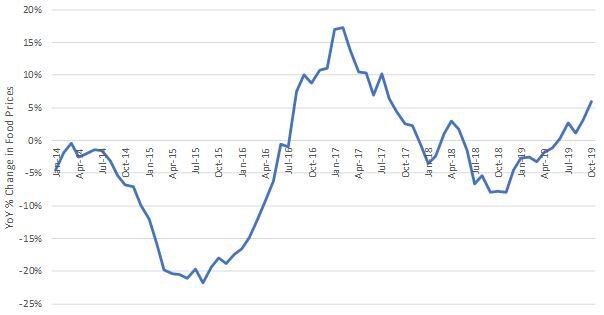
After a steady decline in global food prices throughout most of 2017 and 2018, this summer in 2019, prices began to rise. In October 2019, the last date data are available, global food prices rose 6% relative to the same month a year earlier. It has been more than two years since prices rose at this pace. The recent global food price spike is primarily caused by rising meat prices, which have increased more than 10% in each of the last two moths relative to the same months in 2018. Reductions to the supply of pork in China, due to African Swine Fever, have played a major rule in contributing to the upswing in global food prices. Reports of rising prices of onions in India and supply disruptions in Turkey and Nigeria are additional contributors. Still, the 6% year-over-year monthly increase in global food prices is modest in historical terms. From March 2007 to March 2008, global food prices rose 58%, and after falling more than 30%, rose again by almost 40% in mid-2011.

In the United States, retail food price inflation has remained modest over the past year. From October 2018 to October 2019, prices of food away from home increased 3.3% and prices for food bought for at home consumption increased only about 1%. The USDA Economic Research Service is projecting an overall annual inflation rate for food consumed away from home of between 2% and 3% for both 2019 and 2020. More modest annual inflation of 0.5% to 1.5% is projected for food bought in grocery outlets for at home consumption. These figures are low in historical terms, but are slightly higher than the annual retail food inflation experienced over the past three to four years. Annual inflation rates for food away from home were 2.9%, 2.6%, and 2.3% and for food at home were -1.3%, -0.2% and 0.4% in 2016, 2017, and 2018, respectively. Helped by lower commodity prices, food at home prices have risen at a rate slower than overall non-food price inflation, which averaged about 2.1% per year from 2016-18.

Year-over-Year Percent Change in Global Food Prices (source: United Nations Food and Agricultural Organization)

Year-over-Year Percent Change in Global Food Prices (source: United Nations Food and Agricultural Organization)

What to Expect in 2020

My colleagues and I have pulled together the 2020 Outlook issue of the Purdue Ag Econ Report. Contributions include:

  • Our Long, Slow, Steady Expansion Should Continue by Larry DeBoer

  • Trade and trade policy outlook for 2020 by Russell Hillberry

  • 2020 Outlook: Farm Policy by Roman Keeney

  • Food Price Inflation is on the Rise Globally but Steady at Home by Jayson Lusk

  • Farmland Market Outlook for 2020 by Todd Kuethe and Craig Dobbins

  • Increase in Indiana cash rent seems unlikely in 2020 by Criag Dobbins and Todd Kuethe

  • More milk, consolidation continues, but still an improved 2020 price outlook by Nicole Widmar

  • 2020 Purdue Crop Cost & Return Guide by Michael Langemeier and Craig Dobbins

  • 2020 Corn Price Outlook by James Mintert and Mindy Mallory

  • 2020 Soybean Price Outlook by James Mintert and Mindy Mallory.

Check out the whole thing here.

Food Spending by State

There seems to be a insatiable desire for information on regional food consumption patterns, fed by click-bait headlines fueled by dubious data sources. To help provide some “hard” data on this topic, about three years ago, I wrote a post about how meat demand varies by state. The graphs I presented then came from data collected from the Food Demand Survey (FooDS) we ran for five years, and they relate to measures of demand, not consumption.

I’ve been receiving a large number of emails in recent months about this post, which suggests even more demand for this type of information than I’d originally anticipated. Unfortunately, a big challenge is that there is no good, easily accessible, publicly available data on food consumption by U.S. state.*

Given the apparent interest in the topic, I turned to data collected by the Bureau of Labor Statistics (BLS) Consumer Expenditure Survey (CES). With special permission, one can access state-level consumer spending on food, but anyone can access their representative consumer spending data by U.S. census region. Here, I delve into that data to provide insights into how food spending varies by the nine Census regions they report.

First, here is data on total annual spending on food by region. Consumers in the Pacific Region (Alaska, California, Hawaii, Oregon, and Washington) spend the most on food at $9,166 annually in 2017-18, whereas consumers in the East, South Central Region (Alabama, Kentucky, Mississippi, and Tennessee) spend the least at $6,807/year.

CEX_fig1.JPG

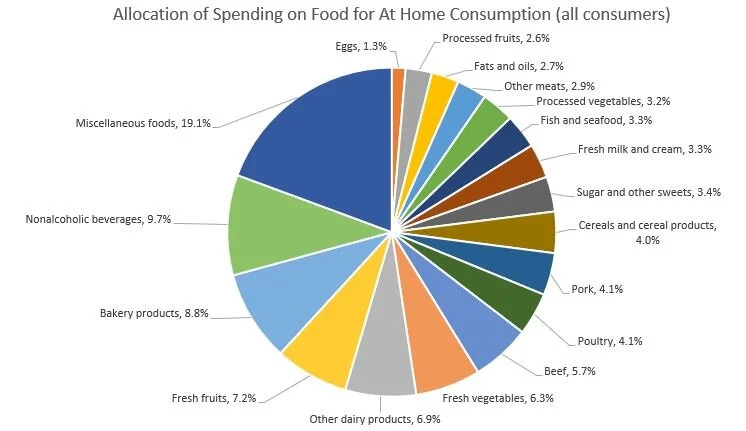
According to these data, on average about 43.6% of spending is on food to be consumed away from home (e.g., at restaurants), whereas 56.4% is spending for food to be consumed at home (e.g., spending at grocery stores). The BLS does not segregate data on spending on food away from home by the type of food, but it does so for spending on food to be consumed at home. Of the spending on food to be consumed at home (e.g., spending at grocery stores), the figure below shows the breakdown for the “average” food consumer. 19.1% of “at home” food spending is for “miscellaneous foods” and the next biggest category is nonalcoholic beverages (9.7%) and then bakery products (8.8%). Combined, all meat products including beef, pork, poultry, and fish account for 21.6% of at home food spending, and all dairy products account for another 10.2%.

The main reason for delving into these data is that they provide information on regional differences in food spending patterns. To explore these issues, I calculated the at food expenditure shares for each of the nine census regions, and then calculate the percent difference in expenditure share for a given region compared to the “average” consumer in the U.S. Here are some breakdowns, starting first with spending on beef as a share of all spending on food at home.

Differences in Spending on Beef by Region.

Differences in Spending on Beef by Region.

Consumers in the South West Central region (Arkansas, Louisiana, Oklahoma, and Texas) allocate 16.2% more of their at-home food budget to beef than does the national average food consumer, whereas on the other extreme, New England consumers (in Connecticut, Maine, Massachusetts, New Hampshire, Rhode Island, Vermont) allocate about 8.7% less of their food budget to beef than does the national average food consumer.

The following shows similar figures for pork and poultry. Whereas consumers in the Upper Midwest allocates a higher than average share of their food at home food budget to beef and pork, consumers there allocate 21.1% less of their food at home budget to poultry as compared to the average national food consumer.

Differences in Spending on Pork by Region

Differences in Spending on Pork by Region

Differences in Spending on Poultry by Region.

Differences in Spending on Poultry by Region.

Turning from meat items, here is data on relative spending on fresh fruits and fresh vegetables by region, which is higher in the West and New England.

Differences in Spending on Fresh Fruit by Region.

Differences in Spending on Fresh Fruit by Region.

Differences in Spending on Fresh Vegetables by Region.

Differences in Spending on Fresh Vegetables by Region.

What about items that are often considered “unhealthy” like sugar and sweets and fats and oils? Spending on sugar and sweets is 27.3% higher in the Mountain region as compared to the average consumer, and spending on oils and fats is relatively highest in the East South Central Region.

Differences in Spending on Sugar and Sweets by Region.

Differences in Spending on Sugar and Sweets by Region.

Differences in Spending on Fats and Oils by Region.

Differences in Spending on Fats and Oils by Region.

The BLS CES reports spending on alcoholic beverages as a separate category from food at home or food away from home. Across all consumers, about 7% of food spending (either at home or away) is on alcoholic beverages. The variation across region is shown below. Spending on alcohol (as a share of total food spending) is positively correlated with spending on fresh fruits and fresh vegetables (as a share of spending on food at home), as alcohol spending is highest in the West and New England.

Differences in Spending on Alcohol by Region.

Differences in Spending on Alcohol by Region.

Finally, here is spending on food away from home as a share of total food spending. Consumers in the South West Central Region (Arkansas, Louisiana, Oklahoma, and Texas) and in the West spend 4% more on food away from home as a share of total food spending as compared to the average food consumer.

Differences in Spending on Food Away from Home by Region.

Differences in Spending on Food Away from Home by Region.

Readers who want to further explore the differences in regional spending patterns can access the BLS CES data here.

*The USDA Economic Research Service (ERS) reports data on per-capita “consumption” (this is actually “disapperance data, which infers consumption based on production, minus exports, plus imports, plus or minus net change in storage), but this is only at the national level. There are some other datasets which provide more local information on food purchases or consumption, but they are proprietary. Examples include grocery store scanner data by Nielsen or IRI. There are publicly available data, like the National Health and Nutrition Examination Survey (NHANES), which have information on location and food consumption, but it often requires significant data analytic abilities or special permission to make use of these data to explore state or regional trends.