Blog

Meat and Egg Prices Following the COVID-19 Outbreak

The declaration of a national emergency on March 13, 2020 by President Donald Trump, and the corresponding state stay-at-home measures, caused significant disruptions in retail food markets.  Aside from take-out, many consumers were suddenly unable to dine at restaurants and food service establishments away from home, which according to U.S. Department of Agriculture data, represents about 54% of all food expenditures.  As a result, consumers turned to grocery stores and supermarkets, where the increase in demand, coupled with concerns about future reduced mobility and scarcity, led to a surge in foot traffic and sales. 

              For the week ending March 22, 2020, the number of trips to grocery stores and supermarkets increased 39%, and during each trip, consumers purchased about 12% more items, and spent, in aggregate, about 61% more as compared to the same week one year prior.  Fresh meat and frozen food sales led the increase in dollar sales.  Pork sales increased 101%, beef sales increased 95%, and chicken sales increased 70% for the week ending March 22, 2020 as compared to the same time period in 2019. 

meatsales_covid19_new.JPG

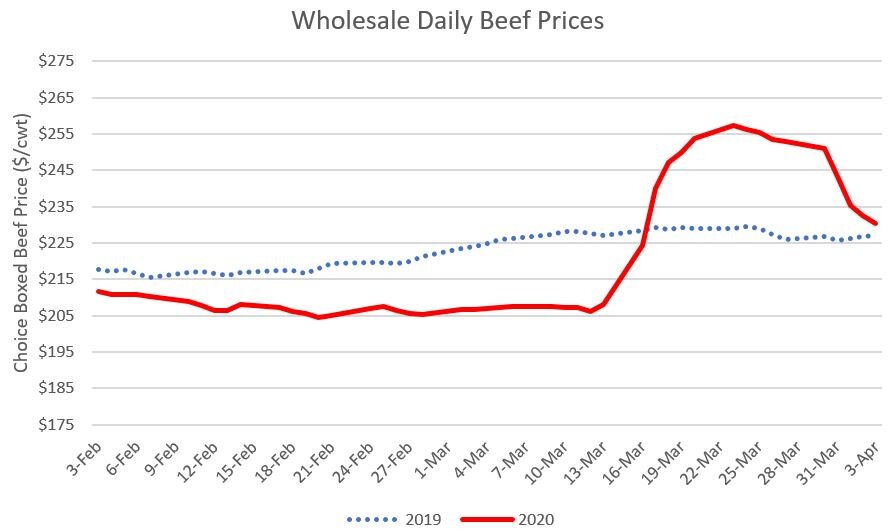
      Increasing food prices suggest the increased demand in grocery establishments appears to have more than compensated for the lost demand at restaurants, at least in the short run.  The figures below report U.S. Department of Agriculture data made available by the Livestock Marketing Information Center on wholesale prices of pork, beef, chicken, eggs.  In each of these cases. wholesale prices began dramatically rising at about the time President Trump declared the national emergency.  For example, wholesale pork prices jumped almost $20/cwt from about $65/cwt in early March to just under $85/cwt by mid-March.  For beef, wholesale boxed beef prices increased about $50/cwt, going from about $205/cwt to over $255/cwt.  Wholesale chicken prices increased a bit over $10/cwt over this same time period.  However, as the figures reveal, the price pressure has already started to subside for beef, pork, and chicken.  In fact, for pork and chicken, price levels are near or below what was experienced at the same time last year. 
wholesale_beef_price.JPG
wholesale_pork_price.JPG
wholesale_chicken_price.JPG

The case of eggs reveals a different story.  Wholesale egg prices were about $1/dozen in early to mid-March 2020, approximately in line with prices at the same time in 2019; however, prices have nearly tripled since that time, and by the week ending April 4, 2020, prices were $3/dozen, with the increase showing no sign of slowing yet.  A number of explanations have been offered for the price run-up in the egg market including consumer perceptions about the necessity of eggs and their longer shelf life relative to other animal proteins, dynamics associated with Easter egg buying, legal barriers that prohibited easy re-sale of eggs headed for restaurant markets to grocery, and the high degree of concentration in the egg production industry.

wholesale_egg_price.JPG

The increases in wholesale meat prices were not initially met with corresponding increases in farm-level hog and beef prices, causing consternation among some producers.  Going forward, increased concerns about illness spread in packing houses is likely to reduce processing capacity, further exasperating this problem, putting downward pressure on livestock prices.  A paper by Glynn Tonsor and Lee Schultz suggests a 20% reduction in processing capacity due to COVID-19 plant shutdowns could reduce cattle prices by 26% and hog prices by 36%. As they note, these effects may already be “baked in” to future’s prices. Moreover, coming into 2020, animal inventories were high, leading to large projected total meat and egg production for the year.  Temporary stocking-up behavior on the part of consumers buoyed demand in the short run following outbreak of COVID-19, providing a respite to the downward price pressure expected for 2020.   However, the loss of restaurant sales, coupled with reduced consumer incomes from a likely recession, and export markets for meat products being hard hit by COVID-19 suggest the general downward price movements witnessed in cattle and hog markets may continue even if wholesale prices rebound should processing capacity be adversely affected by disruptions associated with COVID-19.  
What does COVID-19 tell us about the economics of food waste?

Several months ago, I’d agreed to write an article about food waste, and I’m now finally finding the time (thanks to all the event cancellations) to start writing.

It strikes me that consumers’ food buying behavior in the wake of concerns about COVID-19 reveals much about the economics of food waste. Fearful of reduced mobility and shortages, foot traffic in grocery establishments has increased markedly, leading to stock-outs and empty shelves for many basic foodstuffs. As a result, many consumers have expressed fear and frustration over the stock-outs.

However, prior to the onset of the pandemic, stores were optimizing with the intent of preventing over-stocking. Just-in-time delivery and effectively managed inventories help control costs, and at the same time grocery outlets were also under pressure to adopt such measures (beyond mere profit reasons) to help prevent waste of perishable food items. A system designed to help prevent food waste, however, is not well suited to withstand the large, temporary demand spikes like that seen after COVID-19 hit.

Whatever qualms consumers have about food waste, they were apparently overwhelmed by a more urgent sense of need to stock pantries and refrigerators irrespective of whether some items might later be thrown out. Moreover, if we are under stay-at-home and quarantine measures longer, presumably, we will find ways to store, utilize, and eat the items we’ve stocked up on should scarcity reign (I don’t think it will).

As this discussion helps illustrate, food waste is the result of a complex equilibrium affected by consumers (e.g., preferences for convenience, expectations about the future prices and availability, and food safety concerns) and producers (e.g., cost of holding inventory, cost of transportation and storage affecting temporal and geographic arbitrage opportunities, and liability and reputational concerns) in addition to other factors such as government regulation and technology.

Even in normal times, we may want a little “excess” food in the system, that may go to waste, as a kind of insurance against unexpected events like the one we’re now living through.

A Roundup of Resources: COVID-19 Impacts on Food and Agricultural Markets

With restrictions on travel and in-person meetings, it has been encouraging to see my agricultural economics colleagues take to thew web with a wealth of information for farmers, the food industry, and consumers. Here is a non-exhaustive list of applied research and outreach that might be useful.

  • Larry DeBoer from Purdue provided some comments on possible macro-economic impacts at the onset of COVID-19 in the U.S.

  • Jim Mintert and Michael Langemeier from Purdue will host a webinar on April 1 on the spring crop outlook in light of COVID-19 events and USDA report releases.

  • This piece from Ken Foster and Mike Boehlje at Purdue entitled “Managing in Times of Financial Stress” is as relevant today as it was when it was first written in the wake of the Great Recession

  • Roberto Gallardo from Purdue released this publication with some interesting data on rural American's ability to work from home, broadband access, and in the midst of COVID-19.

  • Some estimated impacts of COVID-19 on local and regional food markets by Dawn Thilmany, Becca Jablonski, Deb Tropp, Blake Angelo and Sarah Low.

  • Trey Malone and Aleks Schaefer from Michigan State hosted a discussion yesterday “to answer the difficult questions the coronavirus global pandemic is having on our food supply chain and the economy.” (I haven’t seen a recording of this posted yet, but will put a link to it if I find it).

  • Brian Briggeman, Dan O’Brian, Glynn Tonsor, and Mykel Taylor from Kansas State are hosting a series of upcoming evening Zoom meetings on impacts of COVID-19 on the macroeconomy, grain markets, livestock markets, and land markets.

  • Derrell Peel from Oklahoma State and Josh Maples from Mississippi state hosted a webinar on COVID-19 And cattle markets this past Thursday.

  • The Farmdoc team at the University of Illinois is hosting a webinar series to discuss the impact of the coronavirus on Midwest agriculture each Tuesday and Friday at 12pm EDT.

  • Diane Charlton of Montana State talks about labor issues in agriculture on NPR’s Planet Money.

  • Since my post last week on coronavirus and food markets, I’ve been inundated with media requests discuss the subject (see a few quotes in the New York Times, Bloomberg, etc.). I’ve taped segment for ABC’s 20/20 and Freakonomics that should air some time in coming weeks.

Addendum

Several new resources have come in during the past couple days. I won’t try to keep this list up to date indefinitely, but wanted to mention a few more helpful resources.

  • Dawn Thilmany at Colorado State and Laurian Unnevehr, formerly with USDA-ERS, gave a webinar on economic impacts of COVID-19 on food manufacturers.

  • Here is Marin Bozic from University of Minnesota on COVID-19 impacts on dairy markets.

  • A CNBC segment on COVID-19 and food supply featuring Derrell Peel at Oklahoma State, among others.

  • I chatted with Dani Nierenberg of FoodTank.

Impacts of Coronavirus on Food Markets

Last week was a whirlwind of trip and event cancellations, movement of courses online, and the dusting off of emergency and contingency plans. This week is likely to bring more social-distancing and quarantining measures. The ultimate toll and impacts of the coronavirus are highly uncertain at present.  Nonetheless, it might be useful to speculate a bit about impacts of coronavirus and the events surrounding it on food markets. 

1. Grocery buying behavior. It has been fascinating to watch online, and in my own local grocery stores, which items consumers are choosing to stock-up on.  The run on toilet paper, for example, seems on the surface of it, downright irrational.  After all, COVID-19 does not cause digestive issues.  As irrational as the initial movement to toilet paper may seem, it isn’t crazy for subsequent consumers to then stock up too.  After all, it doesn’t take much for a reasonable person to see that if all other consumers are buying up all the toilet paper, that they’d better off getting theirs before none is left.  There is a long and interesting economics literature on information cascades and herding behavior, which shows that even if you disagree with what other people are doing, it is sometimes sensible to go along with the crowd.      

Much of the information we have at this point on which items are stocking-out is anecdotal, but there do seem to be some common trends in what I see in my own local stores and commentary online.  For example, it seems many of the new plant-based burgers are being left behind while the rest of the meat case is being cleared (see here or here).  I was surprised to see in my own local store, that virtually all the beef was gone (except for a bit of ground beef), about half the pork was gone, and chicken was plentiful.  This must say something about people’s psychology to go for the highest-price, perishable produce in this time of panic; that or differences in supply chain issues, but more on that later.  In other aisles, rice and pasta went quickly, presumably for issues related to the long shelf life, should quarantining result.  Still, I noticed what was left in those aisles were the gluten-free options and the lesser-known brands or unusual flavors, suggesting stock-outs are related to item popularity.  I hope we can learn more about this behavior after the fact. Unfortunately, it’s difficult to study stocking-out phenomenon because stores are usually well stocked, and because grocery store scanner data only shows us what people bought, but we can’t see what people didn’t buy because it wasn’t available.

2.       Stock-outs and supply chains.  The New York Times ran a story yesterday with the heading “There Is Plenty of Food in the Country.” I largely agree.  The stock-outs we are seeing now are likely temporary disruptions resulting from consumers pulling forward buying behavior in anticipation of future reduce mobility.  But, it’s unlikely people will eat more in aggregate because of the coronavirus.  Thus, this is largely a temporal adjustment in buying behavior with smaller effects on aggregate food demand. 

However, there could be more serious food market disruptions. Some of the stock-outs and slowdowns in grocery check-out lines are because employees are staying at home and practicing social-distancing.  This problem is likely to grow if more people become ill. So, while we might have the food supply available, will we have the workers to get it to us?  

Now, take a step back in the supply chain, and this is where worker issues could have serious issues.  Remember all the fervor over the beef packing-plant fire back in August?  While the impacts was counter-intuitive to many producers, the economics were straightforward: an unexpected disruption in supply depressed cattle prices and boosted wholesale beef prices.  It isn’t far-fetched to imagine worker illnesses getting to the point that plants have to temporarily shut down on a scale that is at least as large as the August-fire, which removed about 5% of the nation’s beef processing capacity.  One difference is that destroying a plant via fire is not the same as temporarily closing plants due to lack of healthy workers; one resulted in a long-term price adjustment while the latter is more likely a temporary price fluctuation.

One thing that makes me nervous even about temporary closures, if large scale, is the animals that have been placed to be market-weight in the next few weeks.  While feedlot cattle can likely remain on feed a few weeks longer with relatively small changes in profitability, that is less true for hogs, and particularly chickens.  Meat supply chains are optimized for efficiency and low-cost production, not necessarily for flexibility and resiliency.    

A signal to keep an eye on is the amount of meat in cold storage (the data currently available are lagged by at least a month).  The buying behavior we’re seeing now is likely to pull meat out of storage and onto our dinner plates.  However, that boost in domestic demand is likely to be offset by reductions in foreign demand, and the coronavirus has hit hard some of our biggest export markets.

The flip-side of this is that we rely on imports from China for a variety of consumer goods, and this trade is likely to be disrupted by coronavirus. I’ve often been critical of the local foods movement, but it’s times like these that highlight some of the benefits of localization and heterogeneity in the food supply chain.

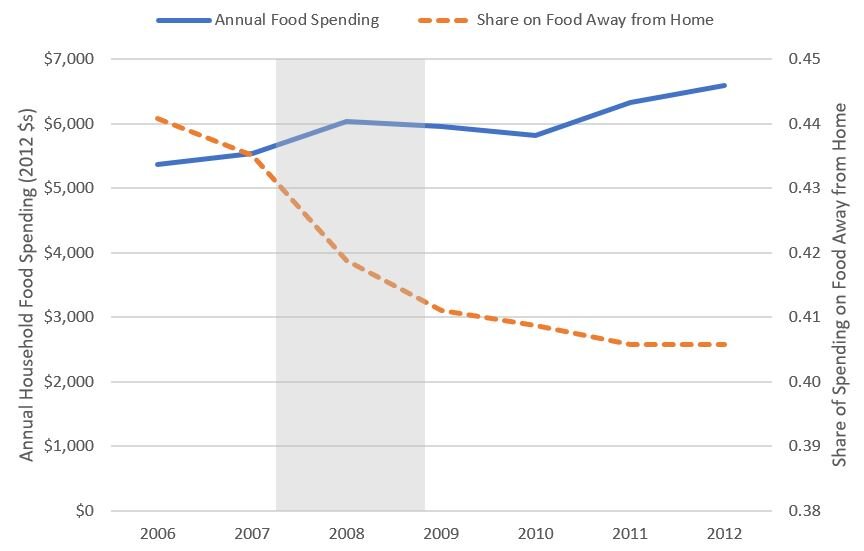
3. Recession. Given the reaction of the stock-market and the disruption to normal business and spending activity, the chances of a recession are high.  The “Great Recession” in 2007-09 had significant impacts on food spending, particularly spending on food away from home.  Here are data from the Bureau of Labor Statistics Consumer Expenditure Survey.  These data show food spending at home only declined slightly after the recession, but the share of spending that occurred outside the home (at restaurants, etc.)  fell from 0.44 to 0.41. 

foodspendingrecession.JPG

It is also interesting to look at how spending on different types of food changed during the Great Recession.  The figure below shows spending on food eaten at home (plus total alcohol spending).  All at-home food spending increased in 2008 before falling in 2009, but the increase was smaller for beef and pork, which implies the share of food spending on these items fell over this period.  Spending on alcohol took the biggest hit.  By contrast, spending on fruits and vegetables, cereal and bakery, and dairy, fared pretty well during the last recession.

spendingrecession_byfood.JPG

There is an old saying that “generals are always fighting the last war.”  Likewise, it is probably wise not to focus too much on the past recession to predict how consumers might respond to one potentially caused by the coronavirus.  Nonetheless, the pattern of reduced spending on food away from home is already occurring, and meat demand is typically thought to respond significantly to income, which suggests, at least in these two cases, the pattern may re-emerge. 

During the past recession, rates of food insecurity spiked. There are concerns about impacts of school closures on childhood food security, and the USDA is considering policies that will allow delivery of free school lunch and breakfast to low income children even in instances where schools are closed.

4. Population. A couple months ago, I discussed the role of population in affecting food demand.  I was writing then about the fact that birth rates have been falling, and indicated a smaller population would put downward pressure on food prices and farm incomes.  Unfortunately, a global pandemic like the coronavirus has the potential to reduce the world’s population (or at least slow the increase). For example, estimates suggest the flu pandemic in 1918 sickened about 27% of the world’s population and killed about 2 to 3% of the world’s population at the time. Estimates of the potential number of deaths from the coronavirus are all over the board, but the greater the number of “excess” deaths, the greater the reduction in aggregate food demand. On the up-side, all this social-distancing and self-quarantining means many more couples will be home together. We may need to hang on to all those hospital beds for the new babies that will arrive in nine months.

Holy Chicken!

Morgan Spurlock’s newest documentary, available on Amazon, is Super Size Me 2: Holy Chicken! I wasn’t a big fan of the 1st edition of Super Size me, and I was expecting this one to fall into the sensationalized, muckraking, one-sided story telling I tend to associate with many food and agricultural documentaries. Yes, there was some of that, but overall I was surprised how much I liked about the film.

The documentary is mainly about Spurlock’s efforts to create a healthy-seeming fast food restaurant selling chicken sandwiches. Oh, and he decides to source and raise the chickens himself, using mainly the conventional production methods employed throughout the industry. One could quibble with some of the claims and comparisons, but I thought the documentary did a reasonably good job accurately showing how modern broilers are raised.

The best aspect of the documentary was the exposure of the ridiculousness of many food marketing claims and the health halos that such claims create. It was fascinating to see the ways fast food companies position themselves to create the aura of healthiness and wellness. To be sure, many fast food companies are indeed offering healthier items than in the past and have made efforts to improve healthiness of kids meals, etc., but it is also the case that a lot of effort has also gone into creating the illusion that a lot of what we’ve been eating all along is today somehow healthier.

From an economic standpoint, there is one bone to pick with the documentary. Spurlock is quite critical of the so-called tournament system that is used to pay the broiler producers (or chicken farmers as Spurlock calls them) who feed out birds for Tyson, Pilgrim’s, Perdue, Sanderson, and the other major chicken companies. Under this system, the performance of one producer is compared to a group of others, and pay is determined by how one’s performance compares to their peers. It is impossible not to feel sympathy for the farmers Spurlock interviews, and I have no intimate knowledge of the veracity of claims about whether the tournament system is used to retaliate against producers who do not toe the party line. As the documentary notes, there are ongoing lawsuits related to the use of the tournament system, and I presume the courts can sort out whether there is legitimate evidence of wrongdoing.

However, the documentary portrayed the tournament system in a one-sided way that made it seem a contrivance only to benefit the big chicken companies. What was missing is a discussion of a key motivation for the use of the tournament system, which rests on very solid economic principles. In particular, the tournament is a potential solution to something called the principal-agent problem. The “principal” (e.g., a company like Tyson) owns the birds and supplies the feed and other inputs to the producer (the “agent”). The problem is that, without high cost, Tyson can’t directly observe how much effort the producer puts into caring for the chickens Tyson owns; it is also difficult for Tyson to observe managerial talent and acumen, which (contrary what the documentary suggests) can have big effects on productivity. When such effort or talent can’t be easily observed or directly rewarded, there is little incentive for producers to put forth high effort. A tournament has the potential to better solve this problem of information asymmetry and induce high effort and high productivity, and thus lower chicken prices for the final consumer. I touched on this a while back when discussing The Meat Racket (see also Aleks Schaefer’s excellent review), which was highly critical of the tournament system.

I wonder if there won’t be other ways that evolve to help solve this principal-agent, asymmetric information problem? With all the sensors, tracking, and data analytics that are being created for agricultural applications, the cost of effort and quality monitoring might eventually fall, albeit in ways that might be perceived as encroaching on privacy. Profit-sharing is another mechanism that is sometimes used to help solve principal-agent problems that might have some application here. If the concern is that the tournament is being manipulated in some way, that seems like a problem that could be solved with a third-party verification system. All this is a way of saying that a lawsuit or legislation might do away with the tournament system, but it won’t remove the underlying problem of asymmetric information.