Blog

Who are the vegetarians?

One of the challenges researchers face in trying to learn about the characteristics of vegetarians is that there are so few of them.  I've seen estimates that put the percentage of vegetarians in the US population as high as 13%, but most estimates are closer to 5%.  That means that if one does a survey that has 1,000 respondents (which is a pretty typical sample size for pollsters), you'll only have about 50 vegetarians in the sample - hardly a large enough sample size to say anything meaningful.

We've been running the Food Demand Survey (FooDS) for 19 months now, and each monthly survey has over 1,000 respondents.  I took the first years' data (from July 2013 to July 2015), which consists of responses from over 12,000 individuals.  This sample is potentially large enough to begin to make some more comprehensive statements about how vegetarians might differ from meat eaters in the US.

Applying weights to the sample that force the sample to match the population in terms of age, gender, region of residence, etc., we find that 4.2% of respondents say "yes" to the following question: "Are you a vegetarian or a vegan?", which means that 95.8% say "no".  

There is some sampling variability from month-to-month, but overall, the trend in the percentage of respondents declaring vegetarian/vegan status has remained relatively constant, and if anything, has trended slightly downward over time.

So, how do self-declared vegetarians/vegans differ from meat eaters?  The following table shows differences/similarities in socio-economic and demographic characteristics.

Some of the biggest differences appear for age, race, overweight status, and politics.  Vegetarians tend to be younger, less white, skinnier, and more liberal than meat eaters.  Two unexpected results are that vegetarians indicate a much higher rate of food stamp participation (which is a bit surprising since the share of households with >$100K in income is higher for vegetarians than meat eaters) and a much, much higher rate of food-borne illness.  

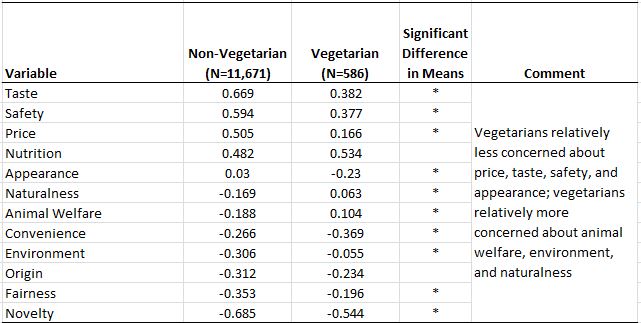
In our survey, we also measure respondents' "food values" (for detail on the approach, see this academic paper we published).  This approach requires people to make trade-offs (they cannot say all issues are most important).  Respondents are shown a set of 12 issues and are asked to place 4 (and only 4) of them in a box indicating they are the most important issues when buying food, and to also place 4 (and only 4) issues in a box indicating they are the least important issues when buying food.  We measure relative importance by subtracting the share of times an item appears in the least important box from the share of times it appears in the most important box.  Thus, relative importance is on a scale of +1 to -1, and average scores across all 12 items must to sum to zero.  

Meat eaters tend to rate taste and price as relatively more important food values than vegetarians.  Vegetarians tend to rate animal welfare and the environment as more important food values than meat eaters.  Even still, vegetarians rate nutrition, taste, price, and safety as more important food values than animal welfare or the environment.  
The survey also shows people a list of 16 issues and respondents indicate how concerned they are about each issue (1=very unconcerned to 5=very concerned).  As the table below shows, vegetarians are more concerned about all issues than are meat eaters, even an issue like GMOs which is (at present) primarily a plant issue.  The difference in level of concern between vegetarians and meat eaters is particularly large for gestation crates, battery cages, and farm animal welfare.  

Given some previous discussion on the economics of Meatless Monday, I ran some statistical models to determine whether vegetarians tend to spend more or less on food than meat eaters.  

Without controlling for any differences in income, age, etc. that were found in the initial table above, I do not find any statistically significant differences in spending patterns.  Meat eaters report spending about $94/week on food eaten at home and vegetarians report spending about $3 less (a difference that isn't statistically significant); meat eaters report spending about $46/week on food eaten away from home (e.g., at restaurants) and vegetarians spend about $9.80 more (a difference that isn't statistically significant).  Even after I control for differences in income, age, etc., I do not find any significant differences in food expenditures between vegetarians and meat eaters.  The biggest determinants of food spending is income (high income individuals (>$100K in income) spend $35/week more away from home than low income (<$40K in income)) and household size (larger households spend more).  Younger people spend about the same as the older on food a home, but spend more eating out than do the old.  

Economics of Meatless Monday

I ran across this article published last week by Katey Troutman entitled the Economics of Meatless Monday, which cited some research by Bailey Norwood and me on vegetarianism.  

The article makes a number of good points, but also some that are a bit off base.  After discussing per-capita beef consumption in US, the author writes:

New trends in consumption, however, suggest that things might (slowly) be changing; per capita consumption of meat in the U.S. has fallen in recent years, though we still consume more meat than either our parents or grandparents did, according to The Huffington Post.

Americans are choosing to eat less meat, or in some cases, turning to an entirely vegetarian diet, for a number of reasons. Animal welfare activists champion vegetarianism as a way of boycotting factory farming and animal cruelty, while environmentalists point out the environmental benefits of forgoing meat. Still other Americans belong to religious traditions which either forbid or look favorably upon vegetarianism, particularly those which originated in ancient India, such as Buddhism, Hinduism, and Jainism. Yet worldwide many people are vegetarian for an entirely different, often overlooked reason: economics.

The author, however, never discusses the the biggest economic reason why per-capita consumption of meat is down.  Is he supply-side not the demand-side.  As I've previously discussed, cattle inventories are at the lowest levels they've at been in decades, largely because of drought and prior high feed prices, resulting in substantially higher beef price.  To put it plainly: consumers are eating less beef because there is less beef being produced.  The fact that prices have risen dramatically means many consumers still want the now scarcer beef and are bidding up the price for available supplies.

I don't see much evidence of a rapid rise in vegetarianism.  For over a year and a half, we've conducted a monthly survey of US consumers as a part of the Food Demand Survey (FooDS).  Self-declared vegetarians have been at about 4-5% of the sample since it began (and this is probably an overstatement given other research suggesting people "over-declare" vegetarian status) with no evidence of a trend.  Unlike the claim in the article that vegetarianism in general and meatless Monday in particular will save you money, my analysis of the FooDS data shows that self-declared vegetarians spend the same amount of money on food at home and on food away from home as do meat-eaters.  

The author also writes:

Jayson Lusk and Bailey Norwood, perhaps the first researchers to study the economics of vegetarianism, concur with advocates of eating less meat. In their 2009 study they found that “it is significantly more expensive to produce a pound of meat (or milk) than a pound of commodity crops.”

I suppose it's nice to be pointed out for being one of the first to tackle a subject (the published paper is here; there were some mistakes in the published paper that are corrected in this document).  The key word in the above quote, however, is "commodity crops."  As I've noted in the past, people generally don't like to eat the commodity crops directly, and if you look at the cost of non-commodity crops (for example, see this USDA study), they can be more expensive on a per-calorie or per-gram-of-protein basis (think about the cost of lettuce on a $/kcal basis).  Finally as we argue in our published paper, economics is about more than just cost, it also involves value, and most Americans are willing to pay quite a bit to have meat in their diet.  

How Animal Welfare Labeling Affects Egg Purchases

A couple of weeks ago in Slovia I saw a presentation of a paper authored by Alexander Schjøll, Frode Alfnes, and Svein Ole Borgen.

The authors conducted an interesting experiment with a Norwegian grocery store chain called REMA 1000 to see how different labels and information campaigns changed sales of cage vs. cage-free eggs.  

For the first part of the study, the authors simply changed labels.  At the beginning of the study, the "battery" or caged eggs simply had the descriptor "12 farm eggs."  The authors replaced this with a new carton that had "BATTERY HENS" printed in large letters in mid 2011.  The new cartons also had the following text in smaller font (translated from Norwegian):

From 2012, you can only buy eggs from barn systems at REMA 1000. Eggs from hens in cages, as these, are not available from 2012 for purchase in REMA 1000 stores. Battery hens live in cages with little opportunity to move freely. Hens living in barn systems can move indoors in environments similar to their natural environment. This contributes to good health and welfare. REMA 1000 knows you are concerned about quality. We believe animals that thrive provide the best ingredients.

The authors looked to see what happened when the new labels were introduced, and watched sales for about 6 months.  Then, at the beginning of 2012, the grocery chain completely removed the "battery" cage eggs from their stores.

So, here are the key questions:

  • Did shoppers respond to the label change?
  • Did the label cause people to switch to cage-free barn eggs or to the even more expensive organic with more stringent standards?
  • What happened when the "battery" eggs were completely removed?  Did sales of organic jump or did they just shift to the next lowest price alternative, the "barn" system?

Here is a graph with the results.

The authors write (in a newer version of the paper I couldn't find online):

In mid-July, REMA 1000 introduced its new battery egg package in some stores, and had a nationwide rollout of the new package in August 2011. As shown, the market share of battery egg packages fell from 54% in June to 28% in September 2011, after varying between 51% and 61% in the month before the introduction of the new package. From September 2011, the sales of battery eggs were relatively stable until they were finally withdrawn from the market at the end of the year.

On January 1, 2012, the retail chain removed battery eggs from its shelves. . . .

The market share for organic eggs remained constant both when the negative battery egg cartons were released and when the battery eggs were removed from the stores.

I interpret this to mean that these consumers viewed the cage, "battery cage" and cage-free "barn" eggs (what these authors call indoor free-range) as close substitutes.  This is also supported by the fact that the authors also note that total egg sales did not much change when the labels were added or when the battery cages were removed.  That primarily means, most people just paid more for eggs (although the authors do not report any information on the relative prices of the eggs).

Other experiments in the store looked at various posters and displays that tried to increase organic sales, but as the authors report, none of them had any substantive effect.

Are there any implications we can draw from this experiment for what is going on in California - assuming that their ban on sales of battery cage eggs withstands legal challenges?  

The above experiment suggested that about 25% of consumers in Norway willingly switched from cage to cage-free eggs when they had added information.  However,  about 30% of consumers still preferred the cage eggs when these were remove from the store. These 30% of consumers were essentially "forced" to buy a higher price option that they didn't previously pick (I use the word "forced" loosely because the consumers presumably could have chosen not to buy eggs at all).  It's hard to know how big the economic loss was for this 30% without knowing more about relative prices, quantities purchased, and consumer characteristics.  Where these 30% on the lower or upper end of the socio-economic ladder? 

Biggest food policy developments of 2014

Over at Reason.com, Balyen Linnekin has a post where he asked several "experts" to indicate what they thought were the

most interesting food-policy development so far this year—for better or worse—and where they see us heading for the rest of the year.

He asked me to contribute, and I tried to think of a topic that would likely be ignored by others and yet might have non-trivial effects on consumers and agricultural producers.  Here was what I had to say:

After California voters passed an initiative in 2008 banning certain livestock production practices, notably battery cages in egg production, the California legislature, fearful that its poultry producers would now be at a competitive disadvantage, passed a law requiring imported eggs to meet the same standard. Earlier this year, the Missouri attorney general (now joined by five other states) filed a federal lawsuit challenging the California law. Proponents of California's law point to state's rights to set their own minimum quality standards. Opponents posit that the law violates the federal interstate Commerce Clause and they argue that farmers and ranchers should be free to sell to consumers in any state, presuming they can find willing buyers. The outcome could have significant implications for states’ abilities to set their own food safety/quality standards and for the free trade of agricultural products across state lines.

Other commentators mentioned things like the new nutritional labeling standards, the implementation of the food safety modernization act, raw milk and feral hogs, and sriracha.  It seems we all ignored the new farm bill.

I liked this comment on my statement:

So, California is arguing for states' rights (What, are they racist?!), and their opponents are citing the interstate Commerce Clause, hoping that the federal courts will use it to protect an individual's right to buy or sell what they want.

Did I wake up in Bizzaro World this morning?


State Egg Battles

The New York Times ran an article yesterday about the egg battle going on in California.

Here's the issue:

California voters set new standards for hen housing in 2008 when they approved a ballot measure that imposed more generous living conditions for egg layers in their state. When producers complained that the measure created a competitive disadvantage, the Legislature tacked on a law that mandated imported eggs be produced under the same standards.

It's the second action - the legislative prohibition against certain types of eggs coming into California - that has the attorney general of Missouri complaining about an interstate commerce clause violation.  California imports a little less than half the eggs it consumes from other states.  Missouri, in particular, supplies about 540 million eggs a year to California. Thus:

The Missouri attorney general has filed a lawsuit to block the California egg rules, and at least three other states are considering doing the same. The beef and pork lobbies are also lining up against the California rules in an effort to prevent any new restrictions on raising livestock.

The attorney general says: 

“I recognize that the California district courts and the Ninth Circuit have not been particularly friendly to this sort of assertion we’re making here, but I also have confidence that will not be the last word on this analysis,” he said. “The U.S. Supreme Court is unlikely to allow a state to put this type of trade barrier in place in the agricultural arena or any other arena.” 

The briefly article discussed the potential price impacts of the new standards for California citizens.  I wished it would have spend a bit more time talking about consumer demand for "cage free" eggs and the interplay between market outcomes and regulated outcomes.  

The market share for cage free eggs in California was only about 10% and yet Prop 2 (which essentially banned the cages) passed with 63% of the vote.  If the population of shoppers is the same as the population of voters (which it isn't), this would mean about 53% of Californians voted to ban a product they regularly buy.  This "vote-buy" gap is not well understood, and we're working on research now to get a better handle on why and under what conditions it emerges.