Blog

The News and Our Misperceptions of Risk

As news reports continue to circulate on the safety of pork and now on animal welfare and fracking, it is useful to step back and consider how we humans perceive and respond to risk.    

I happened to have recently picked back up Kahneman's book Thinking Fast and Slow, and he summarizes some interesting research on these topics.  First on page 138 after showing results from Slovic's research that people were really bad a judging the relative risks of dying from different cases, Kahneman concludes:

The lesson is clear: estimates of causes of death are warped by media coverage.  The coverage is itself biased toward novelty and poignancy.  The media do not just shape what the public is interested in but are also shaped by it . . . Unusual events (such as botulism) attract disproportionate attention and are consequently perceived as less unusual than they really are.  The world in our heads is not a precise replica of reality; our expectations about the frequency of events are distorted by the prevalence and emotional intensity of the messages to which we are exposed.

That last sentence is revealing: the key to creating a public panic is to 1) make the issue emotional and 2) repeat the message so that it is readily available in people's memory.   A few pages later (p. 142), he develops this idea further when discussing Sunstein's research:  

An availability cascade is a self-sustaining chain of events, which may start from media reports of a relatively minor event and lead up to public panic and large-scale government action.  On some occasions, a media story about a risk catches the attention of a segment of the public,k which becomes aroused and worried.  This emotional reaction becomes a story in itself, prompting additional coverage . . . The cycle is sometimes sped along deliberately by 'availability entrepreneurs,' individuals or organizations who work to ensure a continuous flow of worrying news.  The danger is increasingly exaggerated as the media compete for attention-grabbing headlines.  Scientists and others who try to dampen the increasing fear and revulsion attract little attention, most of it hostile: anyone who claims that the danger is overstated is suspected of association with a 'heinous cover-up.'  The issue becomes politically important because it is on everyone's mind, and the response of the political system is guided by the intensity of public sentiment.  The availability cascade has now reset priorities.  Other risks, and other ways that resources could be applied for the public good, all have faded into the background.

Beware of the availability entrepreneur.  

How Many Labels Are Too Many?

One of my bright former students sent me these pictures today.  Are each of these labels actually contributing new information?  What is the company trying to communicate?  Amazing that so much can be claimed on one package! Here are the claims:

1.       Grass-fed 

2.       Organic

3.       Animal-friendly (Certified Humane)

4.       Non-GMO

5.       Real California Cheese

6.       American Cheese Society winner

7.       No artificial hormones or pesticides (written on back)

8.       Milk from local family farms (written on back - ironic since this picture was taken in Illinois and they claim real California cheese)

cheese1.JPG
cheese2.JPG

What Do Cage Free Eggs Have to Do with Gay Marriage?

Brandon McFadden, one of my inquisitive Ph.D. students, stopped by today and asked if I'd looked at the county-by-county breakdown of the vote on Proposition 37 on mandatory GMO labeling.  I hadn't, so we pulled up the maps.

Here is the county-by-county outcome for Prop 37 on mandatory GM labeling.

Prop37outcome.gif

Brandon astutely pointed out that this map looked very similar to  the one on the gay marriage proposition back in 2008 (a no vote on Prop 8 was essential a vote in favor of gay marriage).

prop8outcome2008.gif

Back in 2008, there was also a ballot initiative (Prop 2) that (in essence) banned battery cages in egg production.  This map also looks very similar to the one above on Prop 8 in 2008.  So, Brandon down loaded the data from Prop 2 and Prop 8 in 2008 and did a little analysis somewhat like one we conducted earlier (the final voting tallies for Prop 37 aren't yet available in downloadable format).

Here is what he found:

(fraction of county voting for Prop 2 in 2008) = 0.326 + 0.572 x (fraction of county voting NO on Prop 8).

A hypothetical county with everyone voting no on Prop 8 (for gay marriage)  would be expected to have 32.6+57.2=89.8% voting yes on Prop 2 (for banning battery cages).  By contrast, a hypothetical county with everyone voting yes on prop 8 (against gay marriage  would be expected to have  32.6% voting yes for prop 2 (against banning cages).  

This little equation explains a remarkable 87% of the variation in voting outcomes associated with Prop 2!  A vote against Prop 8 was almost a guaranteed yes vote for Prop 2.  The people who want gay marriage are apparently also the same people who want cage free chickens.  

So, that raises the question I posed as the title of this post: What do cage free eggs have to do with gay marriage?  I might similarly ask: What does GMO labeling have to do with gay marriage?

Ostensibly, gay marriage has nothing to do with eggs or GMOs.  Yet, there seems to be a clear underlying factor (probably political ideology) that is driving votes on all three issues.  But, the facts on these propositions are so very different that is hard to imagine most reasonable people falling in line on all three.  

The results seem to suggest interesting areas of research related to political ideology and food choice.

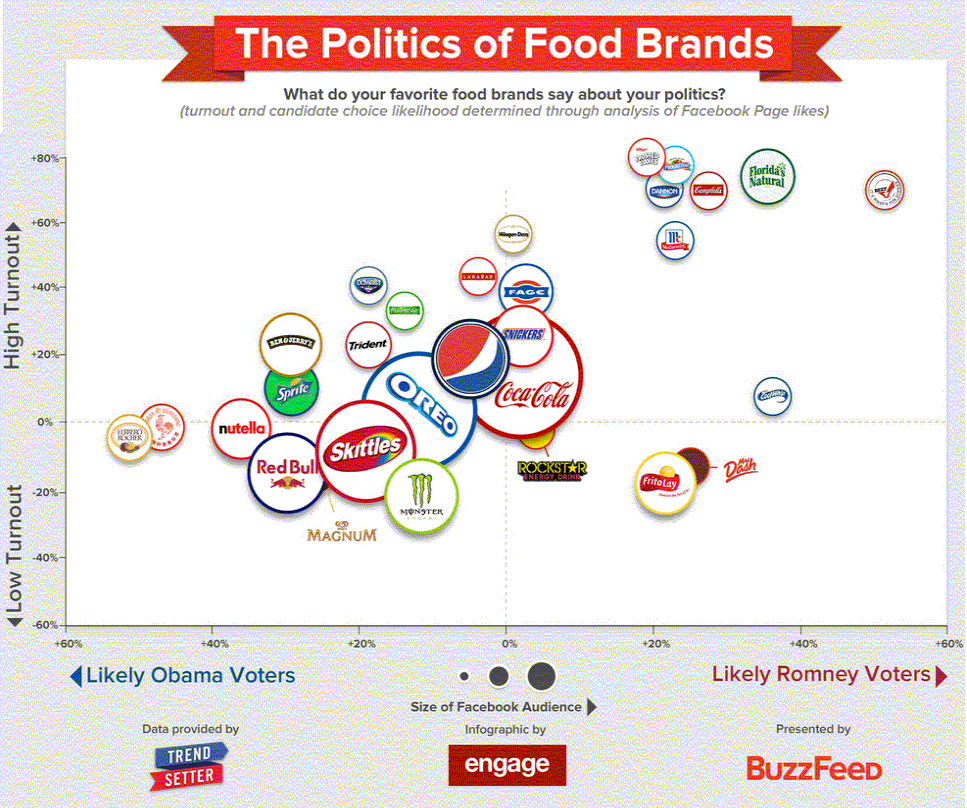
A Little Election Eve Fun

Apparently McDonald's is the most bi-partisan restaurant chain and Coca-Cola is the most bi-partisan food brand. 

Which do you think are the most left- and right- leaning?

Check out the following charts from this web page

politicsfoodchain.gif
politicsfoodbrand.gif

Neuroeconomics of Food Choice

The Chronicle of Higher Education ran a piece last week on the need for more neuroeconomic research.  

While I am a bit unsure of where the field is heading (and in some cases it is over-hyped), I do think there are fascinating things to be learned.   That's one of the reasons why I'm involved in a project with researchers at KSU, UMKC, and KU-med, where we are studying how people make choices between foods produced with controversial technologies while observing their brain responses via fMRI.  The ability of plant and food scientists to innovate depends on people's acceptance of technologies, and I'm hopeful that we can provide insight into this matter.

Right now we have 50 observations collected (which is actually quite a large sample size for an fMRI study), and we are in the process of writing up several papers.  So stay tuned for our findings.

In the meantime, I'll leave you with the optimistic closing sentences from the Chronicle article related to whether economist shoulds be spending their time on neuro-imaging: 

The only way to find out, he says, is to do it. And if it works, if a model of a mental process improves an economist's ability to predict what people will do, "then I think neuroeconomics could be very big."