Blog

Trends in demand for plant based meat

There continues to be high interest in plant-based meat alternatives and speculation about impacts of the emergence of these alternatives on traditional beef, pork, and chicken demand.  This past summer, I discussed the results of a consumer study conducted to address some of these issues, but the results relied on pre-pandemic survey data.  Have consumer preferences changed?  And, how might the emergence of plant-based alternatives affect the entire portfolio of animal-based protein offerings?

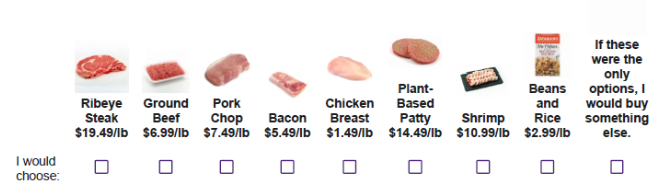
As a follow up to the Food Demand Survey (FooDS) I ran monthly for over five years, Glynn Tonsor and I have been running the monthly Meat Demand Monitor (MDM) since February 2020.  The MDM contains a series of 9 simulated grocery shopping choices where people indicate which, if any, protein product they’d buy at different price levels when shopping. Below is an example choice.
mdm1.png

As you’ll notice in the above question, one of the choice options is a plant-based patty.  Every month, Glynn has released results of the MDM survey reporting the percent of times the plant-based patty is chosen out of this set of 8 meal options (plus a ninth “none of these”).  Say what you may about the merits of survey questions, but the advantages of tracking surveys is that we can at least see if there are significant trends or changes from one month to the next. Below is a graph showing the trends in market shares of two of the items over time. 

mdm2.png

Throughout 2020, plant-based patties have consistently been chosen about 3% of the time in comparison to ground beef, which is chosen about 24% of the time.  The ~3% market share for plant-based patties is much smaller than the estimates I’d previously reported from my study with Ellan van Loo and Vincenzina Caputo.  Part of the explanation for the discrepancy is that the the choice set used in the MDM contains many more options, so of course the share of any one item is likely to be smaller.  The other explanation could be that people who choose plant-based patties might have instead chosen something other than ground beef. That is, some of the people who would choose a plant based patty in a binary choice between ground beef and plant-based instead choose something different, like a chicken breast, when presented a larger set of meal options. 

To explore this issue in a bit more detail, I took the data from the August through December 2020 versions of the MDM associated with retail grocery choices (all the data and description of underlying methods is here). The data consist of 36,018 choices made by 4,002 consumers (a bit under 1,000 each month).  I estimated a choice model that allows for flexible substitution patterns and utilize the estimates to predict which options people would choose in different conditions.

At the average price levels, I predict about 3% of consumers would choose the plant-based patty.  This isn’t surprising as it simply confirms the findings in the figure above.  Here is perhaps a more interesting question.  Of the roughly 3% of consumers who chose the plant-based patty: what would they have chosen instead if the plant-based patty wasn’t available?  The model-based prediction is below.  Perhaps somewhat surprisingly, about the same number of people would have instead have chosen chicken breast as ground beef.  Only 6% were predicted to have not have chosen one of the other items on this list. 

mdm3.png

What about price elasticities?  The model suggests that for every 1% reduction in the price of plant-based patties, there is a 3.08% increase in market share of plant-based patties (this is the own-price elasticity of demand).   This same 1% reduction in the price of plant-based patties would reduce the market share of bacon and shrimp by about 0.12% each, reduce the market share of ribeye and pork chops by about 0.10% each, and ground beef by about 0.08% (these are the cross-price elasticities).  Thus, the estimates suggest very little substitution caused by small marginal price changes.

Some of the above results stem from the fact that, based on current market data, the plant-based patty had an average price of $11.99lb whereas ground beef was assumed to be $4.49/lb.  What if both were priced at $4.49?  Assuming this dramatic price reduction for plant based, the model predicts the market share for plant-based would jump from about 3% to about 22%, lagging only chicken breast at 22.1%.  In this scenario, ground beef is projected to take 18% market share.  One caveat is that this scenario presumes a much larger price change than we used in the survey (so it is a projection outside the range of choices we actually observed). 

This is a fluid situation and there remains much to be learned. Along with Ted Schroeder, Glynn and I have recently completed a series of new studies on the possible impacts of plant-based alternatives on beef demand. I hope be able to release those results in the coming weeks.

Consumer preferences for GMOs before and after a ballot initiative

The journal Applied Economics Perspectives and Policy just released a paper I co-authored with Alexandre Magnier and Nicholas Kalaitzandonakes.

In this paper, we study how consumers’ purchase intentions toward non-GMO foods evolved leading up to a 2013 ballot initiative (I-522) which would have required the labeling of GM foods in the state of Washington. We are interested in how demand for non-GMO foods responds to a real-word information shock. As we indicated in the paper:

During the several months leading up to the vote, more than $30 million was spent on TV, radio, press, and social media ads supporting and opposing mandatory GM labeling, making I‐522 the second most expensive ballot issue in the state of Washington. Newspaper articles and editorials, door‐to‐door distribution of pamphlets and street activism added to the information flow on agricultural biotechnology and GM foods Washingtonians were exposed to over this period of time.

We asked Washingtonians to respond to some simulated shopping scenarios using a so-called “choice experiment” related to soymilk. We conducted the same exercise at two points in time: seven months before the vote, in late April and early May 2013; and at the time of the vote, during the first half of November 2013.

We found that consumers’ implied willingness-to-pay premium for soymilk with a non-GMO label (the non-GMO butterfly label) fell from $0.68 to about $0.32, a 53% decline, over this period. There were no significant changes in consumer willingness-to-pay for brand or organic or “natural,” but there was a slight increase in how much consumers were willing to pay for soy milk overall.

The fact that preferences for the non-GMO fell is likely a result of the divergence in spending for the pro- vs. anti-mandatory labeling groups. Of the $30 million spend on campaign advertising, 73% was from anti-mandatory labeling groups. The interesting thing is that information related to the desirability of a ballot initiative appears to have spilled over into affecting demand for individual products on the market.

Several other studies have shown that information affects consumers’ attitudes toward GMOs in surveys and laboratory experiments. What this study shows is that even in the messiness of the real world, information can influence consumer preferences and choices regarding GM foods.

Internalities

Even casual followers of economics understand the concept of externalities. An externality arises when an individual does not consider the cost of their actions on other people. A classic example is a factory that does not consider the cost of their pollution into nearby streams or rivers when setting the price of their outputs. While the concept of an externality is fairly clear, what to do about it is less so (see this piece I wrote back in 2013), but typical answers include everything from assignment of property rights and negotiation to so-called Pigouvian taxes. The externality argument has been used extensively in food debates to argue various food stuffs are “too cheap” and that items like sodas or meat or ingredients like sugar, fat, or calories should be taxed.

I won’t re-has all the pro- and con-arguments for these taxes here, except to say that the common claim that we need to re-consider the “true cost of food” because the externality consists of impacts on Medicare or Medicaid is much less obvious than is typically presumed. The point of this post, rather, is to note that I’m starting to see a new argument enter the debate. Apparently, drinking soda not only causes externalities, but it also cause internalities.

What is an internality? An internality is thought to arise when an individual does not consider the cost of their current action on their future self. This article by Allcott, Lockwood, and Taubinsky in the Quarterly Journal of Economics in 2019 derives theoretical conditions for optimal soda taxes when there are externalities and internalities. As empirical evidence of the presence of internalities, they show that consumers who score higher on a nutrition knowledge test consume less sugared soda than consumers who score lower on the test. They calculate that if all consumers had the same knowledge as that of trained nutritionists, the average U.S. household would consume 31% fewer sugar sweetened beverages. They calculate that, on average, sugared beverages would need to be roughly 1 cent per ounce higher to induce people to consume an amount equal to what they’d consume if they had the same knowledge as a trained nutritionist.

Moreover, because lower income consumers tend to score worse on nutrition knowledge tests, Allcott et al. argue that lower income consumers suffer from greater internalities than higher income consumers. As such, their logic is that a soda tax is not regressive as is typically assumed (since lower income consumers spend a higher share of income on food), but rather these taxes are helpful in “correcting” the lower income consumers’ lack of knowledge as compared to higher income households. In fact, a soda taxes is now thought to be progressive because there is greater “correction” needed for lower income households’ purchases.

The concept seems to be catching on. Earlier this year, Dubois, Griffith, and O'Connell published a paper in the American Economic Review where they conduct some interesting and careful analysis to determine what types of households would be most affected by a soda tax (there are a lot of interesting results in their paper; I encourage you to check it out). Their baseline result seems to confirm the conventional intuition that soda taxes are regressive (i.e., primarily borne by lower income households). According to the paper:

We show that compensating variation [the economic welfare losses] associated with a tax on sugary soft drinks is around 20 percent higher for those in the bottom half of the distribution of total annual grocery expenditure (a proxy for income) compared with those in the top half.

However, after assuming tax revenues are redistributed back to consumers in a lump sum, and employing Allcott et al.’s estimate of the benefits from reduction in internalities, they are able to conclude that soda taxes are (from the abstract):

unlikely to be strongly regressive especially if consumers benefit from averted internalities.

I’m a little unsure what to make of the rise of the internality argument as a justification for soda taxes. On a visceral level, it strikes me as paternalistic: “These poor people just don’t know what’s good for them. Experts are here to help.” That’s probably a bit harsh. We have plenty of evidence that people make mistakes; the whole field of behavioral economics rests on this notion (though, as I argue here, it need not justify new regulation).

Though neither of these papers make the link, this work is very similar to the area of literature on the “value of information” (I discuss much of that theory here). The basic idea is that if people change their purchases when they are more informed, then there is value in the information. Or, rather, there would be a “cost” to forcing people to buy what they did in ignorance now that they know more.

All this is a way of saying: if people suffer from the kind of internality discussed above: why is the right policy response a tax rather than information disclosure or education? Do we have any good studies on how people’s soda consumption changes after being exposed to information on health consequences? How does the “value of information” estimate from those sorts of studies compare to the internality estimates? I’d also note that sodas contain a nutrition facts panel, so the calorie consequences are clearly available for those willing to look. (For those who are interested, here is a seminal paper on the value of information contained in nutrition facts panel by Teisl, Bockstael, and Levy; they also tend to find a higher value of information for lower educated consumers).

I also can’t help but wonder how people would feel if we applied the internality argument to other areas where we know people make choices with objectively false beliefs? Let me give two examples from papers I’ve co-authored just this year.

First, consider this paper co-authored with Ruoye Yang and Kelly Raper. We find that the median consumer thinks 55% of hogs and 57% of chickens raised in the U.S. are given added growth hormones to promote growth. The truth? Zero. Use of added growth hormones is not allowed with these animals. The trouble is that these mis-perceptions distort demand. The results from one of our pooled models suggests that a person who correctly knows the answer is 0% is willing to pay $0.92/lb more for pork or chicken than someone who incorrectly believes the answer is 100% hormone use. According to the internality argument, we’d need to subsidize pork products by $0.92 *0.55 = $0.51/lb to induce the median consumer (who incorrectly believes 55% of pork has added hormones) to consume the same amount of pork as someone with correct beliefs.

Another example is my paper with Lacy Wilson in Food Policy on redundant labels. We find 47% of consumers are willing to pay a premium for non-GMO salt and 41% are willing to pay a premium for gluten free orange juice. These are almost certainly “mistakes”: there is no DNA in salt (and thus it cannot be a GMO) and there is no gluten in oranges. Additional analysis also bears out the fact that these are choices made in ignorance. People who have farm work experience and who have higher scores on a scientific literacy quiz tend to have lower willingness-to-pay premiums for these redundantly labeled products. We find that a person who got a perfect score on our scientific literacy quiz is willing to pay about $0.30 less for a bottle of “gluten free” orange juice than is someone who missed all the questions in the quiz. According to the internality logic, we need to tax orange juice with a gluten free label $0.33 to induce people with the low scientific literacy to consume the same amount of “gluten free” OJ as people with the highest scientific literacy.

How would advocates for an internality-based soda tax feel about advocates for an internality-based pork subsidy or a gluten free orange juice tax? I might imagine an argument that goes something like the following. Well, excessive soda consumption is going to cause real health care costs in the future that people need to consider now; that’s not comparable to “superfluous” harm of over-paying for non-GMO salt or gluten free orange juice or under-buying pork and chicken. But, not everyone who consumes soda will suffer future adverse health consequences and yet all would have to pay the internality tax. By contrast, virtually everyone who pays a premium for hormone free pork or chicken or non-GMO salt is overpaying now. People foregoing pork or chicken because they mistakenly believe these products contain added growth hormones are foregoing those pleasures now. Moreover, these magnitudes can add up across people and over time. For some context, total retail pork expenditures in the U.S. were in the ballpark of $62 billion last year. If there were even a 1% adjustment in purchases because of incorrect beliefs, it would represent a swing in spending of $600 million.

It is clear internalities exist, but I’m less convinced they represent solid justifications for tax/subsidy policy. For one, it’s a slippery slope. As I’ve illustrated above, there are likely lots of things we know very little about and where the “experts” would exhibit different preferences and beliefs than the lay person. Thus, the scope for internality-based taxes strikes me as nearly limitless. There’s also the issue of whether we in fact know enough to focus people’s attention on the “right” things.

While taxes are likely have a more direct and immediate effect on consumption than information policies, my sense is that, philosophically, the right approach to a lack of information is information provision, not taxes. Nonetheless, one must acknowledge, even if you give people the objective information, as my paper with Lacey shows, it simply isn’t the case that everyone will suddenly agree on the same level of consumption. This also suggests, however, a potential flaw in the way these internalities are calculated; we can’t just assume people with high vs. low nutrition knowledge or scientific literacy are or will behave the same in every other respect except for their nutrition knowledge or scientific literacy no matter how many controls we add to our analysis.

Effects of a Ban on Junk Food Advertising

About a month ago, Tamar Haspel re-opened a debate on the merits (or, rather, demerits) of junk food advertising to children in her regular Washington Post column. My intent is not to take issue with anything written there per se, but rather to bring up a dimension to this debate she didn’t address.

Even if accepts the premise that “advertising works”, and increases the rate at which people buy junk food, that knowledge is insufficient to understand the impacts of an advertising ban for at least two reasons. First, what will people consume instead once ads are banned, and what is the cost and healthfulness of the newly purchased items? Second, how will food manufacturers and consumers respond to the ban?

In a paper back in 2014, Vincent Réquillart and Louis-Georges Soler, while very much in favor of policies aimed at promoting healthy eating, do a good job describing the various ways that food companies might respond to advertising bans or taxes. Companies don’t just “sit still.” For example, if a firm can no longer advertise, what happens to the money the previously spend in this way? Perhaps they invest in cost savings technologies that allow them to lower the price of the food, which would encourage additional consumption. Or, unable to compete by advertising, firms may engage in more price competition, again driving down prices and bringing more consumers into the market - presumably the opposite of the intended effect of the policy.

A couple years ago, Pierre Dubois, Rachel Griffith, and Martin O’Connell published a very careful and through paper in the Review of Economic Studies on this very topic by studying advertising on potato chips in the U.K. They found that an advertising ban would lower the share of consumers buying potato chips by about 5.3 percentage points; however, they also estimated that in response to the ban, firms would lower chip prices, which would bring more consumers back to the chip market, making the net effect of the advertising ban only a 4 percentage point reduction on the share of shoppers buying chips.

So far so good if the goal is an overall reduction in chip buying. However, they also showed that the advertising ban (after all the anticipated price changes) would increase consumption of other unhealthy products by about 2.7 percentage points. The problem, as they point out, is that “these alternative snacks are, on average, less healthy than potato chips (their mean nutrient score is 20 compared to around 14 for potato chips).”

They offer a solution to this problem: a broader ban on advertising to include all “junk food,” however it is unclear which foods would be deemed “junk.” And, the broader point remains: there will likely be offsetting price effects, albeit perhaps not large enough to completely offset the impacts of the lack of advertising.

Ultimately, Tamar ends her piece making a moral argument, and insofar as advertisements aimed at kids, she raises some good points. Still, it is important to recognize policies often have unintended effects. Neither companies nor consumers are passive bystanders in the face of policy changes. They respond, and if not in ways that completely offset the intended effects, at least in ways that can significantly dampen the intended effects.

The non-price effects of soda taxes and bans

The American Journal of Agricultural Economics just published a paper I co-authored with Sunjin Ahn, who is a post-doc at Mississippi State University entitled “Non‐Pecuniary Effects of Sugar‐Sweetened Beverage Policies.” (for the non-economists out there, “non-pecuniary” just means non-price).

Here was our motivation for the study:

There is some market evidence that passage of SSB [sugar sweetened beverage] taxes might generate outcomes beyond that predicted by price elasticities (or the pecuniary effects). Non‐pecuniary effects could amplify the effects of a tax, increasing the intended effects of the policy. In particular, the tax (and the debate and publicity surrounding it) could send information to consumers about the relative healthfulness of beverage options and send cues as to which choices are “socially acceptable”
...
Signaling and information effects associated with SSB taxes are only one potential non‐pecuniary effect, and it is possible that some non‐pecuniary factors, such as reactance, could dampen the effects of a tax, and in the extreme could result in outcomes opposite that intended by the policy. ... Reactance is thought to arise from perceptions of threats to individual freedom, among other factors (Brehm 1966). Thus, although it seems clear that non‐pecuniary effects might exist, the size and the direction of the effect is ambiguous.

We tackled this issue by conducting a series of experiments through surveys with consumers. We asked consumers to participate in a series of simulated grocery shopping exercises. Consumers first made choices between beverage options at a given set of prices, and then they were randomly allocated to different treatments where either:

  • A) prices of SSB increased but respondents were not told why,

  • B) prices of SSB increased and respondents were told it was a result of a soda tax,

  • C) prices of SSB increased and respondents were told it was a result of a shortage of sugar beets and sugar cane,

  • D) the size of SSB was reduced but respondents were not told why,

  • E) the size of SSB was reduced and respondents were told the reduction was due to a government ban on large sized sugared sodas, or

  • F) the size of of SSB was reduced and respondents were told the reduction was due to a plastic shortage.

By comparing how choices of SSBs change when people were told prices or size changes were a result of a policy vs. other non-policy factors, we can get a sense of the size and direction of the non-pecuniary effects.

When conducted our first study in 2016, we found significant results related to the SSB taxes. In particular, our results suggested people who were told price changes were a result of a tax were more likely to choose SSB than people who were not given a reason for the price change. We certainly weren’t the first to find such an effect. Here is a bit about previous research on this topic:

Just and Hanks (2015) argued that consumers might respond with resistance when a new policy obstructs their ability to obtain their preferred option. They argued that the phenomenon arises because consumers are emotionally attached to consumption goods, resulting in reactance. Policies perceived as paternalistic might cause consumers to “double down” on purchases of forbidden or restricted goods (Lusk, Marette, and Norwood 2013). Just and Hanks (2015) constructed a model in which controversial policies such as a sin tax could lead to an increase in the marginal utility for a good, potentially leading to increased consumption even if prices rise. In addition, Hanks et al. (2013) found that demand for unhealthy foods under a tax frame increased while the demand for subsidized healthy foods fell. Similarly, Muller et al. (2017) found that almost 40% of low‐income individuals increased their share of expenditures on unhealthy food after an unhealthy food tax.

When we sent the paper off for review, we received a number of valuable comments, which caused us to make a number of changes to our experiment, and repeat the study with some extensions in 2019. What did we find with these newer data? On average: nothing, nada, zilch. There was no significant difference in the average market share of SSBs across the various information treatments. However, we did find significant variability in the treatment effects, meaning some people choose more SSBs when they knew it was a tax/ban and others chose less; however, these variations were only partly explained by demographic effects. In summary, our results didn’t provide a clear answer on the question we sought out to address: non-pecuniary effects, to the extent they exist, seem to work in different ways for different people, making the net effect small and hard to identify, at least in our experimental setting.

A note on the publication process is worthwhile. Normally, it is very hard to publish null results. This is problematic for the advancement of science because it results in publication biases like the file draw problem. To the credit of Tim Richards, the journal editor, and the three anonymous reviewers at the American Journal of Agricultural Economics, we received a positive reaction and ultimately, after a more changes, acceptance for publication even though we failed to replicate our previous result and found null effects. This is really an example of peer-review working at it’s best.