Blog

The journey of an Indian onion

That was the subtitle of a recent article in The Economist.  The article tracks the path of an Indian onion from farm to consumer, and in the process reveals a badly antiquated food system in that country.  It also shows how much we consumers in the developing world take for granted.  

There are huge opportunities for efficiency gains associated with storage, transportation, and economies of scale but, as the article reveals, various Indian policies have, to the detriment of Indian consumers, kept out firms like Walmart, Carrefour, and Tesco who have the capacity and know-how.  

According to the article:

wholesale onion prices soared by 278% in the year to October and the retail price of all vegetables shot up by 46%. The food supply chain is decades out of date and cannot keep up with booming demand. India’s rulers are watching the cost of food closely, too, ahead of an election due by May. Electoral folklore says that pricey onions are deadly for incumbent governments.

A year ago it seemed that India had bitten the bullet by permitting foreign firms to own majority stakes in domestic supermarkets. The decision came after a fierce political battle. Walmart, Carrefour and Tesco have been waiting for years to invest in India. 

but

On the ground little has happened. Foreign firms complain of hellish fine print, including a stipulation to buy from tiny suppliers. Individual Indian states can opt out of the policy—which is unhelpful if you want to build a national supermarket chain. In October Walmart terminated its joint venture with Bharti, an Indian group. India has reduced the beast of Bentonville to a state of bewilderment. Tesco has cut expatriate staff

People in the developed world like to complain about Walmart, but I think it says something that any of us would be stunned if we walked into one of their stores and were asked to pay more than a buck or so for an onion.  And, we'd be completely perturbed if there were no onions for sale.  Rarely do we stop and think about the process (and the companies) that have led to such "unnaturally" high expectations.

The Hidden Cost of Cheap Food

The "food movement" has a long and varied history, but it seems to me that much of the force behind the modern calls for action came from writings during the early to mid-2000s (think Supersize Me or Fast Food Nation or Omnivore's Dilemma or Food Politics, which ultimately lead to more recent things like Food Inc and Salt Sugar Fat and Pandora's Lunchbox).   

The interesting thing about this time period is that food commodity prices were historically very low.  As a result, a common mantra developed that goes something like the following.  Food is too cheap.  This cheap food masks costs to health and the environment.  These masked costs represent externalities, and economics tells us that externalities justify government action like food taxes, subsidies, etc.  This line of thinking reached such a level that the CDC and the Institute of Medicine of the National Academies has held a couple meetings on the issue (I participated in one of those; more on that in a moment).   

There are two problems with this like of reasoning.  First, in the US, we witnessed extraordinarily run-ups in commodity prices in 2008 and again in 2011.  Worldwide, food prices are higher today in real terms than has been the case for almost 40 years (e.g., see this UN FAO graph).  One might argue that certain types of foods are "too cheap" but to broadly make such a claim is no longer consistent with the facts.  Second, I think outside circles of trained economists, there is often a deep misunderstanding of the nature of externalities, and even within economic circles a lack of critical thinking about the ability of taxes/subsidies to solve externality problems.  

This second point was the focus of an invited talk that I gave to the Northeastern Agricultural and Resource Economics Association this summer in Ithaca, NY.  That address has been published in the association's journal, the Agricultural and Resource Economics Review.  The paper is now available online.  

Here is the abstract:

Social critics have taken aim at modern production agriculture using a common theme: many food, health, and environmental problems are explained by corporate farms, agribusinesses, and fast-food restaurants failing to account for the full costs of their actions. How accurate is this diagnosis? How feasible is the assumption that these externalities are most effectively mitigated via Pigovian taxes and subsidies? Drawing on my experiences at a National Institute of Medicine meeting on the subject, I seek to clarify the definition and nature of externalities and discuss situations in which public policy is most and least effective in efficiently making "hidden” costs of food visible.

A few snippets:

One of the striking observations that emerged from the conference was
the wide disconnect between the views held by participating economists
and noneconomists about the nature and role of externalities. Among many of the noneconomists, it seemed that any “bad” outcome that resulted from food production and consumption—heart attacks, obesity, the low pay of slaughterhouse workers, soil run-off, animal welfare problems, climate change— was evidence of an externality that required regulation, typically in the form of some sort of tax. I also learned in the process that some of my views about externalities were perhaps a bit unorthodox relative to those of other economists.

and

Clearly, the case for regulating externalities is more complicated than first
meets the eye. Indeed, as the preceding examples illustrate, one is apt to
see externalities everywhere. The sheer abundance of examples that fit the definition of “externality” coupled with our unwillingness to tax them all
away is suggestive. As Coase put it, “The ubiquitous nature of ‘externalities’ suggests to me that there is a prima facie case against intervention”

and I start the conclusions with the following:

This essay arose from my failed attempts to explain externalities to
noneconomists and my desire to challenge fellow economists to think more seriously about the real-world implications of policy advice derived from simple textbook models. In popular writing about food and agriculture, there seems to be a lack of appreciation for the types of externalities that reduce welfare and of the difficulty associated with crafting corrective actions that actually increase the size of the pie. Moreover, the concept of externality is often used to advance a particular cause or point of view. There is a lot of talk about the “hidden costs” of our modern food production system. What about the “hidden benefits?” Failing even to mention, let alone seriously address, that question suggests that one is not willing to think seriously about externalities as anything more than academic-sounding justifications designed to garner enough power and support to enact a faction’s preferred policy.

I learned a lot writing the essay, I hope readers might learn something too.

Is Farming the Future?

A story from CNBC has been making the rounds indicating that students should "Skip the MBA, get an agricultural degree."  As a professor of agricultural economics I'm predisposed to like this argument.  And, personally, I think most ag econ departments offer solid skills that students just don't get in an MBA. 

That being said, I think there are good reasons to take pause.  This argument is being made by Jim Rogers, an investor and hedge fund owner.  For years, he has been saying things like

There’s going to be a huge shift in American society, American culture, in the places where one is going to get rich. The stock brokers are going to be driving taxis. The smart ones will learn to drive tractors so they can work for the smart farmers. The farmers are going to be driving Lamborghinis. I’m telling you. You should start Forbes Farming. 

With a growing world population, and the struggle to continue increases in agricultural productivity, he may be right.  He (probably) has millions betting on this proposition.  But, he may also be wrong, and if history is any guide, he may be very wrong.  

If you think ag is going to be really profitable in the future, buy stock in Monsanto, Bayer, John Deere, Tyson, McDonalds, Brinker, and other food and agribusiness companies.  But my reading of the research suggests that by and large, gains in stocks of agribusiness companies have lagged other industries.  For example, here is a graph of relative returns from an Ag Index developed in this research by agricultural economists, and reported on in this paper (the time period runs from 1970 to 2008) relative to S&P 500.

stocksvsag2.JPG

Investing in ag might be good a diversification strategy, but as strategy to maximize returns, the graph above show it would have been a spectacularly bad bet since the 1970s.  

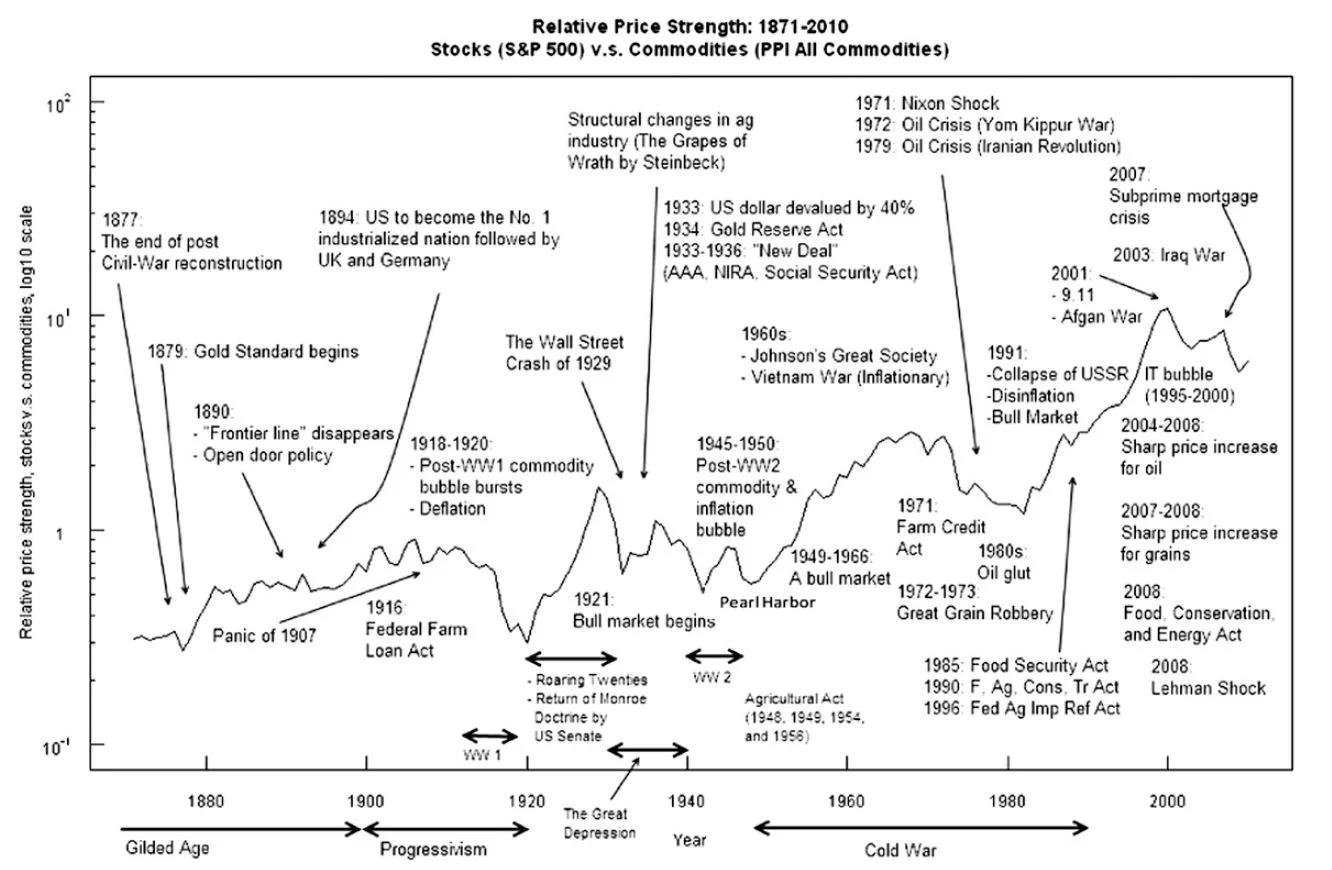
Here is a different perspective in a paper in the Journal of Agricultural and Applied Economics by Zapata, Detre, and Hanabuchi, which shows the price ratio of stocks to commodities from 1871 to 2010.  Again, there are periods where commodities would have provided some diversification benefits, but clearly stocks have generally outperformed commodities over this 100 year time period, as the upward trend indicates.  

stocksvsag.JPG

Just as Malthus under-estimated the potential benefits of agricultural research and technology to keep up with population growth, I think Jim Rogers may be doing the same.

Consumer Attitudes toward Big Food circa 1900

I've been reading an advanced copy of Maureen Ogle's new book, In Meat We Trust: An Unexpected History of Carnivore America .  I'm about half way through, and so far it is fantastic.  

In one section, Ogle writes about Americans' attitudes toward meat packers in the early 1900s:  

Americans insisted on access to cheap food, regardless of its true cost, but believed the worst of those who made that cheap food possible and abundant

Is it any different today?  By the way, when she's referring to "true cost" she doesn't mean externalities - she's talking about the material costs of raising beef and getting it to market, which the average consumer under-estimates.  

She also cited a magazine article written around the same time about by a journalist who actually understood the the effects brought about by the Swift meat packing company:  

“We make great outcry against the concentrated bigness of the packers, yet the probability is that we would make yet greater outcry if the modern system of food supply were suddenly cut off and we were put back on the basis of local butcher-shops.” He was right. in the United States, the mechanisms of food supply were so efficient that they had become taken for granted  —  and when it came to food, Americans took nothing for granted so much as low price. 

They say that the more things change, the more they stay the same.  Here we are a hundred years later, and it remains the case that the mechanisms of food supply are so efficient that they are taken for granted.


What Explains the Difference in the Way Americans and French (and Brits) Eat?

I ran across this fascinating paper entitled "Do Prices and Attributes Explain International Differences in Food Purchases" by Pierre Dubois, Rachel Griffith, and Aviv Nevo that is forthcoming in the American Economic Review (an earlier version of the paper is here; a gated forthcoming version can be found by searching here).

According to the paper, French consumers eat about 1777 calories every day.  Americans, by contrast, eat 2103 calories (UK falls in the middle at 1929).  The differences don't end there.  49% of our calories come from carbs; but for the French its only 38%.  A much larger share of French calories comes from fat than those of us in the US (46% vs. 37%).  When one digs a little deeper - it becomes clear why: The French eat more dairy and oils than Americans.

Now, here is the key question which Dubois and colleagues ask.  Why do people in the US, UK, and France eat so differently?   

The authors consider three possible explanations: 

  1. differences in prices across countries,
  2. differences in the food options available (and nutrient content of foods) across countries, or 
  3. differences in what people like to eat across countries (i.e., differences in preferences).

Their data reveals a number of interesting findings.  For example, even though Americans eat more calories than the French, we spend less money doing so ($426/quarter vs. $466/quarter).  Part of the explanation is that food prices are generally higher in the France than the US, but interestingly, it isn't across the board in the ways one might expect.  Fruit and Veggie prices are similar in the US and France.  But, the prices for dairy, meats, oils, and prepared foods are 31%, 76%,  16%, and 18% lower in the US than France.  Interestingly, sweeteners and drinks are priced 39% and 43% higher in the US than in France.  So, one thing becomes apparent: the French are eating more dairy and oils than we are in spite spite of the higher prices.  They must either really like to eat those foods or there must be more of those kinds of foods in France to choose from (they also eat about the same amount of meat as we do - as a share of calories - despite meats being 76% more expensive it France).   

Ultimately,  Dubois and colleagues find that all the above factors matter.  The author's models predict that Americans consume an average of 2212 calories each day (slightly more than the "raw mean").  Then, the authors make some interesting projections.  They calculate that Americans would:

  • eat 2158 calories if we were exposed to the same food options (or product attributes) as the French
  • eat 1890 calories if we faced the same food prices as the French
  • eat 1841 calories if we faced the same food options and prices as the French

The authors conclude:

The estimates allow us to simulate counterfactual quantities purchased by households with preferences from one country but facing prices and product attributes from another country. We use the simulations to learn about the relative importance of preferences versus the economic environment. We find that, the average US household when faced with French prices and product attributes, will purchase substantially fewer calories, bringing the level close to that of the average French household when faced with the same environment. However, the composition of these calories would differ. The simulated change is mostly due to price differences. In contrast, when we simulate the average US household’s food basket with UK product attributes this has a substantial impact on reducing calories, whereas changing relative prices in fact increases calories. From these findings we conclude that the economic environment makes a substantial difference on the consumption basket. However, in general, it is the interaction of preference, prices and attributes that explains the cross country differences.

I find these results interesting because there are many Americans who seems to subscribe to a view that the French have some kind of moral superiority when it comes to food and weight.  I read these results to say that the French are, in large part, just responding to the economic incentives they face.  And while they consume fewer calories than we do, it isn't all that clear they're better off given that they must pay more for many of the foods they desire than do Americans. 

I'm in Italy for the next two weeks. I wonder what I'll eat differently due to differences in food prices and availability?