Blog

Impacts of Agricultural Research and Extension

About a month ago, I posted on some new research suggesting decline rates of productivity growth in agriculture.  Last week at a conference in Amsterdam, I ran into Wally Huffman from Iowa State University, and knowing he's done work in this area, I asked him if he had any thoughts on the issue.  As it turns out, along with Yu Jin he has a new paper forthcoming in the journal Agricultural Economics on agricultural productivity and the impacts of state and federal spending on agricultural research and extension.  

Jin and Huffman also find evidence of a slowdown in productivity growth, writing: 

We find a strong impact of trended factors on state agricultural productivity of 1.1 percent per year. The most likely reason is continued strong growth in private agricultural R&D investments. The size and strength of this trend makes it unlikely for average annual TFP growth for the U.S. as a whole to become negative in the near future. However, for two-thirds of the states, the forecast of the mean ln(TFP) over 2004-2010 is less than trend. The primary reason is under-investment in public agricultural research and extension in the past. For public agricultural research where the lags are long, it will be impossible for these states to exceed the trend rate of growth for TFP in the near future.

They also find large returns to spending on agricultural research, and even larger returns to spending on extension.  They find the following:

For public agricultural research with a productivity focus the estimated real [internal rate of return] is 67%, and for narrowly defined agricultural and natural resource extension is over 100%. Stated another way, these public investment project could pay a very high interest rate (66% for agricultural research and 100% for extension) and still have a positive net present value. Hence, these [internal rate of return] estimates are quite large relative to alternative public investments in programs of education and health. In addition, there is no evidence of a low returns to public agricultural extension in the U.S., or that public funds should be shifted from public agricultural extension to agricultural research. In fact, if any shifting were to be recommended, it would be to shift some funds from public agricultural research to extension.

The paper includes a couple really interesting graphs on research spending and extension employment over time.  First, they show that for four major agricultural states, real spending on agricultural research peaked in the mid 1990s. 

And, while extension staff has declined in some states, it hasn't in others.  

Why we eat better today

Megan McArdle has an excellent post at Bloomberg review that she titled The Economics Behind Grandma's Tuna Casseroles.

McArdle sets out to explain why we eat differently (and in many ways better) than our grandparents.  Here's my favorite passage:

You have a refrigerator full of good-looking fresh ingredients, and a cabinet overflowing with spices, not because you’re a better person with a more refined palate; you have those things because you live in 2015, when they are cheaply and ubiquitously available. Your average housewife in 1950 did not have the food budget to have 40 spices in her cabinets, or fresh green beans in the crisper drawer all winter.

She also notes that food preference were probably similar in the 1950s as compared to today, it's just that our grandparents couldn't afford to eat the way we now do, and technological changes have made what were previously "fancy" foods available to the masses.  Take, Jello for instance:

The foods of today’s lower middle class are the foods of yesterday’s tycoons. Before the 1890s, gelatin was a food that only rich people could regularly have. It had to be laboriously made from irish moss, or calf’s foot jelly (a disgusting process), or primitive gelatin products that were hard to use. The invention of modern powdered gelatin made these things not merely easy, but also cheap. . . . Over time, the ubiquity of these foods made them déclassé. Just as rich people stopped installing wall-to-wall carpeting when it became a standard option in tract homes, they stopped eating so many jello molds and mayonnaise salads when they became the mainstay of every church potluck and school cafeteria. That’s why eating those items now has a strong class connotation.

There is a lot more at the link and the whole thing is worth reading.

Is the growth in agricultural productivity slowing?

Last week I gave a talk at the University of Nebraska, and Julian Alston from UC Davis was also there.  He presented some recent research with Matt Anderson and Phil Pardey about productivity growth in agriculture.  While I have seen some discussions about the possibility of a slowdown in productivity growth in developing countries, Alston's research suggest it is a phenomenon alive and well here at home.  This is important stuff.  Falling productivity growth has important implications for sustainability, food security, and research and development. They write

We detect sizable and significant slowdowns in the rate of productivity growth. Across the 48 contiguous states for which we have very detailed data for 1949– 2007, U.S. multifactor productivity (MFP) growth averaged just 1.18 percent per year during 1990–2007 compared with 2.02 percent per year for the period 1949–1990. MFP in 44 of the 48 states has been growing at a statistically slower rate since 1990. Using a longer-run national series, since 1990 productivity growth has slowed compared with its longer-run growth rate, which averaged 1.52 percent per year for the entire period, 1910–2007. More subtly, the historically rapid rates of MFP growth during the 1960s, 1970s and 1980s can be seen as an aberration relative to the long-run trend. A cubic time-trend model fits the data very well, with an inflection around 1962. We speculate that a wave of technological progress through the middle of the twentieth century—reflecting the progressive adoption of various mechanical innovations, improved crop varieties, synthetic fertilizers and other chemicals, each in a decades long process—contributed to a sustained surge of faster-than-normal productivity growth throughout the third quarter of the century. A particular feature of this process was to move people off farms, a one-time transformation of agriculture that was largely completed by 1980.

Here's a graph from their paper showing the change in proportional growth rate in yields (i.e., the log of yields) over time for 6 crops with the inflection point indicated for when growth rates began decelerating.  

Breakfast Cereal Economics 101

Yesterday evening I happened to be in the gym while the NBC nightly news was playing on a  screen above my treadmill.  A video of the segment is embedded below.

The premise of the story is that the price of breakfast cereal is on the rise.  As the reporter put it, "sticker shock in the cereal aisle.  The morning staple is getting more expensive."

The story reported that over the past five years, the price of a pound of cereal has increased $0.20 to $3.09.  That doesn't seem like an enormous increase to me.  That works out to a 6.9% price increase over 5 years - or just a 1.4% increase per year (if the price of cereal rose at the same pace as the overall rate of inflation, we'd expect it to have risen by roughly the same amount as it actually has over the past five years).  But, let's leave that aside for now.  I want to focus on the economic arguments made in the piece.

The story says that consumption is down 7% over the same time period.  So far so good.  Prices rise, consumption falls, showing the demand curve is downward sloping.  In econ-speak, we'd say there was a movement along the demand curve.

Where the story runs off the rails is when trying to discuss the causes of the price "spike".  They say "shoppers are looking for healthier and faster food.  They've gone to Greek yogurt, they've gone to power bars, . . ."  The story talks about cereal brands trying to become healthier by adding fiber and cutting sugar.  Then the key phrase at the 1:33 mark:

As the demand for cereal falls . . .

Here's the problem: as we teach in Econ 101, if the demand curve falls (or shifts inward) because of health concerns or change in the price of substitutes then the price will also fall.  But, the whole NBC story was motivated by the fact that cereal prices are rising not falling.

Unless something is happening on the supply-side, falling demand cannot occur at the same time as rising prices.  Either NBC got the facts wrong (cereal prices aren't falling in real terms) or they got the explanation wrong (cereal demand isn't falling but rather the supply curve was shifting).  I suspect the they also did what a lot of students in our intro classes do: they confused a movement along the demand curve for a shift in the demand curve.   

Consider this a friendly lesson in cereal economics 101.

Local foods and seasonal price swings

In the Food Police, I wrote the following about local foods when critiquing the argument that a larger local food system would be better for the environment and for food security:

Because of common weather and temperature, all farms within a region are likely to have their produce come to market around the same time. In a world with regional and international trade, that isn’t a big deal as the surplus can be shipped out to other locations. But, in the locavore’s world, the result is inevitable: spoilage and waste.

...

It would be foolish to invest all your retirement savings in a single stock. The financial experts tell us to diversify. And if we shouldn’t keep all our financial eggs in one basket, the same goes for the real ones. One of the things that makes farming unique compared to other businesses is its unusually large reliance on the weather. An unexpected drought, a rain at the wrong time, an early freeze, or a hail storm can devastate a whole farming community or even an entire region. While farmers protect themselves financially against these kinds of risk by buying crop insurance, what about the food consumer?

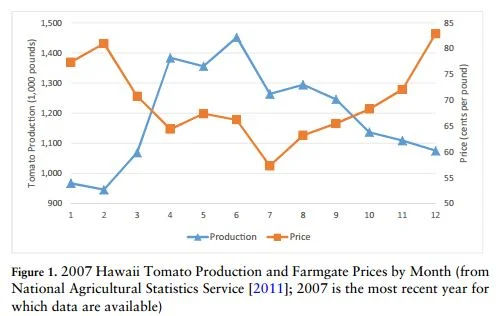
This new paper in the Journal of Agriculture and Applied Economics by some Hawaiian researchers provides some empirical evidence of the price volatility I mention surrounding local foods.  Here's a graph from their paper showing production and prices of local tomatoes over 12 months of the year

There is a very clear negative correlation between production and price.  When tomatoes are "in season" and local producers have a lot to sell, prices are low, and vice versa.

Of course, that inverse relationship is true for most of agricultural production.  But, here's the difference for a lot of local food production: A) with grains you can store the commodity to help smooth out prices over time (something much harder with perishable fruits and vegetables) and B) with trade you can ship to locations with different seasons (where there is less supply and therefore higher prices).

In short, by limiting sales to local consumers, producers are opening themselves up to a lot of potential price volatility, and to lower prices at the exact time they have produce ready to sell.  How can the producers partially mitigate such effects?  Find people in other locations with different seasons with whom to trade.  

The authors write:

It can be seen that local price premiums/discounts vary depending on product type and season. For grape and cherry tomatoes, there is an 18.18% local premium during season 1 (before the peak season). However, starting from season 2 (local peak season), price difference declines and becomes insignificant. On the other hand, there are constant local discounts for other tomatoes throughout the year, although prices are considerably lower in seasons 2 and 3. Comparing the results for both types of product, there is a clear downward effect on prices of local tomatoes during the peak production season, suggesting that market prices are likely influenced by the local production level.

One further contributing factor to the price discounting may be the capacity limitations in marketing and distribution by local producers in Hawaii. Since large national producers with more marketing and logistics competence have access to a larger market, production surpluses can be spread over more market areas with less need for discounting. In comparison, small local farms are often constrained by lack of distribution channels and market outlets (Martinez et al., 2010). In the case of Hawaii, because local tomatoes are exclusively supplied to the Hawaiian Islands, this may result in discounting at the retail level in times of production surplus.

Lastly, the Armington analysis shows that consumer choices with respect to locality and organic origins are elastic, and that both local and organic tomatoes are quite substitutable to import nonorganic tomatoes.