Blog

Factors Affecting Beef Demand

Glynn Tonsor, Ted Schroeder, and I recent completed a report for the Cattlemen's Beef Board on the factors influencing beef demand.  

One of the key factors that emerges from the analysis of the USDA price/quantity data is that beef demand appears to have become less sensitive to price-related factors.  In econ-lingo, beef demand has become more inelastic.  Moreover, changes in pork and poultry prices have fairly small impacts on beef demand.

As a result, we focused on several potential non-price demand determinants.  We find that emerging stories about climate change have adversely affected beef demand, but at the same time increased media focus on taste and flavor have more than compensated for those effects, pulling up demand since 2012.  

We also look at trends from the Food Demand Survey (FooDS) and how they relate to consumers' preferences and beliefs.  Here are some graphs on the relationship between a variety of factors and steak demand.

steak demand.JPG

Here is the same but for ground beef demand.

groundbeefdemand.JPG

Increases in income clearly increase steak demand, but ground beef is demanded similarly by all income categories.  Some of the biggest determinants of beef demand are "food values".  Here's what we have to say about how to interpret those results.

While it may not be initially obvious, results in figure 4.5 [showing the relationship between steak demand and food values] can be interpreted as providing evidence about people’s beliefs about (or perceptions of) steak. Suppose an individual highly values taste. Figure 4.5 shows that such an individual will tend to choose more steak. As a result, it must be that steak is perceived to be highly tasty. By this line of reasoning, figure 4.5 suggests that consumers, on average, perceive steak to be convenient, tasty, attractive, and novel but they also perceive steak to be poor for animal welfare, nutrition, and environment while also being expensive.

There's a lot more in the report.

Don't Want to Eat Pink Slime? Would You Even Know?

It's hard to believe it's been almost five years since the finely textured beef (aka "pink slime")  scandal broke.  To briefly re-cap, by 2012 it had become an industry standard to include finely textured beef with other beef trimmings to make ground beef.  The process enabled food processors to add value, cut down on waste, and increased the leanness of ground beef in an affordable manner.  But, a series of news stories broke, which caused public backlash against the process, and ultimately led to the closure of several plants that produced finely textured beef.  In 2013, I wrote about my visit to BPI, one of the largest producers of lean finely textured beef (this summer, ABC settled a multi-million dollar lawsuit brought by BPI regarding ABC's coverage of the issue).  I devoted a whole chapter of my 2016 book, Unnaturally Delicious, to the issue.  I'll also note, for some aspiring journalist out there,  that I can imagine a highly compelling a book-length treatment of the saga.

Back to the heart of the story, must of the public backlash presumably came about because the public was worried about taste or safety of ground beef made with finely textured beef.  In the monthly Food Demand Survey (FooDS), we've been running for almost five years, we ask about perceptions of the safety of "pink slime" and of "lean finely textured beef".  The data suggests neither are top safety concerns.  The most common answer is that people are "neither concerned nor unconcerned" about the safety of these issues (for lean finely textured beef, the average response is actually in the direction of "somewhat unconcerned").

Well, what about taste?  People may think "pink slime" tastes bad, but what would happen in a blind taste test?  Along with several of my former econ and meat science colleagues at Oklahoma State University (Molly Depue, Morgan Neilson, Gretchen Mafi, Bailey Norwood, Ranjith Ramanathan, and Deb VanOverbek), we conducted a study to find out.  The results were just published in PLoS ONE.  Here's what we found.

Over 200 untrained subjects participated in a sensory analysis in which they tasted one ground beef sample with no finely textured beef, another with 15% finely textured beef (by weight), and another with more than 15%. Beef with 15% finely textured beef has an improved juiciness (p < 0.01) and tenderness (p < 0.01) quality. However, subjects rate the flavor-liking and overall likeability the same regardless of the finely textured beef content. Moreover, when the three beef types are consumed as part of a slider (small hamburger), subjects are indifferent to the level of finely textured beef.

So, a burger made with 15% finely textured beef is as tasty or tastier than a burger without finely textured beef.  If people knew this, would it have changed their reaction to the Jamie Oliver show or the 2012 ABC News stories?   

Meat Consumption in 2018

An article in Bloomberg today reports on a USDA forecast that per capita meat consumption is projected to hit a high in 2018 of 222 pounds per person.  I received a number of emails from people today asking how this is possible.  Questions were of the sort: Aren't there more vegetarians than ever? Isn't plant-based protein and lab grown meat taking off? Aren't people more worried about environmental and health effects of animal production?  Aren't animal welfare concerns on the rise?

Embedded in many of these questions is conflation of demand and supply.  Yes, consumers are projected to consumer more meat in 2018, but that’s because we’re producing more of it than was the case a few years ago.  We consume everything that’s produced (after adjusting for trade).  In short, it's not that demand for meat has increased (what people are willing to pay for meat has remained fairly steady for the past several years - see also these beef and pork demand indices).  Rather, the supply of meat has increased.   

How do I know this is true?  If there were a demand increase, we'd expect higher quantities and higher prices.  But, at least compared to a couple years ago, we're seeing higher quantities but lower beef and pork prices, suggesting it is the supply curve that has shifted. To induce people to consume the higher volume of meat that’s currently being produced, prices have to fall to clear the market.

So, why have supplies increased?  One main reason is that feed prices (particularly corn) dropped and have remained low for the past several years.  All the while, productivity has increased.  Lower input prices and greater inefficiencies means we are going to have more meat as long as consumer demand remains steady.  And at least for now, despite all the negative information about meat production I alluded to earlier, demand appears to be fairly stable.  

Plant-based is the new local (Impossible Burger edition)

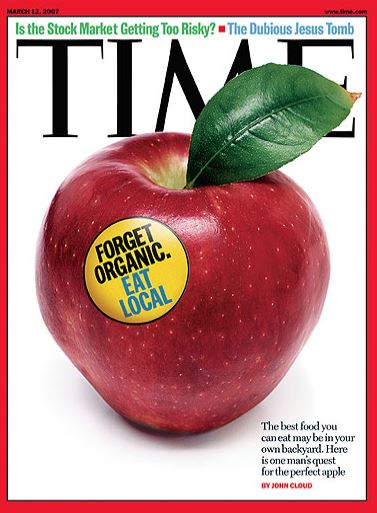
Back in 2007, Time magazine ran the following cover announcing, in essence, that local was the new organic.

timemag.JPG

Well local, has arrived and now it seems it's time to move on to something else.  Last night, I heard Randy Krotz, CEO of the US Farmers and Rachers alliance give a presentation, and as he talked he helped solidify some thoughts that have been rolling around in my head for a while. 

In short, forget local, eat "plant based."  "Plant based" appears to be the new local.  

Randy must have been prescient because, as it turns out, right after his talk, my son (who graciously agreed to attend the meeting with me) and I decided to stop for a burger, and lo-and-behold the joint offered the Impossible Burger.  This is the first time I've seen the plant-based burger - which used genetically engineered yeast to produce animal proteins - listed on a menu.  My son ordered the Impossible Burger, and I went with the good old-fashioned cow burger, which allowed a side-by-side taste test.  

impossibleburger.JPG

Overall, I give the Impossible Burger high marks.  If we didn't know it was plant-based, I don't think we would have been the wiser.  My son thought it was quite good.  It is certainly 100% better than previous vegetarian burgers I've tried.  That said, there was just something about the beef burger that we thought tasted better - I suspect it was the animal fat.  Still, traditional animal-based protein suppliers have due cause for concern from this new competition.  That is, if these new technologies can bring down cost.  

The Impossible Burger was about a dollar more expensive (and about half the thickness) of the beef burgers on the menu, which prompted some discussion between my son and I about relative costs of animal- vs. plant-based proteins.  The ad on the table claims that the Impossible Burger uses 95% land, 97% less greenhouse gas emissions, and 74% less water than a beef burger.  If the Impossible Burger is using so many fewer resources, why is it more expensive?  Land is an enormously costly input.  Some of it may be that they are trying to recoup R&D costs or that they are exercising some price discrimination as they sell to higher income consumers.  At this point, it's hard to know, but if it is really the case that the plant-based burger uses substantially fewer resources, it should ultimately cost less than animal-based proteins.

All that is a way of pointing out that these sorts of plant-based burgers aren't a free lunch.  All those genetically engineered yeast have to "eat" something.  They require stainless steel fermentation vats, produce waste (that ironically is probably best used as feed for livestock), etc.  It will be interesting to see how cost-competitive they can become and how accepting consumers may (or may not be).          

Meat Taxes?

This morning I appeared on Fox Business Network with Varney & Co to discuss the idea of meat taxes (something proposed by many groups and authors - e.g., see this recent piece in Bloomberg).  The short segment is below.  It cut out before my last comment where I argued that efficiency is also good for the consumer because it helps bring down food prices.