Blog

How Reliable are Surveys of Public Opinion and Preference?

A day after the presidential election, it is useful to evaluate the usefulness of the surveys and polls that were used to predict election outcomes.  By and large, my assessment is that most of the polls got it about right.  Republicans complained a lot about state-level polls in Ohio and elsewhere saying that Democrats were being weighted too heavily, but in the end, it appears the pollsters had it right.  

Now turn to economics, where the latest issue of the Journal of Economic Perspectives just arrived in my inbox.  In the issue are three articles on the use of "contingent valuation", which is a survey method used to ask people how much they are willing to pay for some good - normally a public good (like the environment) that is not traded in a market setting.  The first two articles by Kling, Phaneuf, and Zhao and by Carson (here and here) are generally pro-contingent valuation, the last by Jerry Hausman at MIT is against.   

I've spent a lot of time studying contingent valuation and other consumer research methods.  The methods are far from perfect and they suffer from many well-known biases.  At the end of the day, however, my question is: what is the alternative?  

Here is Hausman's answer (footnote and references removed):

I am often asked what should be done given my view that contingent valuation should not be used. Should nonuse value be ignored? My view is that expert government agencies and Congress should make informed decisions and enact regulations that attempt to improve the economic allocation process . . . To the extent that contingent valuation is interpreted as an opinion poll about the environment in general, rather than a measure of preferences about a specific public project, regulators should recognize this concern. However, public policy will do better if expert opinion is used to evaluate  specific projects . . .

Here's my problem with Hausman's answer.  Experts are not unbiased.  They choose their areas of inquiry and expertise based on issues they perceive to be relatively important.  Experts are a non-random sample of the population whose values and judgments are unlikely to mirror the populations'.  Moreover, as this very issue of the Journal of Economic Perspective illustrates, experts often disagree about the meaning of the same set of facts.

Maybe the answer to determining the value of public goods isn't surveys, but while I value expert advice and opinion, I don't think it's a good idea to hand them over the decision making reigns.  The beauty of market-based decisions is that it allows people with competing preferences (defined by their choices) and beliefs to act on their own values and information in a decentralized process that adapts well to change.  Of course, the trouble with goods like the environment is the lack of markets to carry out this allocation process.

Nevertheless, the goal should be to try to find creative mechanisms that simulate what markets do well.  That's one thing I don't like about contingent valuation - it's static and does not allow people to learn and update their beliefs and preferences.  Figuring out how to create new mechanisms and institutions is where I think the future lies - not rehashing a twenty year old debate about contingent valuation.  

The Danger of Naturalism in Food

An interesting and provocative piece in Slate.com by Keith Kloor that mirrors some of the comments in my recent Tedx talk (I'll post it as soon as it's up) and discussion in my forthcoming book.  Here is the best part:

Managing our global food supply in a sustainable, efficient manner necessarily involves allowing for both organic and conventional agriculture. But a simplistic, down-with-industrial-farming chant rings loudly throughout the food movement. Sure, there are legitimate grievances about the corporate conduct of multinational food and agricultural companies. But since when is that unique to big business of any nature? For example, there are compelling social justice issues related to the making of cell phones and sneakers, but I don’t see people demonizing Apple’s or Nike’s technological innovations.

So why is Big Ag different from Big Smartphone or Big Sneaker?  And why has concern over how the world's food is grown become so strongly identified with concern over genetically modified crops?

The answer to both has to do with the legacy of environmentalism. The green movement's worldview today is the same as it was in 1970: Nature is sacred, big business is the enemy, technology is dangerous, the world is on the verge of eco-collapse. The ecologist Barry Commoner, who recently died at the age of 95, was perhaps the most influential apostle for this mindset. He argued in the early 1970s that the “circle of life,” in which “nature knows best,” had been broken by a technology-based society that had put the planet on the brink of ecological suicide. This outdated, unhelpful perspective reverberates in many offshoots of the environmentalism of 40 years ago, not just the food movement. For example, today’s environmentalists (and their enablers in the media) have a tendency to exaggerate the dangers from chemicals in household products. A similar dynamic has played out for years in campaigns against nuclear power and more recently, hydraulic fracking. At the root of these hyperactive fears is a deep distrust of industry.

A Little Election Eve Fun

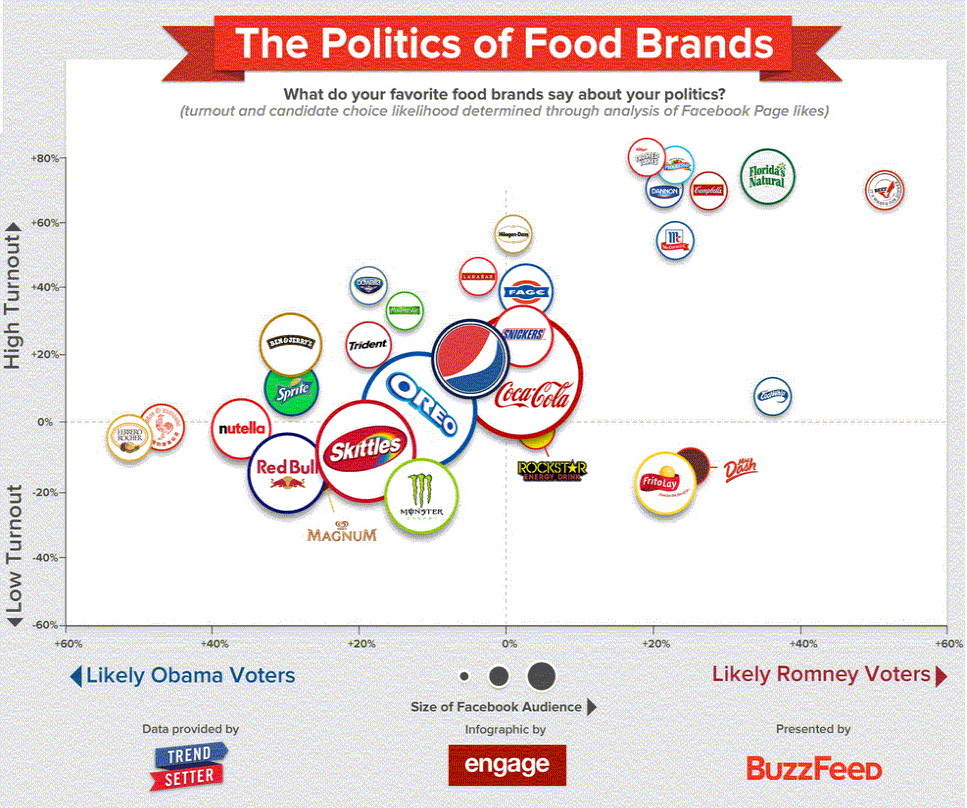
Apparently McDonald's is the most bi-partisan restaurant chain and Coca-Cola is the most bi-partisan food brand. 

Which do you think are the most left- and right- leaning?

Check out the following charts from this web page

politicsfoodchain.gif
politicsfoodbrand.gif

Some Kind Words from Reason.com

In a piece at Reason.com on "The Sorry State of Food-Related Public-Health Research and Journalism", Baylen Linnekin takes issue with the way the media reports on research in food and health science.  

I was reading along when I was surprised (and pleased) to see this bit:

In spite of the current crop of mediocre research and reporting, there are a few bright counterweights.
Take Professor Jayson Lusk of Oklahoma State University, who I interviewed for Reason earlier this year.
Lusk had just published a study in the journal Food Policy, "The Political Ideology of Food," in which he concluded that the great majority of Americans support increasing the extent to which food is regulated. 
Lusk, whose forthcoming book is The Food Police: A Well Fed Manifesto about the Politics of Your Plate, admitted he found his results “a bit disheartening” but published them anyways.
Me? I hate the results (and challenged him on his data in my interview).
But I love the fact Lusk displayed the intellectual honesty and courage to publish research that doesn’t simply reflect his own values and wishes.
For this alone, Lusk deserves a medal. But he’s on a very short list.

I don't know that I deserve  medal, but I'm happy someone said so.  It is easy to selective pursue research or selectively report results that only conform to your prior world view, especially when there are incentives from media, businesses  and granting agencies to do so.  All scientists face these pressures (even if it simply to protect their reputation and prior findings and statements).   

I think a lot of the trouble comes in separating "what the data shows" from "this is what the results mean."  The media is often much more interested in the second issue, but more often than not, there are many competing meanings that fit the data.  But that doesn't make for compelling journalism that sells papers by creating a one-sided story that fits a headline.

Making NonSence of Food Labels

This piece in Time on food labels is frustrating.  In trying to help consumers “make sense” of food labels, they only confuse the situation – making several unsubstantiated claims and linking to dubious sources to support other claims. 

For example, here is what they say on the label hormone free:

There is a long list of health concerns tied to hormone-filled meat, from prenatal developmental problems to early puberty and infertility. Though the evidence isn’t always reliable, some studies have shown growth hormones from certain foods can disrupt human hormones and can even contribute to breast and prostate cancer.

If you click through to all three of the links they provide above, none actually shows what the piece purports they show.  The first link is to an advocacy website for “sustainability,” which in turn mainly references some European Union reports but not any actual studies published in peer-reviewed journals.  The second link is to a website about cancer, which discusses the correlation between meat eating and cancer, but says nothing about how added growth hormones used in meat production relates or does not relate to cancer.  The final link is to a scientific study that has nothing to do, as far as I can tell, with the use of subtherapeutic hormones given to cattle in feedlots.  Ironically, the scientific paper is about chicken meat, but broilers in the US are not given added growth hormones, so I’m not sure what the link has to do with what the authors are claiming.

Now, I’m not saying there are no problems with hormone use.  For example, there is evidence that growth hormones can lead to less tender beef.  But, generally these are concerns about eating quality not safety.

Another example is when the piece discusses pesticide use it says:

If a food product has  the USDA Organic certification, it’s usually pesticide-free, too.

That statement is absolutely false.  Organics can use a long list of “natural” pesticides, many of which are just as toxic as synthetic pesticides.         

Why is it so hard for Time to put out on objective piece on food labels?  It goes to show how much misinformation there is on food floating around that even when one wants to “set the record straight” they can’t find a good place to turn.