Blog

This is Why I'm Optimistic About Biotechnology

Developments like these are where the future of food biotechnology lies (HT: Tyler Cowen):

Researchers have developed a genetically modified tomato that produces a certain peptide which will lower the plaque buildup in the arteries of mice. This could also work in humans.

and

With 2.2% of the rodent’s diet comprised of the GM tomato, the researchers found that the mice had lower levels of blood inflammation, higher activity of the anti-oxidant enzyme paraoxonase, boosted levels of high density lipoproteins, decreased lysophosphatidic acid and less atherosclerotic plaque.

It's hard to know whether something like this could be commercially viable (or even work in humans), but I suspect that there were more developments like these, GMOs would lose the bad rap.

Prop 37 Defeated

I've written a lot on this blog and elsewhere about Prop 37, which would have required mandatory labeling of GM foods in California. 

According to the California election web site, it appears that with 98.5% of precincts reporting, Prop 37 was defeated 53% to 47%. 

As I discussed earlier, there had  been a strong downward trend in support over the past month, but I must say that I am surprised that the proposition failed to pass.  

No doubt proponents of mandatory labeling will decry the money spent by Monsanto, Dow, etc.  And there is little doubt that this money, and the ads it created, turned the tides.  Is this good or bad?  Apparently people were susceptible to the message in the "No" ads and  people voluntarily changed their mind: as it is often said "a man convinced against his will is of the same opinion still."  The counter-argument will be that the ads were deceptive.  But it's hard to argue this point because the arguments made on the yes and no sides were both based on conjectures, extrapolations, and assumptions.  I personally thought there were more misleading claims made by the "yes" side than the "no."

At the end of the day, real, thinking people placed real votes that defeated the proposition.  We can't on the one hand say that these people were unreasonably influenced to  vote against Prop 37 while saying they were reasonably influenced to vote for Obama.  If one wants to fault the money of corporations, they also have to fault the people who change their minds as a result.  I'm not willing to go that far.

In any event, the good news for those who wanted Prop 37 is that there are lots of organic and GM-free products already for sell on the market, which are voluntarily labeled.   Prop 37 supporters didn't get what they wanted in the voting booth, but they can get it at the grocery store.  

How Reliable are Surveys of Public Opinion and Preference?

A day after the presidential election, it is useful to evaluate the usefulness of the surveys and polls that were used to predict election outcomes.  By and large, my assessment is that most of the polls got it about right.  Republicans complained a lot about state-level polls in Ohio and elsewhere saying that Democrats were being weighted too heavily, but in the end, it appears the pollsters had it right.  

Now turn to economics, where the latest issue of the Journal of Economic Perspectives just arrived in my inbox.  In the issue are three articles on the use of "contingent valuation", which is a survey method used to ask people how much they are willing to pay for some good - normally a public good (like the environment) that is not traded in a market setting.  The first two articles by Kling, Phaneuf, and Zhao and by Carson (here and here) are generally pro-contingent valuation, the last by Jerry Hausman at MIT is against.   

I've spent a lot of time studying contingent valuation and other consumer research methods.  The methods are far from perfect and they suffer from many well-known biases.  At the end of the day, however, my question is: what is the alternative?  

Here is Hausman's answer (footnote and references removed):

I am often asked what should be done given my view that contingent valuation should not be used. Should nonuse value be ignored? My view is that expert government agencies and Congress should make informed decisions and enact regulations that attempt to improve the economic allocation process . . . To the extent that contingent valuation is interpreted as an opinion poll about the environment in general, rather than a measure of preferences about a specific public project, regulators should recognize this concern. However, public policy will do better if expert opinion is used to evaluate  specific projects . . .

Here's my problem with Hausman's answer.  Experts are not unbiased.  They choose their areas of inquiry and expertise based on issues they perceive to be relatively important.  Experts are a non-random sample of the population whose values and judgments are unlikely to mirror the populations'.  Moreover, as this very issue of the Journal of Economic Perspective illustrates, experts often disagree about the meaning of the same set of facts.

Maybe the answer to determining the value of public goods isn't surveys, but while I value expert advice and opinion, I don't think it's a good idea to hand them over the decision making reigns.  The beauty of market-based decisions is that it allows people with competing preferences (defined by their choices) and beliefs to act on their own values and information in a decentralized process that adapts well to change.  Of course, the trouble with goods like the environment is the lack of markets to carry out this allocation process.

Nevertheless, the goal should be to try to find creative mechanisms that simulate what markets do well.  That's one thing I don't like about contingent valuation - it's static and does not allow people to learn and update their beliefs and preferences.  Figuring out how to create new mechanisms and institutions is where I think the future lies - not rehashing a twenty year old debate about contingent valuation.  

The Danger of Naturalism in Food

An interesting and provocative piece in Slate.com by Keith Kloor that mirrors some of the comments in my recent Tedx talk (I'll post it as soon as it's up) and discussion in my forthcoming book.  Here is the best part:

Managing our global food supply in a sustainable, efficient manner necessarily involves allowing for both organic and conventional agriculture. But a simplistic, down-with-industrial-farming chant rings loudly throughout the food movement. Sure, there are legitimate grievances about the corporate conduct of multinational food and agricultural companies. But since when is that unique to big business of any nature? For example, there are compelling social justice issues related to the making of cell phones and sneakers, but I don’t see people demonizing Apple’s or Nike’s technological innovations.

So why is Big Ag different from Big Smartphone or Big Sneaker?  And why has concern over how the world's food is grown become so strongly identified with concern over genetically modified crops?

The answer to both has to do with the legacy of environmentalism. The green movement's worldview today is the same as it was in 1970: Nature is sacred, big business is the enemy, technology is dangerous, the world is on the verge of eco-collapse. The ecologist Barry Commoner, who recently died at the age of 95, was perhaps the most influential apostle for this mindset. He argued in the early 1970s that the “circle of life,” in which “nature knows best,” had been broken by a technology-based society that had put the planet on the brink of ecological suicide. This outdated, unhelpful perspective reverberates in many offshoots of the environmentalism of 40 years ago, not just the food movement. For example, today’s environmentalists (and their enablers in the media) have a tendency to exaggerate the dangers from chemicals in household products. A similar dynamic has played out for years in campaigns against nuclear power and more recently, hydraulic fracking. At the root of these hyperactive fears is a deep distrust of industry.

A Little Election Eve Fun

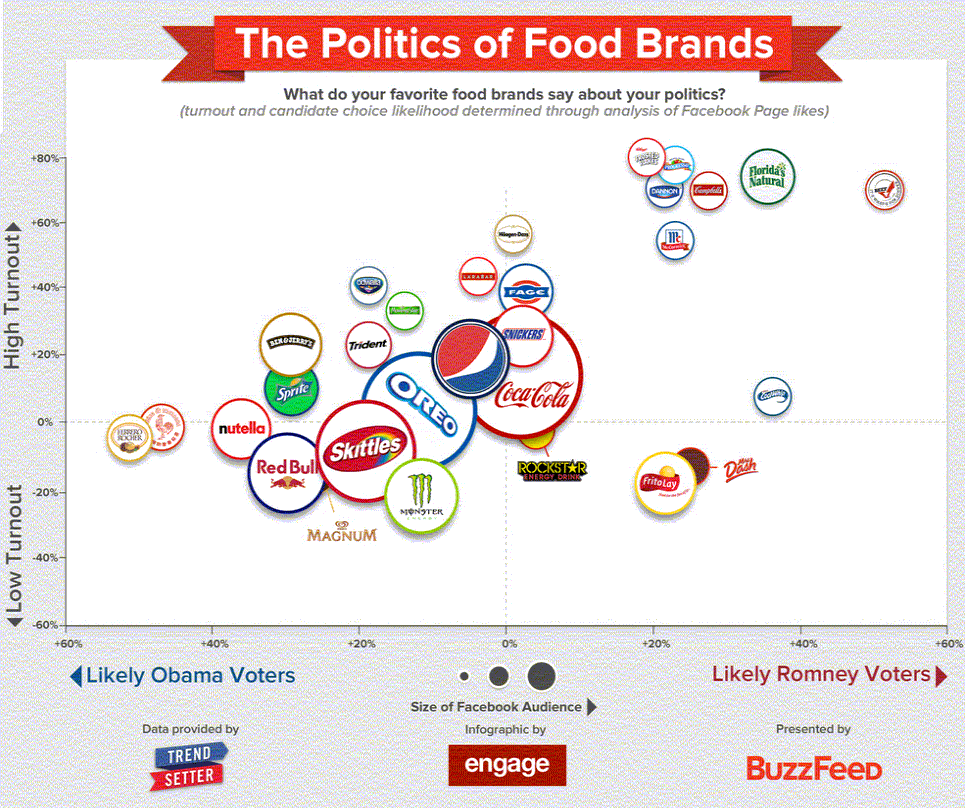
Apparently McDonald's is the most bi-partisan restaurant chain and Coca-Cola is the most bi-partisan food brand. 

Which do you think are the most left- and right- leaning?

Check out the following charts from this web page

politicsfoodchain.gif
politicsfoodbrand.gif