Blog

Is GMO Aversion a Left-Wing Phenomenon?

Amy Harmon recently had another excellent story on GMOs in the New York Times - focusing particularly on Papayas in Hawaii.

The story had the following passage:

Scientists, who have come to rely on liberals in political battles over stem-cell research, climate change and the teaching of evolution, have been dismayed to find themselves at odds with their traditional allies on this issue. Some compare the hostility to G.M.O.s to the rejection of climate-change science, except with liberal opponents instead of conservative ones.

From time to time, I've received some push back on some of the claims in my book, The Food Police, that food technology aversion, and willingness to regulate and restrict food technologies, has roots in the progressive left.  This is, of course, a generalization, and it doesn't not hold in every instance or for every person.  In this particular instance, it appears Harmon supports my claim.

One challenge is that many popular food books (by folks like Pollan, Moss, Warner, etc.) often refrain from specifically mentioning much about policy in the book.  But, then when your see these authors out on the interview circuit, they often talk a lot about policy and advocate all kinds of things.  This has the consequence of their writing appearing more centrist and “ideologically neutral” than is actually the case, and it also lets the authors off the hook by rarely putting them in a position of having to seriously defend their policy proposals.  

Indeed, I did an interview with Minnesota NPR on the Food Police, and I told the host that I didn’t so much disagree with Pollan’s eating advice as his policy advice regarding local foods.  The host (who had previously interviewed Pollan) told me something to the effect that Pollan doesn’t have policy proposals with regard to local food.  Well, that’s just false.  Yes, the Omnivore’s Dilemma or Cooked don’t specifically make policy suggestions, but all you have to do is listen to Pollan’s speeches or watch him on Bill Maher or Bill Moyers, and he has all kinds of policy suggestions (or just read some of his other writings, which plainly offer policy advice).  

It is a mistake to narrowly evaluate Pollan, Moss, et al. strictly based on what they write in their books without also viewing their writing in the larger context of the polices they advocate outside their books.  One also has to pay attention to what they choose to write about and what they choose to omit, and I would argue much of their writing errs by omission.   

I should note that several commentators on the web have chimed in on Harmon's claims of a link between left-leaning politics and aversion to GMO science.

Isaac Chotiner in the New Republic writes:

This story, a news piece which is also pleasingly one-sided (as the evidence demands), is appearing in the most important liberal publication in the country. The liberals who rant about genetically modified food may be pushing a point of view that is objectively as crazy as believing carbon emissions are not causing global warming; but liberals are still more likely (and willing) to get their news from places that tell them the truth. For conservatives who like to claim that Fox News is just a conservative version of The New York Times, ask yourselves this: Could you imagine Fox News running a big, one-sided piece that overwhelmingly discredited global warming deniers? Of course not. (The Times ran another excellent genetically modified food piece last year, also written by Amy Harmon.)

This probably goes some way in explaining why the modern Republican Party and conservative movement frequently seem so much crazier than mainstream liberalism. It's not that people are simply and inherently crazy; they also operate from within crazy bubbles, which is arguably just as dangerous. For this reason, my guess is that over time liberal opposition to genetic engineering will fade away. 

He makes a good point about this piece appearing in the NYT.  One distinction, which I think is missing, is the greater willingness of those on the left to regulate on economic issues, such as GMOs, than those on the right.  Stated differently, there are questions of science: what are the risks of climate change or eating GMOs.  And then there are more normative questions: given said risk, what should we do about it?  Even if the left and the right agreed on the level of risk, I don't think we should expect agreement on political action.  Some (but certainly not all) of the aversion to climate change policies on the right aren't a result of "global warming denialism" but rather skepticism about the government being able to efficiently solve the problem.  My studies on the issue don't reveal huge left-right differences in acceptance of GMOs per se, but rather the difference come in when one gets to the willingness to regulate GMOs.  

In a defense of GMOs from the European left, Leigh Phillips, makes some interesting observations about the politics of the situation:

In the end, what is going on here with opposition to genetic modification is the import into left-wing thinking of the logical fallacy of an ‘appeal to nature’ – the idea that what is found in nature is good and what is synthetic is bad. The origins of this scepticism of science, industry and progress can be found in romanticist counterrevolutionary thought that emerged in the 18th Century in opposition to republican movements. It is a cuckoo’s egg in the nest of the Left.

Transferred to human ecology, the inherent conservatism of this should quickly be revealed: Everything, or everyone – peasant, lord and king – has his place within the ‘natural order’. It is a defence of the status quo against the ‘unintended consequences’ of social programmes by interventionist governments. How alike are the arguments against genetic engineering and ‘social engineering’!

What's the Problem with Personal Responsibility?

Over at the food policy blog, Parke Wilde takes issue with my answer to a question from Dan Koontz at the Casual Kitchen blog.  Or perhaps the issue is that Dan asked the question?  Or, perhaps that I didn't mention Michelle Obama in my answer?  

Parke makes a good point that many folks, including the first lady, advocate personal responsibility.  Indeed, the Let's Move! campaign seems as clear a sign as any that Mrs. Obama is encouraging folks to get off their duffs.

But, Parke also seems to insinuate that somehow this discussion of personal responsibility is aiming at a straw man or lining up and knocking down carnival dolls as Parke puts it.  As if there aren't people out there who use the "lack of personal responsibility" premise as motivation for public policy.  Thus, it might be useful to share a segment from a paper I co-authored in the journal Appetite:

Consumer activist groups and many public health professionals, on the other hand, have repeatedly argued that individuals are powerless to stop the rising tide of obesity; that forces outside their control (in other words, environmental factors) are to blame and are in need of constraint. The following quotations are illustrative of this viewpoint:

•“The obesity crisis would not be solved by treating it as a personal failing on the part of those who weigh too much… We must realize that our predicament cannot be solved through individual action alone.” David Satcher, 16th Surgeon General of the United States (Levi, Segal, & St. Laurent, 2011).

•“Obesity is not merely a matter of individual responsibility. Such suggestions are naive and simplistic.” Bruce Silverglade, Center for Science in the Public Interest (Silverglade, 2004).

•“We’ve got to move beyond personal responsibility.” Margo Wootan, Center for Science in the Public Interest (Balko, 2004).

•“If only it were that simple. The harsh reality is that millions of Americans can’t be trusted to look after their own well-being.” David Lazarus, consumer columnist, Los Angeles Times (Lazarus, 2012).

•“Everyone talks about personal responsibility, and that won’t work here... These are things that have to be done at a governmental level, and government has to get off its ass.” Robert Lustig, pediatric endocrinologist, University of California at San Francisco (Allday, 2012).

These are hardly straw men or women.  

By the way, the title of that paper in Appetite is "Who is to blame for the rise in obesity", and our nationwide consumer survey revealed the following: 

Eighty percent said individuals were primarily to blame for the rise in obesity. Parents were the next-most blameworthy group, with 59% ascribing primary blame. Responses fell along three dimensions related to individual responsibility, agribusiness responsibility, and government-farm policy. A number of individual-specific factors were associated with perceptions of blame. For example, individuals with a more statist score on the economic political ideology scale were more likely to blame the government and agribusiness for obesity.

Now, back to Parke's point.

Do some food companies use a "personal responsibility" mantra to try to avoid regulation.  You bet.  But, do some food activists do the reverse to advocate for regulation?  

Which is worse?  

I think there is a problem with the message of many in the food movement on this issue.  It is contradictory and undermines people's volition.  For example, In Michael Moss's book Salt, Sugar, Fat he concludes by saying:

They may have salt, sugar, and fat on their side, but we, ultimately, have the power to make choices. After all, we decide what to buy. We decide how much to eat.

So, there we have it.  Moss apparently advocates personal responsibility.  

But, didn't Moss just spend the preceding ~300 pages trying to convince us that our food choices are out of our control - that we are "hooked" - and that we are little match for the teams of scientists and advertisers employed by Big Food?  The implicit implication seems to be that consumers need a more powerful third party - the government - to constrain Big Food - because these are matters beyond our control.  

That's a story of helplessness - of victimization.  And whether they mean it nor not, narratives such as this can be demotivating.

To advocate people take personal responsibility for their food choices - as I have - is a message of empowerment.

Parke is right that some of the "food police" also encourage (and practice) personal responsibility, but I contend that much of their writing and their policy advocacy undermines their own message.

Strange Claims on Meat Consumption

Alison Spiegel at Huffington Post recently ran a story with the lead title: 

Chicken More Popular Than Beef In U.S. For First Time In 100 Years

As best I can tell, however, claim isn't true.  It is true that per capita consumption of chicken is increasing, but it surpassed beef back in the early 1990s.

The claim comes from a graph, which was reproduced from a story by Priceonomics,who in turn took it from Angela Wong at NPR, who in turn cites the Earth Policy Institute.  Beyond that, I have no idea where the data come from.  

For context, here is the graph from Huffington Post:

percapitawrong.JPG

But, according to USDA data, per capita chicken consumption passed beef in about 1992.  Here, for example, is a graph from the Livestock Marketing Information Center (which uses USDA data).

percapitaright.JPG

Oddly, the Earth Policy Institute has, on their web site, a graph showing something similar to the LMIC.  

There may be a rational explanation for the discrepancy (such as differences in data sources or differences in what is being counted in "total chicken") but without any details we only have to guess.

One final point.  Yes, per capita consumption of chicken is on on the rise and has been higher than beef for now over 20 years (according to USDA data).  But, that is largely because chicken has become much less expensive and, lately, beef more expensive.  

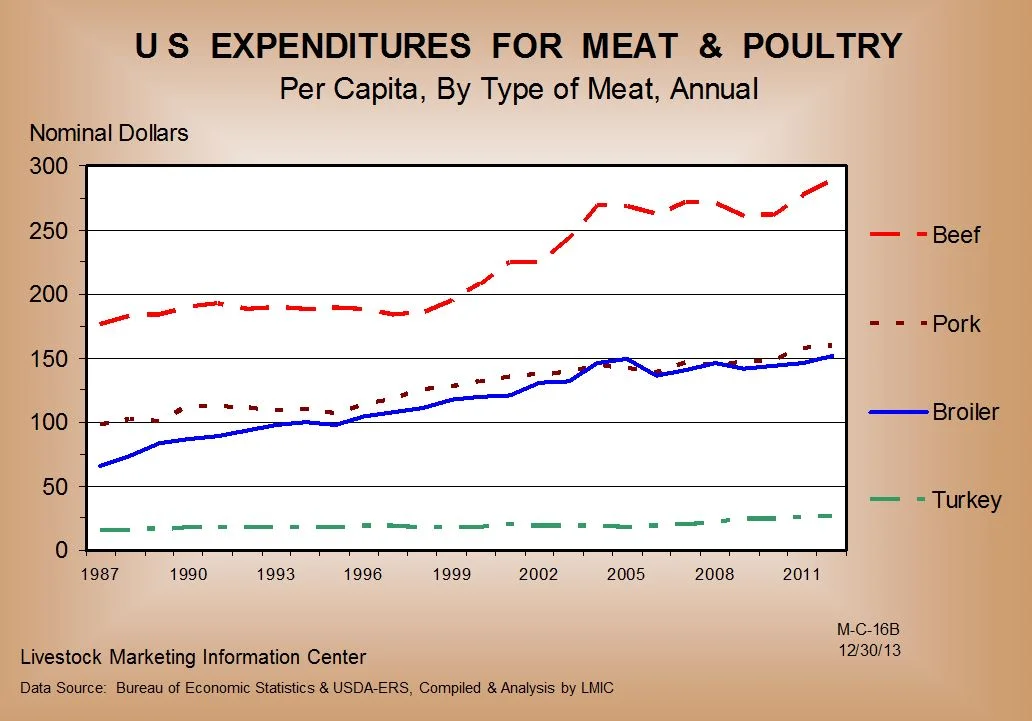
Thus, I don't know that we should say chicken is more "popular" than beef.  Indeed, people SPEND much more money on beef than chicken - about twice as much as the following graph shows.  If we judge by dollars spent, beef is much more popular than chicken.

meatexp.JPG

The new gentleman farmer

That's the the title of a story in the winter issue of WSJ.Money magazine.

The piece documents the rise of the gentlemen and gentlewomen farmers: folks who made millions elsewhere and who are now trying their hand at agriculture - primarily organic agriculture.  

Here are some of the folks jumping in:

It's late afternoon on a Friday, but Lerner, the 58-year-old tech pioneer who co-founded Cisco Systems, is still working, driving her Range Rover around the pastures and barns that make up her 800-acre Ayrshire Farm in Upperville, Va 

. . .

The nation is in the middle of an organic-food boom, and in case you haven't noticed, a surprising number of boldface names are becoming part of it. That includes Oprah Winfrey, who is growing kale, carrots and more than 60 other varieties of vegetables, fruits and herbs on her organic farm on the Hawaiian island of Maui, as well as comedian Roseanne Barr, who is growing macadamia nuts and produce on her organic farm on Hawaii's Big Island. Fashion-world honchos George Malkemus and Anthony Yurgaitis—president and vice president, respectively, of designer shoe brand Manolo Blahnik—have a dairy farm in Litchfield, Conn., where the 325 cows are pasture-fed (at least when the weather allows; otherwise, they are given a special diet of high-quality hay and a premium feed)


Are they making any money?  

It appears not.  Indeed much of their fortunes are being lost (or rather perhaps we should say they are spending their fortunes on a consumption good or experience).

But by Lerner's own admission, she has yet to turn a profit on her $7 million-a-year business, which includes two additional farms in the area, bringing her total acreage to 1,200. And at times, it seems she is consciously running it as a nonprofit entity, especially given the considerable time and energy she devotes to research on organic farming practices.

It seems she is having to make some big changes:

she has taken a series of steps to save money, including farming out some of her operations and making adjustments in her meat-packaging operations. Her biggest step of all, though, is deciding to sell a good chunk of the farm. Indeed, some 600 of Ayrshire's 800 acres are now on the market, replete with the mansion she's restored. The asking price: $30 million. To many, this might be seen as an acknowledgement that Lerner has ultimately failed in her mission. She prefers to view it as the next step in the evolution of her business. 

More generally:

But the good intentions of these type-A types notwithstanding, the economics of organic farming are a potential blow to their fairly large egos. These are individuals with scores of successes in life, but experts say that despite the price premiums that come with organic labeling or other likeminded practices, the math doesn't always work out. It is just too expensive to do. For that matter, almost all farming, organic or conventional, is a financial boondoggle when it's outside the realm of factory farming. The median projected income of the American farm in 2013? It's actually a loss of roughly $2,300, according to the U.S. Department of Agriculture. Is it any wonder that—the organic boom notwithstanding—the number of farms in the U.S. has been on a dramatic decline, from a high of nearly 7 million in the 1930s to 2.2 million today?

Although I have been critical of many of the claims of organic agriculture, one shouldn't be too quick to conclude that all organic farming is unprofitable.  Indeed, many conventional producers have switched some of their operation to organic because they expect higher profits (i.e., they expect the higher price premiums for organic to compensate for lower yields and higher input costs).  But, the ones making money at it typically aren't "gentlemen farmers" or mom-and-pop set-ups.  

In terms of profitability, it may matter less whether one is an organic or non-organic farmer as compared to whether the producer uses efficient practices and technologies.  For example, here is a study about dairies by some of my former colleagues at Purdue University published in the American Journal of Agricultural Economics.  They show that the technology used by organic farms is less efficient than that used by non-organic (organic is about 13% less productive).  However, there are differences in efficiency across farms, both organic and non-organic.  As they say:

To our knowledge, our research is the first to show that economies of scale also exist in organic dairy production.

In other words, size matters - even if you're organic. Larger dairy farms are going to have lower costs. That's true for non-organic and it is true for organic.  Also:

We find that compared to the Upper Midwest, the technology used by farms in the Southeast is more productive. Farms with cows of higher weight also produce more milk. . . .In terms of management practices we find that farms that tend to rent more of their land for either crop production or pasture are less productive. Intuitively, a renter does not have the same incentive as a land owner to invest in the productivity of the land. Farms that raise more of their own feed seem to be less productive. . . .

If gentlemen farmers want to make more money, they may have to stop being so gentlemanly and get down to business.