Blog

Controversy over the new dietary guidelines

Yesterday I filmed a piece on Fox Business about the new dietary recommendations and the call to reduce meat consumption to improve health and the environment (I couldn't get the video to embed, but you can view it here).  I suppose I had at least a couple good points to make because the clip was featured for most of yesterday on the main web page for Fox News.  

One of the hosts mentioned a Cambridge study showing that vegetarians and vegans have substantially lower environmental impacts than meat-eating diets.  A written piece at foxnews.com about the recommendations also mentions the same study.  I'm not sure how representative that cited study is.  My own analysis suggests that vegetarians spend about the same amount on food as do meat eaters.  To the extent prices reflect resource use, that stat would suggest both diets are "using up" similar levels of "stuff."  I've also written on the argument that the grain fed to livestock is "wasted."

But, perhaps more importantly, what evidence is cited in the new report of the dietary guidelines committee?  The papers they cite seem to suggest small improvements in greenhouse gas (GHG) emissions and improved health outcomes (but more on that in a minute) from a move to vegetarian diet.  Here are some selected quotes of the review in Chapter 5 part D where quantitative impacts on environment were mentioned (note: there are many other cited studies, some of which suggest higher impacts).

Peters et al. examined 42 different dietary patterns and land use in New York, with patterns ranging from low-fat, lacto-ovo vegetarian diets to high fat, meat-rich omnivorous diets . . . although meat increased land requirements, diets including meat could feed more people than some higher fat vegetarian-style diets

and

Aston et al. assessed a pattern that was modeled on a feasible UK population in which the proportion of vegetarians in the survey was doubled, and the remainder adopted a diet pattern consistent with the lowest category of red and processed meat (RPM) consumers. They found . . . the expected reduction in GHG for this diet was ~3 percent of current total carbon dioxide (CO2) emissions for agriculture. De Carvalho et al. also examined a high RPM dietary pattern with diet quality assessed using the Brazilian Healthy Eating Index.They found . . . that excessive meat intake was associated not only with poorer diet quality but also with increased projected GHG emissions (~ 4 percent total CO2 emitted by agriculture).

This one is most interesting references:

a report from Heller and Keoleian suggests that an isocaloric shift from the average U.S. diet (at current U.S. per capita intake of 2,534 kcals/day from Loss-Adjusted Food Availability (LAFA) data) to a pattern that adheres to the 2010 Dietary Guidelines for Americans would result in a 12 percent increase in diet-related GHG emissions. This result was modified, however, by their finding that if Americans consumed the recommended pattern within the recommended calorie intake level of 2,000 kcal/day, there would be a 1 percent decrease in GHG emissions.

My take?  Eating too many calories likely has as much an impact on GHG as eating meat.  Reducing meat consumption would lower GHG emissions, but I would characterize the effects as "small" (3 to 4% of the GHG emissions from agriculture, or likely less than 1% of the total of all GHG emissions), particularly if people move toward pork and poultry, which have far fewer GHG emissions than ruminants like cattle.  Moreover, if we want to improve environmental impacts of livestock production, I think we're likely to get a bigger bang for our buck by improving productivity and researching new ways to reduce impacts than we will be cajoling people to eat less meat (see this paper on the reduction in environmental impact of beef production brought about over the past 40 years due to technological advancement).

What about the health impacts of meat consumption?  It is true that many observational, epidemiological studies show a correlation between red meat eating and adverse health outcomes (interestingly there is a fair amount of overlap on the authors of the dietary studies and the environmental studies on meat eating).  But, this is a pretty weak form of evidence, and much of this work reminds of the kinds of regression analyses done in the 1980s and 90s in economics before the so-called "credibility revolution." 

There have been many, many books written on the topic of whether meat eating is good or bad for you, and I won't try to adjudicate them all here.  However, I will point you to this really interesting exchange (see the comments section) on Marion Nestle's website where she mentions the new guidelines and takes a swipe at Nina Teicholz's book, Big Fat Surprise.  Nina responds, as do her critics.  
What happens when we ban the slaughter of horses?

One of my former Ph.D. students, Mallory Vestal, sought to answer that question in a paper that we just published in the Journal of Agricultural and Applied Economics.  Mallory is a horse-lover, a former graduate assistant coach of the Oklahoma State University Equestrian team, and is now an assistant professor at West Texas A&M University. Here's the abstract of the paper:

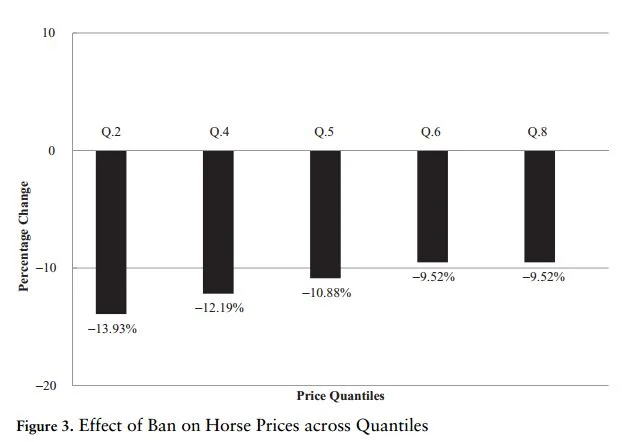
As a result of several judicial rulings, processing of horses for human consumption came to a halt in 2007. This article determines the change in horse prices resulting from elimination of horse-processing facilities. As expected, lower-valued horses were more affected by the ban than higher-valued horses. The analysis suggests the slaughter ban reduced horse prices, on average, by about 13% and resulted in a loss in producer surplus to sellers of approximately 14% at the sale we analyzed. We also show horse prices are affected by a myriad of factors including breed, gender, age, coat color, and sale catalog description.

Because "lower value" horses were those most likely to (eventually) head to the slaughter house, we anticipated that their prices would be most affected by the slaughter ban, and that's indeed what we found.  Here's the impact of the ban on horses priced in the upper 20$, 40% . . and 80% of the price distribution.  

There were a number of interesting side-results, like these . . .

The indicator variables related to the horse catalog descriptions were significantly
associated with horse prices. Consistent with Levitt and Dubner (2005), an ambiguous description such as “nice” was shown to negatively impact prices by −5% to −10% across all models. A more objective descriptive variable such as “finished” was significant in several of the quantiles examined and in the OLS model. Including the word “finished” in the horse’s description was associated with increased prices from 26% to 68%. This result is intuitive as it indicates the horse has specialized training and will be ready to show in the specified discipline. Another descriptive and informative variable, “100% sound,” positively impacted prices from 8% to 11%, whereas “athletic” and “quiet/gentle” negatively impacted higher-quantile prices by −10% and −8% respectively.

Want to know my own view on eating horse meat?  I hinted at it in this editorial.

New Dietary Guidelines

The federal committee that makes dietary guidelines and recommendations has just released their newest report.  As expected, they've incorporated "sustainability" objectives and have recommended a move away from meat eating.  I've previously commented on the the problem with a single committee making both nutritional and sustainability recommendations, and I had a piece in the Wall Street Journal on environmental impacts of meat production.   Now we can take a look at what's actually been proposed.

Here's one tidbit from a Washington Post summary on the issue.

“We’re not saying that people need to become vegans,” said Miriam Nelson, a professor at Tufts University and one of the committee’s members. “But we are saying that people need to eat less meat.”

The panel’s findings, which were released to the public in the form on a 572 page report this afternoon, specifically recommend that Americans be kinder to the environment by eating more plant-based foods and fewer animal-based foods. The panel is confident that the country can align both health goals and environmental aims, but warns that the U.S. diet, as currently constructed, could improve.

Other conservative news sources point to some pretty heavy handed portions of the report.  The Dietary Guidelines Advisory Committee (DGAC):  

called for diet and weight management interventions by “trained interventionists” in healthcare settings, community locations, and worksites.

"Interventionists" is the right word here, but rarely are interventionists so forthcoming in their intentions.They also want to tax foods, limit speech, and monitor TV use.   

DGAC also called for policy interventions to “reduce unhealthy options,” limit access to high calorie foods in public buildings, “limit the exposure” of advertisements for junk food, a soda tax, and taxing high sugar and salt items and dessert.

“Align nutritional and agricultural policies with Dietary Guidelines recommendations and make broad policy changes to transform the food system so as to promote population health, including the use of economic and taxing policies to encourage the production and consumption of healthy foods and to reduce unhealthy foods,” its report read.

“For example, earmark tax revenues from sugar-sweetened beverages, snack foods and desserts high in calories, added sugars, or sodium, and other less healthy foods for nutrition education initiatives and obesity prevention programs.”

The amount of sedentary time Americans spend in front of computers and TV sets is also a concern to the federal panel.

If you think this is a one-off isolated example, you haven't been paying attention.

Why people lie on surveys and how to make them stop

Companies spend millions (perhaps billions?) of dollars every year surveying consumers to figure out want they want.  Environmental, health, and food economists do the same to try to figure out the costs and benefits of various policies.  What are people willing to pay for organic or non-GMO foods or for country of origin labels on meat?  These are the sorts of questions I'm routinely asked.

Here's the problem: there is ample evidence (from economics and marketing among other disciplines) that people don't always do what they say they will do on a survey.  A fairly typical result from the economics literature is that the amount people say they are willing to pay for a new good or service is about twice what they'll actually pay when money is on the line.  It's what we economists call hypothetical bias.

We don't yet have a solid theory that explains this phenomenon in every situation, and it likely results from a variety of factors like: social desirability bias (we give answers we think the surveyor wants to hear), warm glow, yea-saying, and self presentation bias (it feels good to support "good" causes and say "yes", and why not say we're willing to do something, particularly when there is no cost to doing so and it can make us look and feel good about ourselves), idealized responses (we imagine whether we'd ever buy the good when we eventually have the money and the time is right, rather than answering whether we'd buy it here and now), strategy (if we think our answers to a survey question can influence the eventual price that is charged or whether the good is actually offered, we might over- or under-state our willingness to buy), uncertainty (research suggest a lot of the hypothetical bias comes from those who say they aren't sure about whether they'd buy the good), among other possible reasons.

What to do?

Various fixes have been proposed over the years.

  • Calibration.  Take responses from a survey and reduce them by some factor so that they more closely approximate what consumers will actually do.  The problem: calibration factors are unknown and vary across people and goods.
  • Cheap talk.  On the survey, explain the problem of hypothetical bias and explicitly ask people to avoid it.  The problem: it doesn't always "work" for all people (particularly experienced people familiar with the good), and there is always some uncertainty over whether you've simply introduced a new bias.
  • Certainty scales.  Ask people how sure they are about their answers, and for people who indicate a high level of uncertainty, re-code their "yes" answers to "no".  The problem: the approach is ad-hoc, and it is hard to know a priori what the cut-off on the certainty scale should be.  Moreover, it only works for simple yes/no questions.
  • Use particular question formats.  Early practitioners of contingent valuation (an approach for asking willingness-to-pay popular in environmental economics) swear by a "double-bounded dichotomous choice, referendum question" which they believe has good incentives for truth telling if respondents believe their answers might actually influence whether the good is provided (i.e., if the answer is consequential).  I'm skeptical.  I'm more open to the use of so-called "choice experiments", where people make multiple choices between goods that have different attributes, and where we're only interested in "marginal" trade offs (i.e., whether you want good A vs. good B).  There is likely more bias in the "total" (i.e., whether you want good A or nothing).    

There is another important alternative.  If the problem is that surveys don't prompt people to act as they would in a market, well, whey don't we just create a real market?  A market where people have to give up real money for real goods - where we make people put their money where their mouth is?  It is an approach I wrote about in the book Experimental Auctions with Jason Shogren and it is the approach I teach with  Rudy Nayga, Andreas Drichoutis, and Maurizio Canavari in the summer school we have planned for this summer in Crete (sign up now!)  It is an approach with a long history , stemming mainly from the work of experimental economists.

One of the drawbacks with the experimental market approach is that it is often limited to a particular geographic region.  You've got to recruit people and get them in a room (or as people like John List and others have done, go to a real-world market already in existence and bend it to your research purposes).   

Well, there's now a new option with particularly wider reach.  Several months ago I was contacted by Anouar El Haji who is at the Business School at the University of Amsterdam.  He's created a simple online platform he calls Veylinx where researchers can conduct real auctions designed to give participants an incentive to truthfully reveal their maximum willingness-to-pay.  The advantage is that one can reach a large number of people across the US (potentially across the world).  It's a bit like ebay, but with a much simpler environment (which researchers can control) with a clearer incentive to get people to bid their maximum willingness-to-pay.  

One of the coolest parts is that you can even sign up to participate in the auctions.  I've done so, and encourage you to do the same.  Hopefully, we'll eventually get some auctions up and running that relate specifically to food and agriculture.