Blog

Food Demand Survey (FooDS) - January 2016

The January 2016 edition of the Food Demand Survey (FooDS) is now out.

Here are a few highlights from the regular tracking portion of the survey:

  • Willingness-to-pays (WTP) for all meat products, except pork chops, were down a bit this month compared to last, but were generally higher than was the case a year ago.  The changes in WTP were generally small and within the margin of error (which varies across meat products but is typically about +/- 7%).  
    • On a related note, my paper with Glynn Tonsor, where we used these WTP choice data to estimate demand inter-relationships is now finally out in the journal Applied Economic Perspectives and Policy (I previously discussed that paper here)
  • There was a large drop in plans to eat away from home in January compared to December.
  • There was also a large drop in awareness of E Coli and Salmonella in the news, and a small drop in concern for these issues as well (a likely Chipotle effect).  The same pattern of results was also true for GMOs and antibiotics.  
  • Two different questions suggested an uptick in concern for farm animal welfare at the beginning of 2016.

Three new ad hoc questions were added to the survey this month.

The three questions inquired about consumers’ perceptions of taste, health, and safety of the eight different food products for which we track WTP.  The first question asked: “How tasty or untasty do you consider the following products, where -5 is very untasty and +5 is very tasty?” Participants were asked the same questions twice more, only the words “tasty or untasty” were replaced with “healthy or unhealthy” and “safe or unsafe”.


Chicken breast was, on average, perceived as most healthy and as the most tasty. While beans and rice were perceived as the safest option, it was also the least tasty of the eight choices. Participants perceived deli ham was, on average, one of the least healthy, least tasty, and least safe products. Pork chop and chicken wing fell in the middle for each of the three categories. On average, all six meat products were perceived as less safe than the two non-meat products.

The average perception of taste can be plotted against average perceived health or
average perceived safety.

There is a slight positive correlation between perceived taste and health (correlation
coefficient of 0.15).  Similar plots reveal a slight negative correlation between perceived taste and safety (correlation coefficient of -0.14) and a strong positive correlation between perceived health and safety (correlation coefficient of 0.83).   All of this of course is at the aggregate level; plots like this could be created for each and every one of the 1,000 respondents.

What the above graph shows is that although beef products rate relatively well in terms of taste, they fall well below chicken breast in terms of perceived health.  I can use my demand model estimates (the model that gives rise to the WTP values) to do some thought experiments.  What if ground beef was perceived as healthy or as tasty as chicken breast?  How much would WTP for ground beef increase?  

First, we have to ask how much people value improvements in taste, health, and safety.  My model estimates suggest, unsurprisingly, that the higher the perceived taste, health, and safety, the higher the WTP for a product. But, by how much?  I find that a 1 unit increase in perceived taste (on the -5 to +5 scale) has about twice the impact on WTP as a 1 unit increase in safety (again on the -5 to +5 scale) and about the 1.4 times the impact on WTP as a 1 unit increase in perceived health (again on a -5 to +5 scale).  So, changes in perceived health have a bigger impact than changes in perceived health, which in turn has a bigger impact than changes in perceived safety.

All that would seem to suggest that  meat industry organizations would want to focus on improvements in perceived taste.  And that's true.  Increasing the perceived taste of pork chops by 1 unit, for example, would increase WTP by $0.36, whereas increasing perceived health by one unit only increases WTP by $0.25 (note: the mean WTP for chops was about $3.94 this month).

But, it is also important to note that there are larger differences in perceived healthiness across the meat products than there is in perceived taste or safety.  This leads me back to the question I asked earlier: What if ground beef was perceived as healthy or as tasty as chicken breast? How much would WTP for ground beef increase?  Here are my projections based on the model estimates and average perceptions.  

If ground beef had the same average taste perceptions as chicken breast, WTP for ground beef would increase $0.09.  If ground beef had the same average health perceptions as chicken breast, WTP for ground beef would increase $0.45.  If ground beef had the same average safety perceptions as chicken breast, WTP would increase $0.11.  For reference, average WTP for ground beef was $4.36 this month.  

The last thing I'll note is that it's not all about perceived taste, health, and safety.  Average WTP for steak, for example, is about $7.43 whereas average WTP for chicken breast is only $5.34.  How is it that people are willing to pay more for steak than chicken breast when they tell us that they think chicken breast is tastier, healthier, and safer?  The answer is that people care about other stuff than just these three things.  There's just something that makes a steak a steak and a chicken breast a chicken breast that is hard to put in words.  Call it "steakyness"  (not to be confused with the popular dance move).  Of the roughly $2 premium people are willing to pay for steak over chicken breast, about 20% can be explained by taste, health, and safety perceptions, and the other 80% is a desire for "steakyness."
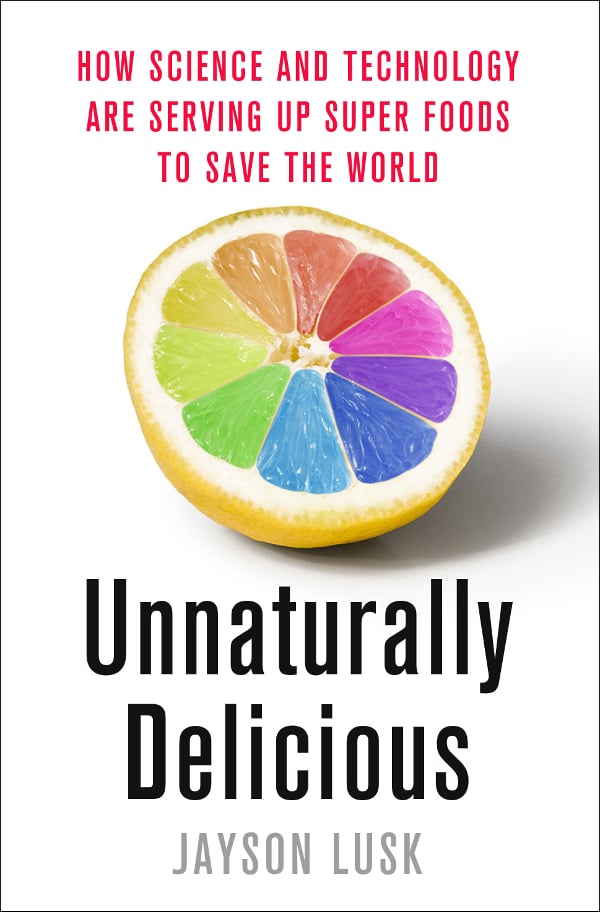
Kirkus Review of Unnaturally Delicious

“A provocative, well-documented challenge to one of the major contentions of environmentalists.”

That's a summary of the review of my forthcoming book, Unnaturally Delicious, from review magazine, Kirkus.

Here's the whole review:

An exploration of “the innovators and innovations shaping the future of food.”

Lusk (Agricultural Economics/Oklahoma State Univ.; The Food Police: A Well-Fed Manifesto About the Politics of Your Plate, 2013, etc.) admits that along with the abundance we now enjoy, there are significant challenges that must be met head-on, including climate change, environmental degradation, cruelty to animals, the abundance of unhealthy junk food, obesity, and more. Nonetheless, the author is optimistic. “We have inherited a bountiful world of food…[that] our ancestors could scarcely have imagined,” writes the author. For him, this is proof that Malthus and his modern followers such as Paul Ehrlich—author of The Population Bomb (1968) and other books—were misguided. Lusk’s claims are provocative, but he buttresses them by citing Department of Agriculture statistics demonstrating that U.S. agriculture has kept up with population growth through the application of technological innovations. Lusk reports that American crop production has more than doubled since 1970 while the use of pesticides has fallen, less land is in production, the agricultural labor force has decreased by half, and soil erosion has been reduced. In short, “agriculture has one of the highest rates of production of any sector of the U.S. economy.” The author admits to having had an axe to grind in the past, and he bristles at the use of the descriptive term “sustainable.” To him, it was “synonymous with organic, natural and local” and implied the necessity of reducing population. Lusk explains that he now recognizes that true sustainability depends on the use of agricultural technology. One counterintuitive example is the sustainability of U.S. beef production, which he claims has a “far lower carbon footprint than [grass-fed beef] in other parts of the world” because it is fattened with grain. Another fascinating example is the use of information technology to regulate seed-planting by providing farmers detailed, real-time information about their fields.

A provocative, well-documented challenge to one of the major contentions of environmentalists.

It's officially out March 22, but you can buy your copy now.

Did the Cancer Announcement Affect Bacon Demand?

On October 26, 2015 the International Agency for Research on Cancer (IARC) — an agency within the World Health Organization — released its report indicating that processed meat is carcinogenic.  

The announcement sparked a lot of media coverage with titles like: "Bad Day for Bacon".  (Here were my thoughts shortly after the announcement, along with some survey responses based the news).

Despite the news coverage after the announcement, I haven't seen much investigation of whether it impacted meat markets.  Thus, I thought I'd take a look at the data, recognizing it is probably impossible at this point to conclusively identify whether the IARC report caused a shift in demand.

I turned to the USDA Ag Marketing Service's daily reporting of pork primal composite values.  Rather than just looking at what happened to the prices of bacon (or rather pork belly) in isolation, it is probably useful to look in relation to another cut that may be less affected by the announcement.  I chose the pork loin.  This is an attempt to control for any changes over time happening on the supply-side (the quantity of loin from a pig is, at least in the short run, in fixed proportion to the quantity of pig belly).

I calculated the ratio of pork belly prices to pork loin prices over the past year.  The graph below shows the price ratio before and after the IARC announcement.  In the few weeks before the announcement, bellys were selling at 1.9 times the price of loins.  In the few weeks after the announcement, bellys were selling at only 1.5 times the price of loins.  Thus, there has been a roughly 26% drop in the relative value of bacon. 

At this point, I'd be hesitant to say that the IARC announcement is THE cause of this change, but the large immediate drop just following the release date is suggestive of some impact.  


Food Company Voluntarily Adds GMO Labels

This is a potential game changer (from the NYT):

Breaking from its industry rivals, Campbell Soup will become the first major food company to begin disclosing the presence of genetically engineered ingredients like corn, soy and sugar beets in its products.

A while back when writing about the duplicity of a many food companies on the issue of GMO labeling, I wrote

For now, food companies are not required to add labels indicating the presence of genetically engineered ingredients. But, it might ultimately be in their best interest to do it voluntarily, and in a way that avoids the negative connotations implied by the labels that would have been mandated in state ballot initiatives.

Some day in the near future, after concerted efforts to educate the public and create consumer-oriented biotechnologies, we may see food companies clamoring to voluntarily add a label that proclaims: proudly made with biotechnology.

Campbell's isn't going that far (and in fact they're supporting nationwide mandatory labels on foods with genetically engineered ingredients).  Nonetheless, this is an interesting move, and it will be fascinating to see how it plays out.

Possible Impacts of Massachusetts Ballot Question on Animal Welfare

Joshua Miler of the Boston Globe has a piece on a ballot initiative in Massachusetts.  He writes:

The proposed Massachusetts ballot initiative, backed by a coalition called Citizens for Farm Animal Protection, has met the first and most arduous signature-gathering hurdle to make the ballot and is expected to clear the other obstacles that remain to make the November ballot.

It would ban the production and sale in the state of eggs from hens and meat from pigs and calves kept in tight enclosures starting in January 2022. For selling of shell eggs in Massachusetts, each hen would have to have access to at least 1.5 square feet of usable floor space.

What are the possible cost implications?  

On the one hand:

a consulting firm being paid by advocates to conduct an economic analysis of the ballot question’s impact, said the price increase would be modest. He predicted something on the order of 1 or 2 cents per egg, 12 to 24 cents a dozen

On the other hand:

[a top executive at Sauder’s Eggs, a big producer in Pennsylvania which ships many eggs to Massachusetts] estimates that the Massachusetts ballot question would raise the price by 70 or 80 cents per dozen, maybe more.

Here was my take, as cited in the story:

Some experts in the field say the best place to look to compare prices is California, where the sale of eggs from hens kept in small “battery cages” became illegal at the start of last year.

In a recent paper, Jayson L. Lusk, a professor of agricultural economics at Oklahoma State University, and another researcher used grocery store scanner data from California and other states to estimate how California’s animal welfare law changed the price of eggs. Per a dozen eggs, they found it raised prices by around 75 cents on average, a 22 percent increase over what the price of eggs would have been had the laws not gone into effect.

Lusk acknowledged that there are several confounding variables in extrapolating that data to Massachusetts, from last year’s avian influenza outbreak to Massachusetts importing more of its eggs than California (which could make the increase bigger) to the growth of the cage-free industry by 2022 (which could make the increase smaller).

But the overarching conclusion was clear.

“Egg prices are going to increase in Massachusetts” if the ballot measure passes, he said, “I don’t think there’s any doubt about that. The question really is ‘how much?’ ”

The cited research papers are discussed in this post.