Blog

Restaurant Performance Index

I was recently made aware of the so-called Restaurant Performance Index (RPI) put out by the National Restaurant Association (NRA).  According to their website: 

The RPI is based on the responses to the National Restaurant Association’s Restaurant Industry Tracking Survey, which is fielded monthly among more than 400 restaurant operators nationwide on a variety of indicators including sales, traffic, labor and capital expenditures. Restaurant operators interested in participating in the tracking survey

and

Index values above 100 indicate that key industry indicators are in a period of expansion, while index values below 100 represent a period of contraction for key industry indicators. The Index consists of two components – the Current Situation Index, which measures current trends in four industry indicators (same-store sales, traffic, labor and capital expenditures), and the Expectations Index, which measures restaurant operators’ six-month outlook for four industry indicators (same-store sales, employees, capital expenditures and business conditions).

I was a bit curious. How well do some of the variables I'm tracking in my Food Demand Survey (FooDS) follow the NRA's RPI?  By looking back at past releases, I was able pull together  monthly data on the overall RPI, the current situation index, and the expectations index, and I merged these with data from FooDS on average reported spending on food away from home and changes in anticipated spending on food away from home each month.  

First, the good news.  Spending on food away from home (as measured by FooDS) seems to track closely with the RPI-current situation index.  

It probably isn't too surprising that the two are positive correlated since two of the measures of the RPI-current situation index are same store sales and traffic volume; however, it is still comforting to see my FooDS data roughly track this measure from the NRI.  One benefit of FooDS is that we release the data in a more timely manner.  Right now, the latest figures available from the National Restaurant Association (NRA) are for March.  However, I already have a measure of April's away from home food expenditures from FooDS (it's $55.43).  A simple linear regression predicts that NRA's current situation index will be 102.3 for April.  We're already fielding May's FooDS right now, so I can make an even more up-to-date forecast in a few days.

Now, the not-so-good news.  In FooDS, we track consumers' stated intentions to increase or decrease spending on food away from home in the following weeks.  One "anomaly" present in the FooDS data is that, every month, people say they plan to spend less on food away from home next month.  Over the three years we've been doing FooDS, the measure ranges from a -2.4% cutback in spending to a -1.05% cutback in spending (average is -1.59%).  I interpret this as people feeling guilty about spending on food away from home, and perhaps even evidence of a self-control problem: people plan to cut back on eating out but rarely actually do.  In any event, despite this "bias", trends in this variable might still be useful as there are some months people plan to cut back more than others.  

Here's a plot of the planned spending change on food away from home from FooDS alongside the expectations portion of the NRA's Restaurant Performance Index:  
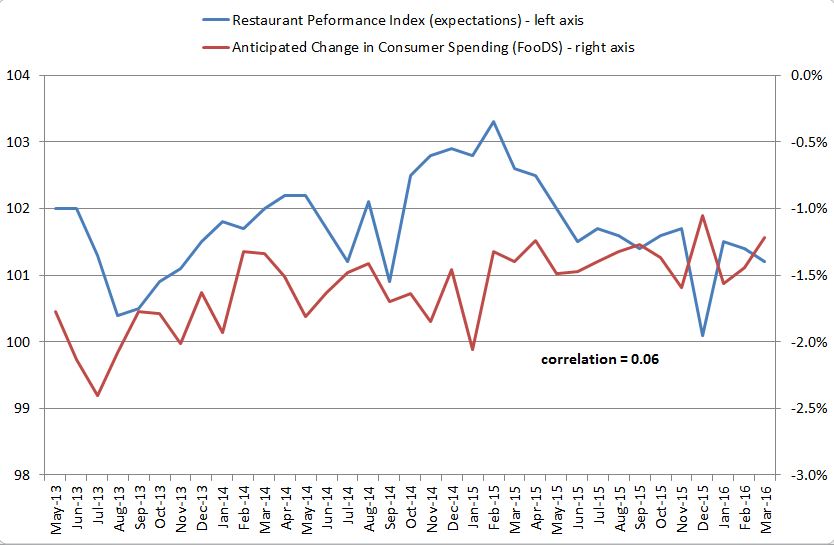
While the correlation between the two is positive, it is pretty weak.  The two track each other pretty closely through about mid 2014 and then start moving in opposite directions.  The two measures are getting at slightly different things.  One is measuring how restaurant owners/managers are planning to change capital expenditures, staffing, and what they think sales will be in the future; the other is a measure of how much consumers think they'll change spending.  Maybe all this says is that restaurant operators' expectations are not the same as restaurant consumers' expectations.  

So, here's a little test.  How well do restaurant owner's expectations this month correlate with their own "acutal" (or current performance index) the following month?  The correlation between the lagged NRA expectation index and the current period NRA current situation index is 0.35.  O.k., so there is some accuracy associated with the NRA's expectation index.

Now, let's do the same thing with the FooDS data.  How well do consumers' expected spending changes this month correlate with their own "acutal" food away from spending next month? The correlation between the two is 0.68.  So, despite the fact consumers' expectations are downwardly biased as discussed above, changes in their expectations seem quite predictive of next month's spending on food away from home.    

So, it seems consumers (in aggregate) know their own futures a bit better than restaurant operators know theirs.  

Books of possible interest

Food and Nutrition Economics by George Davis and Elena Serrano published by Oxford University Press.  

Food and Nutrition Economics offers a much-needed resource for non-economists looking to understand the basic economic principles that govern our food and nutritional systems. Comprising both a quick grounding in nutrition with the fundamentals of economics and expert applications to food systems, it is a uniquely accessible and much-needed bridge between previously disparate scholarly and professional fields.

Douglas Southgate sent me a review copy of his book with Lois Roberts, Globalized Fruit, Local Entrepreneurs How One Banana-Exporting Country Achieved Worldwide Reach just published by University of Pennsylvania Press.  Here's how the book starts:

A tropical commodity bought and sold by the boatload throughout the world. Agribusinesses with worldwide reach, including a firm that has been a lightning rod for anti-corporate criticism since the Great Depression. Minor Latin American states on the receiving end of globalization. An uncomplicated, and oft-told, story of banana republics and the misfortunes visited on them by multinational companies. What more need be said?

Bananas are the ultimate nonlocal food.

But . . . (from the publisher):

Instead, Southgate and Roberts show that a competitive market for tropical fruit exists in and around Guayaquil, a port city dedicated to international commerce for centuries. Moreover, that market has consistently rewarded productive entrepreneurship.

Wheat breeding

One of my favorite interviews in Unnaturally Delicious was with Brett Carver, who is a fellow professor at Oklahoma State.  Carver is a wheat breeder.  He took me out to some fields I drive past every day.

Carver took me out to the middle of an unusual-looking wheat field. The feeling of awe and beauty that comes when you look out at amber waves of grain arises, in part, from the many acting as one: each stalk and head of grain is about the same height and size, and the group moves in unison with the wind. But this wasn’t that type of field. Carver’s field looked a bit like
a bad hair day. It was chaotic. Some stalks of wheat were almost up to my waist, others were only a bit taller than ankle height. Some stalks were golden yellow, others were darker brown. Some spikes scrawny, others fat. Long bristles protruded from most of the plants’ heads, but some had no bristles. Carver’s goal is to create a new wheat variety.

and

Standing in the middle of the proverbial haystack he planted, Carver said, “There are sixty-six thousand different strains out here. I’ll pick one of them, and it will ultimately be grown on millions of acres. It’s a big responsibility.” Carver developed all the top four varieties of wheat planted in the state of Oklahoma——Duster, Endurance, Gallagher, and Ruby Lee— where farmers planted more than five million acres of wheat in 2015.

One of the most fascinating lessons I learned was about the history of wheat.

Even though wheat has been around since the dawn of civilization, it is actually a product of biotechnology. But, as Carver said, “Man didn’t do it. . . . God did it or nature did it, but it wasn’t man.” He added, “If I tried to do this today, I’d be labeled a mad scientist who’s creating some sort of evil genetically modified food.”

The history of wheat can be found in its DNA. Unlike humans, wheat does not have one father and mother but three fathers and three mothers. Rather than a single pairing of genes, which is what occurs in humans (a diploid), wheat has three sets of chromosomes, and each set exists as a pair—something called a hexaploid. This somewhat strange state of affairs came about when one species mated with another, and then it happened yet again. Carver explained that about 300,000 years ago one grassy weed species crossed with another—a spiky, unruly-looking plant that eventually led to the plant we call emmer. Then, about ten thousand years ago, this crossbreed mated yet again, with another grassy species, one of the many goatgrasses. The result is our modern wheat used for making bread . . . All this makes Carver’s job more complex. Whereas humans have an estimated twenty-to twenty-five thousand genes, wheat has 164,000 to 334,000 genes.

An Unusual Proposal

A reader who read my WSJ editorial on GMO labeling emailed me the following proposal.  

The arguments in support of mandatory labeling largely fall in the “consumers have a right to know what’s in their food” category, which in theory is hard to argue with. On the flip side, there are no proven scientific based concerns regarding GMOs in the foods we eat and this is the basis (in general) for the position for those who oppose mandatory labeling of GMOs. Therefore, the solution seems very simple: make labeling of non-GMOs mandatory. If those in support of mandatory GMO labeling truly are interested in transparency, then mandatory labeling of non-GMOs provides the same amount of transparency (if you’re only going to mandate labeling for one side of the argument, why not the non-GMO side?). In addition, this should ease the concern of those who fear that mandatory labeling of GMOs will scare the public into thinking they are unsafe. Another great aspect of this solution is the cost to implement is almost zero because the food industry, in general, already labels non-GMO products.

Food-Related Lawsuits of Interest

  • Chipotle has been hit with a couple lawsuits, at least one of which has made it through initial phases, related to its non-GMO claims.  One suit is in California and the other in Florida.  Both claim false advertising: despite the non-GMO claims, Chipotle's meat and dairy products continue to come from animals fed GMO.


  • In response to a Massachusetts ballot initiative that would change farm animal housing practices (and retailer's ability to source "caged" eggs/pork), a state farmer and a local anti-poverty activist (and SNAP recipient) have teamed up file a suit asking the courts to stop the ballot initiative. 


  • A couple years ago I commented on increasing amounts of litigation over "all natural" claims on food.  Several of those suits have now settled, with the food companies agreeing to compensate the plaintiffs  (e.g., Stevia, Kashi, Crisco, and others).  Kind bars are in the midst of a legal battle on its use of the word natural.