Blog

Locally-produced as compost the solution to global warming?

Gary Paul Nabhan published an op-ed yesterday in the NYT on global warming, agriculture, and farm policy.  Some of his suggestions, such as reducing regs and restrictions on "gray water" might have some merit (assuming food safety risks can be adequately handled) but most of his suggestions presume government is the only answer.

First, let's look at his premise that global warming will invariably lead to a "coming food crisis".  In actuality, a warming planet will produce some winners and some losers, and may be net-plus for agriculture.  It is possible that farmers in Arizona, where Nabhan resides, will lose from higher temperatures, but there likely to be other locations, like Canada, where agriculture benefits.  There is a lively debate among economists, fought out in the pages of the American Economic Review over precisely this issue (see the papers here or here suggesting climate change will benefit US agriculture or herehere, or here suggesting the reverse).  It would have been nice to see some discussion on this issue rather than simply claiming a disaster is coming.

Where things really go off base, however, are in the policy prescriptions.  Here are a few with some brief comments. 

First, he says about his strategies that: 

The problem is that several agribusiness advocacy organizations have done their best to block any federal effort to promote them
I'm not sure exactly what "blocks" these groups have but in the way of Nabhan's ideas, but more generally several farmer groups like the idea of carbon trading because they'd get paid for sequestration.   

His first policy is to: 

promote the use of locally produced compost to increase the moisture-holding capacity of fields, orchards and vineyards.

I'm not sure why the compost needs to be local if it is really so beneficial.  It is also unclear why farmers wouldn't source these materials now if they improved yield and limited chances of loss. I suspect if research showed these techniques could improve the moisture-holding capacity of soils, there wouldn't need to be much promotion or subsidy for farmers to adopt.

Then, we are told: 

the farm bill should include funds from the Strikeforce Initiative of the Department of Agriculture to help farmers transition to forms of perennial agriculture — initially focusing on edible tree crops and perennial grass pastures 

However, if the problem is that conventional crops are not as profitable in a warming environment, there needn't be a Strikeforce Initiative or top-town planning; farmers will willingly seek out those alternatives they can grow most profitably given altered weather conditions.

Then, we have another crisis: 

We also need to address the looming seed crisis. Because of recent episodes of drought, fire and floods, we are facing the largest shortfall in the availability of native grass, forage legume, tree and shrub seeds in American history

and

the National Plant Germplasm System, the Department of Agriculture’s national reserve of crop seeds, should be charged with evaluating hundreds of thousands of seed collections for drought and heat tolerance, as well as other climatic adaptations — and given the financing to do so.

Don't you think Monsanto, Dow, Bayer, and other seed producers have a HUGE incentive to store and develop crop varieties that are likely to be more profitable in a warmer climate?  I'm not exactly sure what is described here as a "seed crisis" that profit-making seed companies (and University breeders) aren't already thinking about.  Moreover, if the problem is really so dire as Nabhan suggest, why doesn't he suggest using all methods - including biotechnology - to increase drought resistance of crop varieties?  

The answer to that last question, I think, says it all.  I suspect Nabhan doesn't support use of biotechnology to solve the problem he sets up because his issue isn't really with the global warming effects on crop production per se, but rather it seems he sees an opportunity to re-engineer a food system to his liking using subsidies, regulations, and Strikeforce Initiatives, without giving much thought into the effects of such a system on global hunger and the price consumers pay for food.  It is all together fanciful to imagine the food system he proposes as bring down food prices, which, ironically, Nabhan, sets up as being the problem he aims to solve.  
 

Do Consumers Want Mandatory GMO Labeling?

The newest release of our monthly, nationwide food demand survey (FooDS) is now up.  The report contains data on trends in meat demand and awareness and concern over various food issues.  

Given the renewed interesting in mandatory labeling for genetically engineered food, we added two new questions to the July survey (if you're interested, you can see the results of a previous survey we conducted in California just before the Prop 37 vote); a version of that report is coming out in the Journal of Agricultural and Resource Economics).

The first question on GMO labeling asked in the most recent survey was worded:

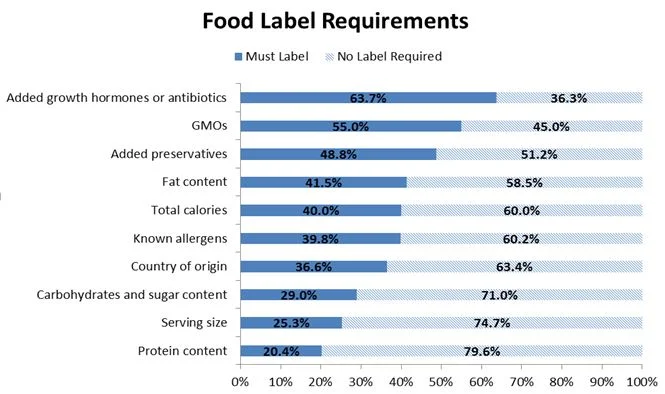
Which of the following do you think the FDA or USDA should require to be labeled on food packaging?

Then, 10 items were listed, and respondents had to place four and only four items in a box indicating which items they though were most important to label.  Here are the results.


gmolabelin1.JPG

I must say that I am shocked by the results.  63.6% said they thought "added growth hormones and antibiotics" should be labeled followed by 55% who said "GMOs."  Oddly, those items which ARE currently required to be labeled, including fat content, total calories, and known allergens (e.g., nuts), fell further down the list.  At first I thought this might be a mistake, but after double and triple checking the data, this is apparently how consumers responded.  Perhaps they take currently mandated information (e.g., calorie content) for granted (or don't realize it is mandated).  Perhaps GMOs are just more in news these days drawing attention?  On a technical note, the order of the 10 items was randomized across respondents, so these findings cannot result from some sort of order effect.  All in all, I'm not sure what is driving the result but I welcome any insights if you have them.

Secondly, we asked consumers: 

Which of the following best describes your views on mandatory labeling of foods containing genetically modified (GMO) ingredients?

They could pick one (and only one) of the following responses: 

  • I support mandatory labeling because consumers have a right to know regardless of the cost 
  • I support mandatory labeling, but only if it doesn't significantly raise food prices or cause frivolous lawsuits
  • I do not support mandatory labeling because voluntary labeling exists and will thrive if consumers really want to avoid GMOs
  • I do not support mandatory labels because the scientific consensus suggests GMOs are safe to eat
  • I don't know (5)

Here are the results


gmolabelin2.JPG

A majority (54%) said they wanted mandatory GMO labeling because they said they had a right to know regardless of the costs.  This result is surprisingly high and doesn't quite mesh with the actual voting outcome in California (or our previous survey which showed voting intentions influenced by cost and information).

As I articulated in several editorials in Sept-November last year, I do not think the economic arguments for mandatory GMO labeling are particularly strong (voluntary labeling is a different matter all together).  These survey results suggest little public support for that particular view.  However, there is also ample evidence to show that most consumers are woefully uninformed about biotechnology and that information can have big effects on attitudes (and as Prop 37 showed - voting outcomes).

Criticizing Technology

If you don’t want to see skeptics and libertarians “taking the side” of “big corporations,” don’t base your criticisms of them on false assertions and pseudoscience. Get your facts straight at the outset, and don’t argue beyond where they will take you. Skeptics don’t have any particular love for industrial giants, either, but what we don’t tend to do is use reasoning that guarantees a certain outcome, regardless of the evidence. Here’s how most reactionary, Luddite thinking works:
1. Assume any new product or technology is guilty until proven innocent.
2. Deny any evidence that could prove it innocent as fabricated.
3. Dismiss critics as deluded or paid off.
4. Invent a conspiracy to explain a lack of mainstream scientific support.
This kind of reasoning is absolutely impervious to reality, and it can be used support any position, no matter how absurd. Whenever you see an insular arguments like this, it’s almost guaranteed to be wrong. Don’t assume what you’re trying to prove–unless you’re trying to prove you’re an idiot. You shouldn’t confuse questions about the science with questions about a particularcompany, and don’t embrace any argument, no matter how appealing, until you are sure of its validity.

That's from Daniel Bier at the Skeptical Libertarian Blog.


Study shows GMO feed improves liver health in pigs!

Curiously, that it not the headline that is circling the web.  Rather, the headline in credible (but uncritical) news agencies is "Scientists say new study shows pig health hurt by GMO feed."

Wow!  Sounds scary.  I had to check it out.  The claim comes from a study published in the Journal of Organic Systems (you can find it on the author's web page).  My first thought was: A journal that essentially promotes organic is not exactly credibility inspiring.  But, the study should speak for itself and I read it.  

What you'll find is, by and large, a fishing expedition.  The authors fed one group of pigs a diet of GM corn and soy and another group of pigs a diet of non-GM corn and soy.  They then tested for differences between the two group.  Here's where the problem comes in.  The authors didn't set out with a specific causal hypothesis - they simply tested for differences in everything from liver size to body weight to the headline-grabbing stomach inflammation.  I counted more than 40 different p-values coming from tests in the paper.  Just by chance, the authors would expect to find one or two significant differences and that's exactly what they found.  Out of the 40+ tests conducted there were two p-values less than 0.05 (at 5% level of significance, you'd expect 1 test out of 20 (or 2 out of 40) to be significant just by chance).  One significant result showed higher proportion of pigs with "severe stomach inflation" in GM fed pigs than in non-GM fed.  The other showed a elevated levels of GGT (a signal of liver problems) in non-GM fed pigs relative to GM fed.   

To me, the take home message is that there is no difference in GM and non-GM fed pigs that is not attributable to chance (the authors would need to correct their p-values for multiple comparisons to truly say this is non-random; they'd also need a causal theory for why one result is significant while 40+ are not).  Oddly, the only result that they find significant and gets played up is also one of the ones that is not an "objective" measure but is one in which veterinarians have to make a judgement call as to which stomachs are inflamed and which are not.  If you add together the severe and moderately inflamed, what you find is that 52% of non-GM feed pigs meet this condition and 56.9% of GM feed pigs meet this condition - a difference that is unlikely significant (moreover, a higher percent of GM fed pigs (11.1% ) had no stomach inflammation as compared to non-GM fed (5.4%).  Again, the authors need to do some kind of joint test of significance across all 4 inflammation categories. 

Unfortunately, this study, much like the previous French-rat study will be used uncritically by anti-GMO activists, and it wont be taken in the larger context of the hundreds of other studies showing no differences.   

Although the paper should stand (or fall) on its own merits (or demerits), it is sometimes useful to look at author connections.  And even though no conflicts of interests were declared, Mark Lynas points out on his blog that these are hardly disinterested parties. Among other issues,  the funding comes from a company promoting non-GMO "natural" food.  For other critical analysis see the Lynas blog as well as this one.