Blog

Experimental Auctions - What's New?

It is hard to believe it’s been over a decade since my book with Jason Shogren on experimental auctions was first published. We’ve learned a lot and the field has evolved in the intervening years since this publication. As a result, I’m happy to announce a new review article, just released by the European Review of Agricultural Economics, on experimental auctions with Maurizio Canavari, Andreas Drichoutis, Rudy Nayga, and myself. Maurizio, Andrea, Rudy, and I have been hosting a summer school in various European locations on this topic ever since 2011, and our annual discussions have been very useful in thinking about works well and what doesn’t when conducting an experimental auction.

For readers of this blog who aren’t academic economists, you might be wondering: what, exactly, is an experimental auction and why would you want to conduct one? The motivation for the method comes from the widely known fact that people’s answers on surveys don’t always align with their behavior in a grocery store. A general rule of thumb is that the average willingness-to-pay one finds in a survey can be divided by two if one wants to know know what people will actually pay when money is on the line.

The problem is that we often want to know the value people place on times that aren’t regularly traded in a market, where real economic incentives are at play. An experimental auction solves the non-market problem by creating a market in a lab or online setting. An experimental auction involves people bidding real money to obtain (or exchange) real goods (typically food in my applications) in a type of auction with rules where people have an incentive to truthfully reveal their preferences.

Here’s the abstract:

In this paper, we review recent advances in experimental auctions and provide practical advice and guidelines for researchers. We focus on issues related to randomisation to treatment and causal identification of treatment effects, design issues such as selection between different elicitation formats, multiple auction groups in a single session and house money effects. We also discuss sample size and power analysis issues in relation to recent trends in experimental research about pre-registration and pre-analysis plans. We position our discussion with respect to how the agricultural economics profession could benefit from practices adopted in the experimental economics community. We then present the pros and cons of moving auction studies from the laboratory to the field and review the recent literature on behavioural factors that have been identified as important for auction outcomes.

For Ph.D. students, or anyone looking for a new idea to work on, I’ll note that the conclusions section has a slew of ideas for future research.

Milk - Differentiation and Substitution

This article in the Wall Street Journal has some interesting data and anecdotes about the rise of Fairlife Milk - an ultrafiltered, branded milk product that has more protein and less sugar than regular milk. Apparently sales of Fairlife are up 30% over the past year, and that’s in spite of some negative publicity about some animal welfare issues over the same time period. What’s interesting about the article is that we are likely to see similar trends in mean animal protein markets in the coming years - the push to differentiate and the rise of unexpected competitors.

As the article makes clear, the rise of Fairlife has been quick and surprising. Fairlife now commands about 3% of the dairy-milk market, just a bit less than Horizon, the largest organic milk brand, which has been on the market for 30 years and has a market share of 3.7%. I suspect not many would have guessed 5 to 10 years ago, that the hottest selling milk brand would make its mark based on a technology-enabled nutritional profile as opposed to sustainability/animal-welfare claims.

As for unexpected competition, I’m heard folks in the dairy industry complain about competition from plant-based sources such as almond milk and soy milk, but according to the article:

... in the last four years, when milk sales fell by 330 million gallons, plant-based milk sales increased by only 60 million gallons.

The sector lost 270 million gallons elsewhere.

The likely culprit? Water.

“We’re losing over 50% to bottled water,” Mr. Ziemnisky said. “No. 2 is ready-to-drink coffee.” In addition, Americans are eating less breakfast cereal, accounting for about 25% of milk’s decline.

Consumer beliefs about healthy foods and diets

That’s the title of a new article I just published in the journal PLoS ONE. This is an exploratory/descriptive study with the aim of probing consumer’s perceptions of the term “healthy” in relation to food. The study is motivated by the fact that the FDA regulates the use of the term on food packages, and is in the process of reconsidering the definition. Here are some of the key results:

Consumers were about evenly split on whether a food can be deemed healthy based solely on the foods’ nutritional content (52.1% believing as such) or whether there were other factors that affect whether a food is healthy (47.9% believing as such). Consumers were also about evenly split on whether an individual food can be considered healthy (believed by 47.9%) or whether this healthiness is instead a characteristic of one’s overall diet (believed by 52.1%). Ratings of individual food products revealed that “healthy” perceptions are comprised of at least three underlying latent dimensions related to animal origin, preservation, and freshness/processing. Focusing on individual macronutrients, perceived healthiness was generally decreasing in a food’s fat, sodium, and carbohydrate content and increasing in protein content. About 40% of consumers thought a healthy label implied they should increase consumption of the type of food bearing the label and about 15% thought the label meant they could eat all they wanted.

One part of the analysis focuses on parsing out the correlations between the healthiness rating consumers placed on different types of foods . Below are three dimensions of 15 food’s healthiness ratings as determined by factor analysis.

healthy_factor.JPG

Here’s the portion of the text describing these results:

The first factor (explaining 54% of the total variance), shown on the vertical axis of the bottom panel of Fig 3 shows all animal products with high values and other non-animal products with lower values, suggesting consumers use animal origin as a primary factor in judging whether a food is healthy. A second factor (explaining 31% of the total variance), illustrated on the horizontal axis of the top panel of Fig 3, has canned and frozen fruits and vegetables with the highest values, bakery and cereal items, candy, and fresh fruits and vegetables with mid-to-low values, and animal products with the lowest values, which seems to suggest consumers use degree of preservation as another dimension of healthiness. Finally, the third factor (explaining 22% of total variance), illustrated on the vertical axis of the top panel and the horizontal axis of the bottom panel of Fig 3, indicates freshness or degree of processing is another dimension to healthiness evaluations. These results indicate that healthiness is not a single unifying construct, but rather consumers evaluate healthiness along a number of different dimensions or factors. A food, such as beef or fish, can be seen as scoring high in some dimensions of healthy but low in another.

There’s a lot more in the article.

What Food Policies do Consumers Like and Dislike?

I have a new working paper with Vincenzina Caputo in which we elicit consumers’ preferences for 13 different food policies. Here’s our main motivation (references removed for readability).

A variety of food policies have been proposed, and in some cases enacted, in an effort to improve public health, environmental outcomes, or food security. Proposed actions include a spectrum of policies ranging from fiscal incentives/disincentives, bans, labelling programs, and passive policies such as subsides and investments in education. What food policy proposals do consumers prefer? While there have been numerous studies aimed at calculating the welfare effects of individual food policies it is difficult to easily ascertain the relative preferability of numerous policy options, even those that have the same objective (e.g., “fat taxes” and nutritional education both aim to improve public health).


We conducted a nationwide survey of 1,056 U.S. consumers who were asked to indicate the relative desirability of the following food policies.

policy1.JPG

Rather than use a traditional approach, where respondents are not required to make trade-offs between policies (e.g., people can approve of all policies or rank all policies as “very important”), we used the “best worst scaling” approach that requires respondents to make trade-offs. The approach requires respondents to answer a series of questions like the one below, where for each question, they have to indicate their most and least preferred policies.

policy2.JPG

The results are analyzed using a choice model that allows for preference heterogeneity. The main outcomes are below, reported as “preference shares” - i.e., the percent of people predicted to choose each policy as most preferable. Results indicate the highest levels of support for investments in agricultural research and requirements of food and agricultural literacy standards in public education. Fat, calorie, and soda taxes are the least popular. These preference shares provide a measure of intensity of preference in a population. Funding for agricultural research is 14%/8% = 1.75 times more preferable than symbolic nutritional labeling.

policy3.JPG

While the above results are useful in providing intensity of relative preferences, they do not indicate whether people would actually vote in favor of a policy. The table below shows the results of that question; the results largely align with the best-worse scaling approach. Fewer than one-third of respondents are in favor of these three tax policies.

policy4.JPG

There are a number of significant demographic correlates with policy preferences. Some are not surprising. For example, Nutrition Assistance (or SNAP) is more desirable to lower income vs. higher income households and Democrats vs. Republicans. As another example, soda taxes are less desirable among lower income households.

Funding for agricultural research was generally supported across all demographic categories except for age: older individuals were more supportive of funding for agricultural research than younger individuals.

My State is Better than Yours: Competition between State Food Branding Programs

The journal Agribusiness just released a new paper I co-authored with Clint Neill and Rodney Holcomb. The work was motivated by the observation that every state in the U.S. has an agricultural marketing program aimed at promoting foods from their state. Examples include the “Taste NY” and “Pride of New York” programs as well as “Go Texan” and “California Grown.”

Our questions were two fold: 1) How much do consumers value products labeled with their state’s logo relative to other states’ products, and 2) what are the implications for state marketing programs?

We surveyed 6,900 consumers in an eight‐state contiguous region. For our application, we chose milk, and asked people which of several milk products with different state logos (and a regional or national brand) they preferred at different prices.

Not surprisingly, we find that consumers prefer products with their own state’s logo. For example, Texans’ average willingness-to-pay (WTP) for Texas milk is $4.14/gallon, but Texans’ value for milk from bordering states, New Mexico, Oklahoma, and Arkansas only averaged $1.82, $2.65, and $2.72/gallon, respectively. There are a number of interesting patterns. Here’s an excerpt from the text:

While each state’s consumers tend to prefer their own label and have a distinct order of preference for other states, the asymmetry between states is less clear. For example, Oklahoma consumers are willing to pay $2.84 for the Texas label but Texas consumers are only willing to pay $2.65 for the Oklahoma label, so there is an asymmetry of $2.84−$2.65 = $0.19. Thus, Oklahomans value the Texas label $0.19 more than Texans value the Oklahoma label.

Table 5 shows this type of asymmetry for all combinations. Interestingly, every other state’s consumers value the Colorado label more than Colorado consumers value other states’ labels. Alternatively, New Mexico consumers value all other state brands more than the other states’ consumers value the New Mexico label.

While it is perhaps obvious that people in a state will tend to prefer their own products, it is also important to note that people have some value from agricultural products from other states (and, in fact, some small share of people prefer products from another state). The result is that state branding programs “steal” consumers from other states (the effect is a bit like the prisoner’s dilemma problem). The state branding program looks great if your the only state that has the program, but if all states have their own programs, the effects partially serve to cancel each other out. Here’s what we write about this so-called “beggar thy neighbor” effects:

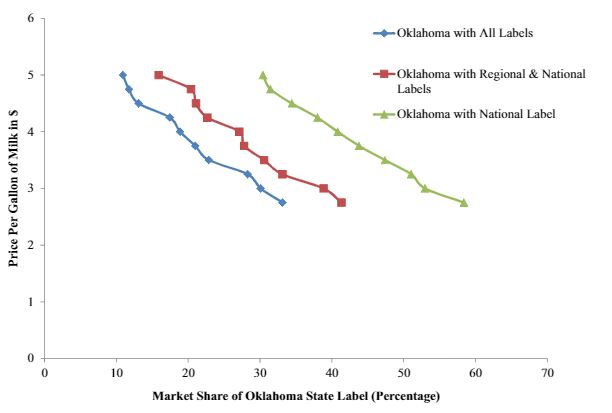
In the case of market shares, we were able to illustrate the large decreases as a group of producers from one state starts with having no state branded competitors to competing against several other brands within a region. Producers, ideally, would have a higher return if they were the only ones with a state label, but the optimal strategy for all agents in the region is to utilize a state label. Thus, the potential beggar‐thy‐neighbor scenario is possibly a Nash equilibrium. Furthermore, states who market their brand outside their borders are shown to have increased total market share

For example, below is a graph showing what happens to demand for milk with a “Made in Oklahoma” label when no other states label their product (the green line with triangle markers) relative to what happens to demand for “Make in Oklahoma” milk when other states introduce their own labels (the red and blue lines). As the figure below shows, the market share more than halves when one state’s label has to compete with all the others in a region.

beggarneighbor.JPG

One potential solution (at least from the producer’s perspective) we discuss is for groups of states to band together and use a regional label.