Blog

Food Affordability Over Time

On a number of occasions, I’ve written about the Engel Curve, which relates the share of consumer spending on food to the consumer’s income (or total expenditures on all goods). Whether we compare consumers within a country or compare spending across countries, a common relationship holds: the higher a consumer (or country’s) income, the smaller the share of their income they tend to spend on food.*

This relationship indicates that as consumers and countries get richer, we’d expect food expenditure shares to fall, a phenomenon generally thought to be associated with higher consumer well-being. While this relationship is widely known among economists, there is another fact that is not as widely known. In particular, the entire Engel Curve has been shifting downward over time. That is, for any given level of income, consumers today are spending less on food than they were in the past.

To illustrate this phenomenon, I pulled data from the Consumer Expenditure Survey that has been collected annually since 1984 by the Bureau of Labor Statistics (BLS). The BLS report food expenditures and total expenditures by quintiles of income. These data were used to create the following animation.

The video shows that, despite the year-to-year variation, there is a fairly steady shift in the Engel Curve over time downward and to the right. That is, consumers are getting richer over time (i.e., their total expenditures are rising), and for any given level of total expenditures, the share being spent on food is generally falling. There are several possible drivers of this phenomenon, but one likely culprit is technological progress. For any given level of income or total expenditure, innovation and technological change has brought down the price of food such that consumers are able to eat what they want while being able to spend more of their income on other, non-food items. That is, food today is more affordable (at least by this metric) for households of all incomes (or total expenditure categories).


*Note: just because the food share falls, it doesn’t mean total spending on food falls as income increases. In general, richer consumers spend more on food than poorer consumers. However, spending on non-food items tends to increase at a faster rate than spending on food as income rises, leading to a smaller share of income being spent on food.

Retail Food Prices in 2018 and Beyond

The December 2018 edition of the Purdue Ag Econ Report is out. Some of the questions addressed by my colleagues include:

  • Why will the U.S. economy slowdown in 2019?

  • What are the implications of the Administration’s trade policy in 2019?

  • What was accomplished for agriculture in the new farm bill?

  • Record corn yields and higher corn prices increase corn returns. How much?

  • Record bean yields, Chinese tariffs and trade assistance payments. What’s the net effect?

  • Crop costs for 2019. What crops to plant?

  • Cash rents and land values. Up or down for 2019?

  • What will you be paying for food in 2019?

My contribution was to weigh in on the last question about retail food prices.

Changes in the retail price of food at home have remained low, averaging just 0.5% year-over-year growth over the past five years and 0.4% year-over-year growth thus far through 2018 according to data from the Bureau of Labor Statistics.  Inflation of food prices away from home, by contrast, is higher but has remained fairly stable over time at about 2.6% year-over-year increases.  Since 2016, prices of food at home have grown much more slowly than overall prices in the economy, implying food at home is becoming cheaper in real terms.  Since 2017, changes in prices of food away from home have been at about the same level as prices changes in the rest of the economy. 

foodprices18.JPG

The U.S. Department of Agriculture, Economic Research Service (ERS) projects annual food price inflation, for combined food at home and away from home, of between 0.75% and 1.75% for the year 2018, increasing to 1.5% to 2.5% for 2019.  In 2018, low agricultural commodity prices helped keep downward pressure on food price inflation.  Several commodities, such as pork, dairy, and processed fruits and vegetates experienced overall price declines, or deflation, in 2018.  A few commodities have experienced more significant retail price increases in 2018, including beef (expected to increase about 1.75%) and eggs (expected to increase more than 9% from 2017 to 2018).

 As the foregoing suggests, food price affordability is driven in part by where consumers choose to buy their food.  ERS calculations indicate that since 2010, consumers have been spending more money on food away from than they are on food for at-home consumption.  In 2017, consumer spent almost $870 billion on food away from home and about $747 billion on food at home, implying 54% of food expenditures were for food consumed away from home. 

Even for food consumed at home, consumers are changing their purchasing habits.  Two decades ago, 71% of food for at-home consumption was bought at grocery stores; today the figure is only 58%.  Consumers have shifted food purchases away from grocery stores toward warehouses clubs and superstores.  For food away from home, there has been a slight shift toward more food spending at limited-service restaurants over the past two decades, but overall the share of meal spending at full service restaurants compared to other outlets has remained steady at about 36% of all food away from home spending. 

Turkey Prices

It’s almost Thanksgiving. That means its time for the annual news stories on trends in turkey prices. I put out a story a week or so ago that has been picked up in a number of print, radio, and TV spots. The headline is that this November’s turkey prices are expected to be at a 10 year low.

For a bit of background and context, this claim is based on average price data reported by the Bureau of Labor Statistics (BLS). These data are collected as a part of the BLS’s effort to construct the consumer price index (CPI) and monitor inflation. Here is a graph of inflation-adjusted retail prices for frozen turkey for the past eleven years in the months of October, November, and December.

turkeyprice.JPG

The blue line represents November prices (we don’t yet know the 2018 November’s price, so it is foretasted based on past price movements). This year’s November price is expected to be around $1.45/lb, which is about 22% lower than the peak in 2013 and about 6% lower than back in 2008.

A couple comments based on the above graph. Interestingly, prices tend to fall from October to November. On average during the past 10 years, November prices are about 8% lower than October prices. At first blush, this might seem a bit strange. Doesn’t demand for turkey increase during thanksgiving, which should drive up turkey prices? Yes, but other factors are also at play. For one, retailers may strategically cut the price of turkey to get people in the door to buy the rest of their thanksgiving meal - i.e., turkey is potentially a “loss leader.” Second, producers expect the demand shift and produce more birds around the holiday. Here is a figure from the Livestock Marketing Information Center (LMIC) based on USDA data. As you can see, turkey production tends to peak each year in November.

turkeyproduction.JPG

I should note that the American Farm Bureau puts out an annual cost of Thanksgiving, and their estimates are for prices to be down this year as well. The USDA Economic Research Service estimates overall food price inflation and they’re also projecting historically low price increases. For 2018, they forecast prices for food at home to only rise only between 0 and 1% for the year; the 20 year average is about 2.1%. Why the low food prices?

One answer is that food production in general, and turkey production in particular, has become much more productive. We get more using less. Here is data again from the LIMC and USDA showing the number of turkeys slaughtered in federally inspected facilities since 1960 alongside the calculated number of pounds produced per turkey.

turkeyproduction2.JPG

Prior to the 1970s, turkeys averaged about 15 lbs/bird, a figure that’s increased almost linearly since the 1980s up to the point now where we are over 30 lbs/bird. In fact, compared to the mid 1990’s we now have about 5 million fewer turkeys slaughtered every month even though we’re actually producing more total lbs of turkey today than in the early 1990s. Here’s total lbs of production over time.

turkeyproduction3.JPG

The other big factor driving the recent affordability of turkey and other foodstuffs is that commodity (e.g., corn, soy, wheat) prices are low and have been low for the past couple years. Of course, this can’t be the only explanation because the price of retail foodstuffs is comprised of much more than just commodities, so it must mean that the prices of other inputs like labor, energy, and packaging have also remained relatively affordable.

The Cost and Market Impacts of Slow Growth Broilers

I just finished up a new working paper (available here) with my Purdue ag econ colleague Nathan Thompson and Shawna Weimer, a soon-to-be assistant professor of poultry science at the University of Maryland.

Readers may recall my post from a couple months ago on consumer demand for slow-growth chickens. This new paper focuses on producer costs of switching to slow-growth broiler chicken. Here’s the motivation from the paper (references removed for readability):

While modern broilers only live about six weeks, there are concerns that the bird’s legs are unable to adequately support the larger bodyweights, leading to pain and an inability to exhibit natural behaviors. As a result of such findings, animal advocacy organizations have begun to pressure food retailers to use slower growing breeds, European regulators have encouraged slow growth broilers, national media attention has begun to focus on the issue, and some animal welfare standards and labels have begun to require slower growing broiler breeds. There has been some consumer research on demand for this attribute, but little is known about the added production costs associated with slow growth chickens.

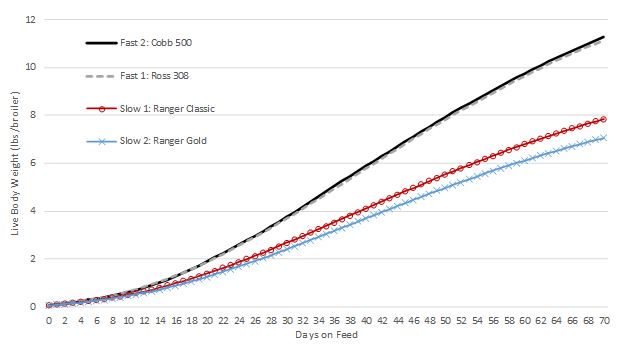
We obtained data from commercial breeding companies on two slow growth broiler breeds (called Ranger Classic and Ranger Gold) and data on two modern fast growing breeds (called Ross 308 and Cobb 500). Here are the growth curves for the four broiler breeds:

slow_growth3.JPG

The two slow growth breeds are, well, slower growing. The slower-growing breeds take 54 and 59 days, respectively to reach 6 lbs, whereas the faster growing breeds both hit this target weight in about 41 days.

These growth data are combined with data on feed intake, prices, assumptions about stocking density, and more, and we calculate costs and returns under a number of different scenarios. Here are the main results for the most likely scenario where producers choose the number of days to feed broilers so as to maximize net returns and where slow growth broilers have a more generous stocking density than fast growth broilers, as dictated in many animal welfare guidelines.

slow_growth4.JPG

About 17.45 lbs/ft2/year (or 73%) more chicken on a dressed weight basis is provided by the two fast vs. two slow growth productions systems, on average. Thus, substantially more barn space, or square footage, would be required to produce the same volume of chicken from slow as compared to fast growth breeds. Costs of production average $0.54/lb for the two slow growth breeds and average $0.47/lb for the two fast growth breeds, implying costs are 14% higher per pound for the slower growth breeds. Fast growth breeds are substantially more profitable - generating returns about twice as high per square foot than the slower growth breeds. We calculate that the slower growth broilers would need to obtain wholesale price premiums of $0.285/lb and $0.363/lb to achieve the same profitability as the best performing fast growth breed.

We also use these estimates to calculate potential market impacts that would occur if the entire industry transitioned from fast to slow growth broiler breeds. Under the most likely scenario, we calculate that converting to slow growth breeds would increase retail chicken prices by 1.17% and reduce the amount of retail chicken sold by 0.91%, resulting in losses in producer profits of $3.5 billion/year. We also calculate that consumers would be worse off by $630 million/year, assuming their demand for chicken doesn’t change in response to the switch from slow to fast growth. Increases in consumer willingness-to-pay of 8.5% would be needed to offset the adverse effect on producer profits.

Market Impacts of GMO Labeling

Readers might recall the result from the study Jane Kolodinsky and I published in Science Advances earlier this year. We found that the provision of mandatory labels in Vermont appears to have reduced opposition to GMOs in that state. However, as I noted at the time,

Our result does NOT suggest people will suddenly support GMOs once mandatory labels are in place.

Indeed, the data suggest consumers will still want to avoid products with GMO labels, which provides incentives for food retailers and manufacturers to find ways to avoid GMO ingredients.

Colin Carter and Aleks Schaefer just published an interesting new study in the American Journal of Agricultural Economics, which powerfully shows that mandatory GMO labels are already having significant market impacts. They found a creative way to explore this issue by focusing on the market for sugar. They provide the following background:

In the United States, sugar is produced from both sugarcane and sugarbeets. Sugarcane stalks are milled to produce raw sugar. Raw cane sugar is then sent to a refining facility to be transformed into refined sugar. Sugbarbeets, in contrast, have no raw stage; they are processed from beet to refined sugar in one continuous process. The U.S. market share for beet (cane) sugar is approximately 58% (42%). Almost all U.S. sugarbeet production is GE, while cane sugar is GE-free. However, sugar derived from beets is chemically identical to sugar derived from cane.

This summary data they provide on prices of sugar from cane and beet sources suggests “something” change around the same time as the Vermont mandatory GMO labeling law.

Source: Carter and Schaefer, American Journal of Agricultural Economics

Source: Carter and Schaefer, American Journal of Agricultural Economics

Here are the main findings.

Our analysis supports the explanation that the divergence in U.S. prices for refined cane and beet sugar was the result of Vermont’s mandatory GE labeling. The divergence occurred on or around July 2016— the month the Vermont Act took effect.

Counterfactual price estimates generated by a regression model suggest that GE food labeling initiatives generated a small premium for cane sugar and a price discount for beet sugar of approximately 13% relative to what prices would have been in the absence of such legislation.

These changes in raw ingredient prices will ultimately have impacts on retail food prices. All this is suggests that mandatory labels aren’t a free lunch.