Blog

What is Natural Food Anyway?

At little over a month ago, I discussed some of the ongoing legal challenges that are swirling around "natural" claims on foods.  One of the big challenges is that the word "natural" is nebulous and is vaguely defined by regulators.   

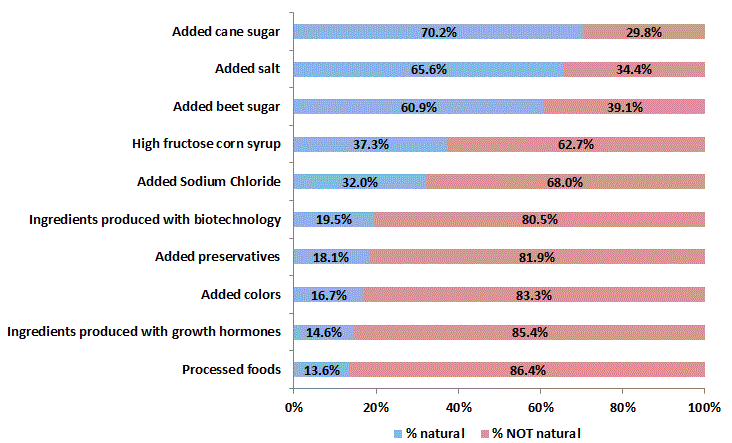
I thought I'd try to shed a little light on the subject by making use of the survey project I just started and asking consumers what they think the word means.  In June, I added two questions to the survey.  The first question listed 10 statements and individuals had to place them in a box that said "I believe foods containing this ingredient are natural" or one that said "I DO NOT believe foods containing this ingredient are natural."  The order of items was randomized across respondents (sample size is 1,004, demographically weighted to match the US population, sampling error is about +/- 3%).  

naturalfig.GIF

The results indicate that most people think added cane sugar, salt, at beet sugar are "natural" but HFCS, sodium chloride, and biotechnology are not.  Interestingly, salt and Sodium Chloride are the same thing!  Yet, using the technical/scientific name reduces the % perceiving salt as natural from 65.6% to 32%!

Processed foods are seen as least natural.  "Processed food" is also a vague term.  Is cheese a processed food?   

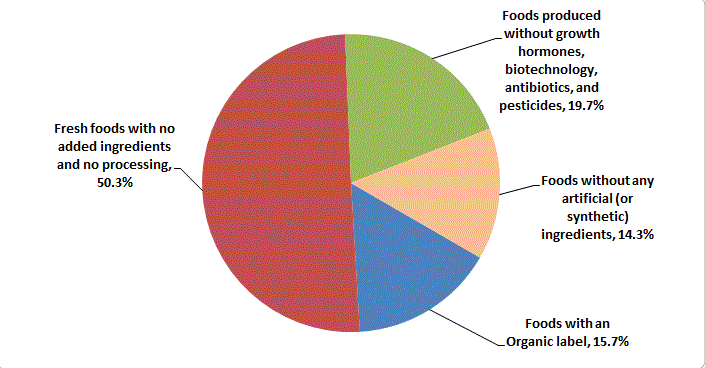
The second question I asked was the following, "Which of the following best fits your definition of 'natural food'?"  I gave four options, and here is the % of respondents choosing each option.

nafig2.GIF

The majority of respondents thought that the best definition (at least among the four I included) was, "fresh foods with no added ingredients and no processing."  

I suspect many of the foods sitting on a grocery store shelf that use the word "natural" do not meet this definition consumers found most descriptive.  

Stossel teaches the kids

Last night, I talked about biotech and GMOs on the John Stossel show.  I haven't yet been able to find a link to the entire show, but it is summarized here.   They edited down the segment I was in but overall, I was pleased with how it turned out.  

 I was particularly pleased when my older sister sent me the following picture of her kids (my niece and nephew) watching the show.  I suppose the lesson here is that if you want your kids (and nieces and nephews) to pay attention to you - get on TV.  Hey, they might have actually learned something!   

grantraylee.JPG

Economists, Fat Taxes, and the 3500kcal rule

Economists are often sought out to help determine the effects of fat and soda taxes.  We are generally well-equipped to estimate how much less of a particular type of food will be eaten when prices increase as a results of a tax.  However, we are much less well-equipped to go the next step and figure out how changes in the consumption of a food results in a change in weight - the key statistic of interest.  That last step requires some knowledge of nutrition, biology, and metabolism.  

Unfortunately, it turns out that one of the critical "thumb rules" that we economists have used from those literatures, that a change in 3500 kcal will equate to a change in 1 pound of body weight, is likely highly misleading and overstates the effects of the tax (not to mention that it says nothing of when the weight change will happen or how long it will take to happen).  

I've previously blogged about some of the issues with this thumb rule but I'm not sure how widely the problem is understood or recognized among economists.  For example, here are some quotes from some recent, otherwise well-done papers.     

Okrent and Alston in the American Journal of Agricultural Economics in 2012 (free version here) said:

One frequently used relationship in textbooks (e.g., Whitney, Cataldo, and Rolfes 1994) and academic articles that address the potential impacts of fiscal policies on weight (e.g., Chouinard et al. 2007; Smith, Lin and Lee 2010) is that a pound of fat tissue has about 3,500 calories. We used this multiplier to convert changes in annual calorie consumption into changes in body weight.

Dharmasena and Capps in the Health Economics in 2011 said:

Finally, using the conversion ratio of 3500 cal per pound of body weight, we calculate the induced change in the per capita body weight in pounds as a result of aforementioned change in the per capita caloric intake.

Kulcher et al in Applied Economic Perspectives and Policy (formerly the Review of Agricultural Economics) in 2005 said: 

Assuming that no food would be substituted, at 3,500 calories per pound of body weight (American Dietetic Association), the [estimated] reduction translates into less than a fourth of a pound.

To be fair, I didn't appreciate the problem till only recently.  My own paper with Schroeter and Tyner in the Journal of Health Economics in 2008 stated the following (although we used a different calculation to derive weight changes):

On average, in order to gain (lose) one pound, a person needs to consume (burn) 3500 calories in addition to the typical caloric intake (expenditure). Overall, a surplus (deficit) of 500 kcal a day brings about a gain (loss) of body fat at the rate of one pound per week and a surplus (deficit) of 1000 kcal a gain (loss) of two pounds per week (Whitney et al., 2002).

In this context, I was pleased to see this recent article in the International Journal of Obesity, which we economists can use to derive better weight effects.  Here is the abstract

Despite theoretical evidence that the model commonly referred to as the 3500-kcal rule grossly overestimates actual weight loss, widespread application of the 3500-kcal formula continues to appear in textbooks, on respected government- and health-related websites, and scientific research publications. Here we demonstrate the risk of applying the 3500-kcal rule even as a convenient estimate by comparing predicted against actual weight loss in seven weight loss experiments conducted in confinement under total supervision or objectively measured energy intake. We offer three newly developed, downloadable applications housed in Microsoft Excel and Java, which simulates a rigorously validated, dynamic model of weight change. The first two tools available at http://www.pbrc.edu/sswcp, provide a convenient alternative method for providing patients with projected weight loss/gain estimates in response to changes in dietary intake. The second tool, which can be downloaded from the URL http://www.pbrc.edu/mswcp, projects estimated weight loss simultaneously for multiple subjects. This tool was developed to inform weight change experimental design and analysis. While complex dynamic models may not be directly tractable, the newly developed tools offer the opportunity to deliver dynamic model predictions as a convenient and significantly more accurate alternative to the 3500-kcal rule.

Finally, I will end by noting that there are many papers that use economic models to project how a tax/subsidy will change the consumption of certain nutrients, and similar thumb rules are used to translate to changes in heart attacks, diabetes, etc.  Although I don't know for sure, I suspect many of the exact same sorts of problems exist with these thumb rule extrapolations as exists with the 3500kcal=1lb rule, not to mention the larger difficulty of ascribing causation in those models.   


Country of Origin Labeling for Meat

About a decade ago, the US Congress passed mandatory country of origin labeling for a variety of food products including beef and pork.  At the time, we did some research on the costs of the law and the demand responses that would be required to offset those costs.  

In the intervening years, the law was implemented, the US was taken to court by Canada and Mexico, and the US labeling law was deemed to be an illegal trade barrier by the World Trade Organization (WTO).  However, rather than dropping the law altogether, lawmakers have doubled down and made them even more onerous and costly in an attempt to comply with the WTO ruling (you can read the current regs here).    ​

There is a key disconnect that is driving much of this debate.  When you ask people on surveys if they want to know the origin of their meat products, almost all say "yes."   But, when you look at the data on whether people read origin labels or whether demand for meat has been affected by the origin laws, a much different story emerges.   ​

Given that backdrop, I found the recent editorial by the president of the National Cattlemans Beef Association interesting (the Kansas Study to which he refers is here, and as you can see, I was a co-author on that publication)​.  Here is an excerpt:

It seems as if the first thing that is said whenever COOL is brought up is, “I am proud of the cattle my family raises,” and that is absolutely correct. I too am very proud of my family’s operation and all the work my wife and I, with our children and grandchildren, do to produce great beef. But a mandatory labeling program run by the federal government is not the way I want to showcase my product and add value. Labeling programs can work - just look at Certified Angus Beef or Safeway’s “Rancher’s Reserve.” These are marketing programs that are run by individuals with a specific interest and that is to promote and sell more beef to put on dinner tables across America. That is why these programs are successful. Additionally there is a tremendous amount of time and effort that goes into marketing these programs to the consumer.. But slapping on a label that says where this product was born, raised and slaughtered does not achieve the same result. In fact, a study by Kansas State University conducted in November of 2012 titled Mandatory County of Origin Labeling: Consumer Demand Impact made some key findings on this subject. The study found that mere country-of-origin information has not impacted consumer demand for beef or other covered products, and in fact, that many consumers are unaware labeling information exists. This is the issue with allowing the federal government to mandate a marketing program - it is not in their wheelhouse. Marketing at its very core relies on the distinction of one product from another. Neither USDA, nor any other government agency, can make that distinction based on origin labeling.