Blog

The fight over whether fat kills

A little after Christmas, Katherine Flegal and colleagues published a big review paper in the Journal of the American Medical Association.  They found that people who are overweight and even a little obese actually live a bit longer than "normal" weight people.  I wrote an article for Townhall.com in response with the tongue in cheek title (Will Fat Taxes Kill You?)

There was actually more to the story that I haven't previously touched on.  In particular, a very high profile Harvard Nutrition/Public Health Professor, Walter Willett, came out soon after the Flegal study and said  

This study is really a pile of rubbish and no one should waste their time reading it

And a symposium was pulled together to further criticize the study, which was seen as "dangerous" in some circles because it seemed to undermined the public health community's call to loose weight.  

Here is where it gets really interesting.  In May, Nature, one of the most prestigious scientific journals, actually called out Willett in an editorial and a feature article.  This editorial by Trevor Butterworth has most of the details, and as he summarizes it:

Science is complex, and Willett’s message to his fellow scientists appears to be that the public can’t be trusted with this complexity (except, as noted, when it might be something that he thinks is worthy of research); the question, which the public might ask in turn, is whether Willett can be trusted with complexity given his apparent intolerance for it in other scientists?

The problem seems to be that Willett and others could not separate their normative, ideological position from evidence-based science.  The evidence conflicted with their prior beliefs and commitments, ergo it must have been wrong.

I found this response from this from Mike Gibney (who also seems to have an interesting new book out) insightful:

Leaving the science aside, there is a critically important aspect to this row that needs highlighting. Think back to the BSE crisis. At that point, within the EU we had the risk assessment process and the risk management process both operated by the European Commission. That was then amended to take the risk assessment process away from the Commission and to create a totally science- based independent body, The European Food Safety Authority, to conduct risk assessment. The Harvard group is effectively seeking to be both risk assessors and risk managers. The former is science based and the latter is politically or policy based. If the two are attended to within the same institute, as the Harvard group seem to want, then the risk management process will filter the risk assessment process. Why support a scientific paper, which conflicts with your risk management goals? Indeed, in this week’s Harvard Gazette which covered this controversy, Professor Willett is quoted thus: “If you don’t have the right goal you are very unlikely to end up in the right place”[6]Clearly, Professor Willett knows what is “right” and those who differ are “wrong”. This is simply bad for science. As I said, dissent is the oxygen of science.
 

Do Consumers Want Mandatory GMO Labeling?

The newest release of our monthly, nationwide food demand survey (FooDS) is now up.  The report contains data on trends in meat demand and awareness and concern over various food issues.  

Given the renewed interesting in mandatory labeling for genetically engineered food, we added two new questions to the July survey (if you're interested, you can see the results of a previous survey we conducted in California just before the Prop 37 vote); a version of that report is coming out in the Journal of Agricultural and Resource Economics).

The first question on GMO labeling asked in the most recent survey was worded:

Which of the following do you think the FDA or USDA should require to be labeled on food packaging?

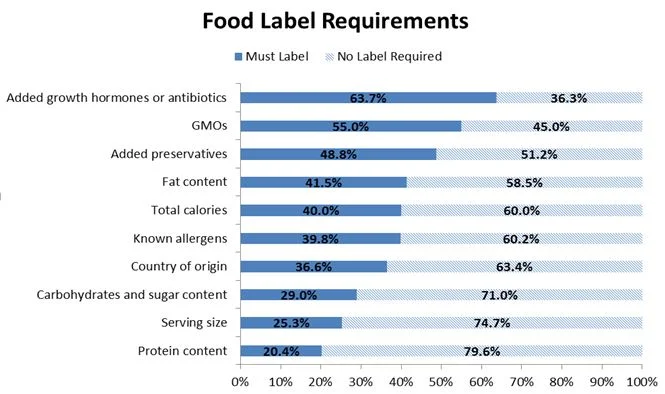
Then, 10 items were listed, and respondents had to place four and only four items in a box indicating which items they though were most important to label.  Here are the results.


gmolabelin1.JPG

I must say that I am shocked by the results.  63.6% said they thought "added growth hormones and antibiotics" should be labeled followed by 55% who said "GMOs."  Oddly, those items which ARE currently required to be labeled, including fat content, total calories, and known allergens (e.g., nuts), fell further down the list.  At first I thought this might be a mistake, but after double and triple checking the data, this is apparently how consumers responded.  Perhaps they take currently mandated information (e.g., calorie content) for granted (or don't realize it is mandated).  Perhaps GMOs are just more in news these days drawing attention?  On a technical note, the order of the 10 items was randomized across respondents, so these findings cannot result from some sort of order effect.  All in all, I'm not sure what is driving the result but I welcome any insights if you have them.

Secondly, we asked consumers: 

Which of the following best describes your views on mandatory labeling of foods containing genetically modified (GMO) ingredients?

They could pick one (and only one) of the following responses: 

  • I support mandatory labeling because consumers have a right to know regardless of the cost 
  • I support mandatory labeling, but only if it doesn't significantly raise food prices or cause frivolous lawsuits
  • I do not support mandatory labeling because voluntary labeling exists and will thrive if consumers really want to avoid GMOs
  • I do not support mandatory labels because the scientific consensus suggests GMOs are safe to eat
  • I don't know (5)

Here are the results


gmolabelin2.JPG

A majority (54%) said they wanted mandatory GMO labeling because they said they had a right to know regardless of the costs.  This result is surprisingly high and doesn't quite mesh with the actual voting outcome in California (or our previous survey which showed voting intentions influenced by cost and information).

As I articulated in several editorials in Sept-November last year, I do not think the economic arguments for mandatory GMO labeling are particularly strong (voluntary labeling is a different matter all together).  These survey results suggest little public support for that particular view.  However, there is also ample evidence to show that most consumers are woefully uninformed about biotechnology and that information can have big effects on attitudes (and as Prop 37 showed - voting outcomes).

Vegetarian Revolution

Saturday was Bastille Day, the French holiday commemorating a pivotal moment of the French Revolution: The storming of the Bastille prison. But in addition to remembering the revolutionaries with a spirited verse of "Do You Hear The People Sing?"* should we also celebrate with a plate of veggies?
The French Revolution storyline that lives in history books and popular culture involves the lower classes, driven by hunger and rising bread prices, fighting back against oppression from their 18th century rulers.
However, nearly lost to history were the middle and upper class opponents of the political system, some of whom were reported to have used vegetarianism — not the guillotine — to protest the monarchy.

That's from the NPR blog, the salt.  I also thought this line at the end was interesting: 

Of course, political vegetarianism did not begin or end with the French revolutionaries.

As an aside, I was sitting on a beach in Nice France on Bastille Day in 2011 watching fireworks with my wife and kids, and I couldn't help but think it was a bit odd that the Beach Boys were blaring over the loud speakers as the French were celebrating their revolution.


Stone-age agricultural industrialists

Claims about early agricultural practices and how much grain our ancestors ate are apparently full of… manure.
As early as 8,000 years ago, Stone Age farmers across Europe were working their crop lands intensely, irrigating and strategically applying manure, according to new research published in today’s Proceedings of the National Academy of Sciences. The findings also call into question previous estimates of how much protein in the Neolithic human diet was derived from animals rather than plants.

There is more at the post by Gemma Tarlach at Discovermagazine.com