Blog

Price impacts of avian influenza (bird flu)

Since the last time I posted on the issue, avian influenza has continued to spread, particularly in flocks of egg-laying hens, and the price impacts are becoming more apparent. 

Here's what I wrote back in April:

Demand for eggs is likely much more inelastic [than turkey] because of fewer substitutes. The elasticity of demand for eggs is probably somewhere around -0.15 to -0.20. The USDA-APHIS data indicates that about 4 million chickens (I believe these are egg-laying chickens) have been killed due to the flu. There are about 300 million laying hens in the U.S., implying this is a supply reduction of about 1.3%. Following the same logic as before, a 1.3% supply shock in the short run would cause a (0.013/0.15)*100=8.7% increase in egg prices in the immediate short run. Why so much higher than for turkey? Because demand for eggs is likely more inelastic than is demand for turkey. If the outbreak in egg laying hens doubles, reducing supply by 2.6%, that would imply a price increase of 17.3% in the short run.

Now, here's what Kelsey Gee wrote in the Wall Street Journal just yesterday:

Avian influenza has resulted in the deaths or extermination of at least 38.9 million birds, more than double the previous major U.S. outbreak in the 1980s. Of that total, more than 32 million are egg-laying hens, accounting for about 10% of the U.S. egg-laying flock.

The wholesale price of “breaker” eggs—the kind sold in liquid form to restaurants like McDonald’s Corp., food-service supplier Sysco Corp. and packaged-food producers—nearly tripled in the past month to a record $2.03 a dozen on Thursday, according to market-research firm Urner Barry. Meanwhile, U.S. prices for wholesale large shell eggs, those sold at the grocery store, have jumped about 85% to $2.20 a dozen in the Midwest.

The actual price impacts aren't that far off from what were predicted from my very simply supply/demand model.  In the very short run, supply is predetermined, so the price impacts of a reduction in supply are determined entirely by the shape of the demand curve.  A very simple demand curve is Q = e*P, where Q is the proportionate change in quantity, P is the proportionate change in price, and e is the own-price elasticity of demand.  Changes in price are thus given by: P=Q/e.  

Thus, if the change in quantity is about -10% as indicated in the WSJ article, and the elasticity of demand is about -0.15 as I previously suggested, the expected short-run price change is P = 0.1/0.15 = 0.667, or a 66.7% increase.  

The 85% price increase cited in the WSJ is larger than the projected 66.7% increase.  This could be because consumer demand for eggs has fallen among some consumers worried about bird flu (see my recent survey for evidence on that), so we may be witnessing not only movements along the demand curve but also a shift in the demand curve.  Or, it could simply be that demand for eggs was more inelastic that I previously assumed.  An own-price elasticity of egg demand of -0.117 rather than -0.15 would imply an 85% price increase in response to a 10% reduction in quantity supplied.  

But, no matter the cause of the price increases, it certainly isn't good for consumers who are harmed by having to pay higher prices for a smaller number of eggs. Producers who have lost flocks are certainly worse off.  The only beneficiaries are those egg producers who've (at least so far) avoided the outbreak.  

How do people respond to scientific information about GMOs and climate change?

The journal Food Policy just published a paper by Brandon McFadden and me that explores how consumers respond to scientific information about genetically engineered foods and about climate change.  The paper was motivated by some previous work we'd done where we found that people didn't always respond as anticipated to television advertisements encouraging them to vote for or against mandatory labels on GMOs.  

In this study, respondents were shown a collection of statements from authoritative scientific bodies (like the National Academies of Science and United Nations) about the safety of eating approved GMOs or the risk of climate change.  Then we asked respondents whether they were more or less likely to believe GMOs were safe to eat or whether the earth was warming more than it would have otherwise due to human activities.    

We classified people as "conservative" (if they stuck with their prior beliefs regardless of the information), "convergent" (if they changed their beliefs in a way consistent with the scientific information), or "divergent" (if they changed their beliefs in a way inconsistent with the scientific information). 

We then explored the factors that explained how people responded to the information.  As it turns out, one of the most important factors determining how you respond to information is your prior belief.  If your priors were that GMOs were safe to eat and that global warming was occurring, you were more likely to find the information credible and respond in a "rational" (or Bayesian updating) way.  

Here are a couple graphs from the paper illustrating that result (where believers already tended to believe the information contained in the scientific statements and deniers did not).  As the results below show, the "deniers" were more likely to be "divergent" - that is, the provision scientific information caused them to be more likely to believe the opposite of the message conveyed in the scientific information.  

We also explored a host of other psychological factors that influenced how people responded to scientific information.  Here's the abstract:

The ability of scientific knowledge to contribute to public debate about societal risks depends on how the public assimilates information resulting from the scientific community. Bayesian decision theory assumes that people update a belief by allocating weights to a prior belief and new information to form a posterior belief. The purpose of this study was to determine the effects of prior beliefs on assimilation of scientific information and test several hypotheses about the manner in which people process scientific information on genetically modified food and global warming. Results indicated that assimilation of information is dependent on prior beliefs and that the failure to converge a posterior belief to information is a result of several factors including: misinterpreting information, illusionary correlations, selectively scrutinizing information, information-processing problems, knowledge, political affiliation, and cognitive function.

An excerpt from the conclusions:

Participants who misinterpreted the information provided did not converge posterior beliefs to the information. Rabin and Schrag (1999) asserted that people suffering from confirmation bias misinterpret evidence to conform to a prior belief. The results here confirmed that people who misinterpreted information did indeed exhibit confirmation, as well as people who conserved a prior belief. This is more evidence that assuming optimal Bayesian updating may only be appropriate when new information is somewhat aligned with a prior belief.

A comedian's take on contract poultry farming

On the HBO show Last Week Tonight, comedian John Oliver (formerly with the Daily Show on Comedy Central) weights in on the issue of contract poultry farming.  His piece is a take-off of the themes in Christopher Leonard's book, The Meat Racket (which I critically reviewed here).  

Here's the episode, which already seems to be garnering quite a bit of attention. 

Are consumers really spending more on food away from home?

A couple days ago, the Wall Street Journal ran a story that started as follows

Retail-sales figures released by the U.S. Commerce Department garnered considerable attention last month when news reports suggested they showed Americans spent more money dining out than buying groceries for the first time ever.

Some observers jumped from there and attributed the shift to the growing clout of millennials, saying they prefer breaking bread with friends at restaurants, while sad-sack baby boomers who didn’t save enough for retirement are stuck cooking at home.

But as it turns out, reports on the decline of home cooking were half baked. They demonstrate, once again, that it is important to understand how the government compiles statistics to avoid jumping to conclusions the figures don’t support.

I agree.

As the story points out, the government's data ignores sales from some major grocery establishments like Wal-Mart.

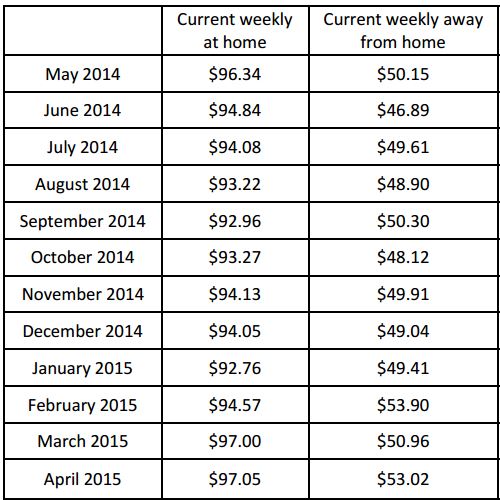
This is an issue we've been tracking in the Food Demand Survey (FooDS) for over two years now.  Our data from a nationally representative sample of consumers show it's not even close.   People spend a lot more money on food at home.  Here's the data from our second annual report.

Our most recent release, just a couple days ago shows at home consumption at about $96/week and away from home at about $53/week.  

Thus, our data clearly supports the conclusion drawn by Jo Craven McGinty in the WSJ:

The government’s monthly retail-sales report provides valuable information that reveals legitimate trends, providing users understand what the numbers represent.

In this case, no matter how you slice it, spending on dining out hasn’t surpassed spending on groceries

Does Subsidized Crop Insurance Encourage Farmers to Take Risk?

This paper devises a tractable empirical framework to examine whether the highly subsidized crop insurance program by the United States government makes farmers more sensitive to changes in extreme heat and thereby limits their ability to cope with extreme heat or adapt to it. Insured farmers might not engage in the optimal protection against harmful extreme heat as the resulting crop losses are covered by the insurance program. . . Our results suggest a significant amount of moral hazard in federal crop insurance.

That's from a paper by Francis Annan and Wolfram Schlenker  just released in the American Economic Review proceedings issue.  The authors go on to write:

This has important implications: first, since the federal government encourages participation in the crop insurance program through premium subsidies, the presence of moral hazard implies that there will be additional cost to the program as losses exceed what they could have been without the program. Second, climate change will amplify the government induced distortion as it will increase the frequency of extremely hot temperatures. Third, our findings imply that there are possibilities to adapt to climate change as uninsured areas show lower sensitivities, but this adaptation potential is skewed by government programs that give a disincentive to engage in it. A farmer will choose subsidized yield guarantees over costly adaptation measures.