Blog

Tragedy of the commons- have we been buffaloed?

We all know the story about how buffaloes almost went extinct - it's a phenomenon economists call the tragedy of the commons.  Here's how Bailey Norwood and I described it in our undergraduate textbook:

Consumers want beef today and they will want beef in the future. Ranchers understand this, and when they sell cattle they reserve some males and females for breeding. This is an investment. They forego the money they could have earned by selling cattle today, electing instead to produce more by breeding, earning greater profits at a later date. . . . Consumers in the nineteenth century wanted buffalo hides today and in the future, so it was in society’s interest to not kill all the buffalo. By leaving some males and females alive, one could be assured of buffalo hides in the future. Despite this obvious truth, hunters tried to kill them all. The reason is that no one owned the buffalo, so if you decided to leave some males and females alive to breed, another person may come and kill them. Better you benefit from the kill than someone else.

Is this common knowledge about the tragedy of the commons all wrong?  The economist Peter Hill thinks so.  Here is a snippet from his contrarian take in The Independent Review:

The history of the American bison is one of rational individuals operating under an institutional framework that did not create a tragedy of the commons. It is true that property rights were not well defined and established for bison on the open prairies, but because bison were not a valuable resource, property-rights entrepreneurs put little effort into establishing rights for them. And even if there had been well-defined and enforced property rights, cattle would still have replaced bison as the primary converter of grass on the Great Plains. The adjustment from bison to cattle may not have been perfect, but there is no evidence of large-scale rent dissipation. When bison did become valuable as they came close to complete extermination, entrepreneurs established rights to live animals and prevented their complete demise. Thus, economists who wish to describe how rational individuals under an open-access resource will overuse that resource should turn to some other example than that of the American bison. And economists should recognize that other situations of rapid depletion of a resource do not necessarily represent the tragedy of the commons if the analysis has ignored important opportunity costs.

Excess Supply of Cage Free Eggs?

Many of the cage-free egg purchase pledges have implementation dates around 2025, which was thought to be the minimum amount of time required for the industry to convert from more than 90 percent cage-housed hens to being predominantly cage free. Unfortunately, many of the retail store purchase pledges don’t contain intermediate benchmarks, and they have provisions for availability and affordability of eggs. Couple this with many consumers’ reluctance to pay the premium for cage-free eggs, and we have the current confusion in the marketplace where surplus cage-free eggs are being sold to breakers at substantial losses for egg producers.

That's from this article by Austin Alonzo and Terrence O'Keefe. 

Real World Demand Curves

On a recent flight, I listened to the latest Freakonomics podcast in which Stephen Dubner interviewed the University of Chicago economist Steven Levitt about some of his latest research.  The podcast is mainly about how Levitt creatively estimated demand for Uber and then used the demand estimates to calculate the benefits we consumers derive from the new ride sharing service.  

Levitt made some pretty strong statements at the beginning of the podcast that I just couldn't let slide.  He said the following:

And I looked around, and I realized that nobody ever had really actually estimated a demand curve. Obviously, we know what they are. We know how to put them on a board, but I literally could not find a good example where we could put it in a box in our textbook to say, “This is what a demand curve really looks like in the real world,” because someone went out and found it.

As someone whose spent the better part of his professional career estimating consumer demand curves, I was a bit surprised to hear Levitt claim "nobody ever had really estimated a demand curve."  He also said, "we completely and totally understand what a demand curve is, but we’ve never seen one."  The implication seems to be that Levitt is the first economist to produce a real world estimate of a demand curve.  That's sheer baloney.  

The most recent Nobel prize winner in economics, Angus Deaton, is perhaps most well known for his work on estimating consumer demand curves.

In fact, agricultural economists were among the first people to estimate real world demand curves (see this historical account I coauthored a few years ago).  Here is a screenshot of a figure out of a paper by Schultz in the Journal of Farm Economics in 1924 who estimated demand for beef.  Yes - in 1924!  I'm pretty sure that figure was hand drawn!

Or, here's Working in a paper in the Quarterly Journal of Economics in 1925 estimating demand for potatoes.

Two years later in 1927, Working's brother was perhaps the first to discuss "endogeneity" in demand (how do we know we're observing a demand curve and not a supply curve?), an insight that had a big influence on future empirical work.

Fast forward to today and there are literally thousands of studies that have estimated consumer demand curves.  The USDA ERS even has a database which, in their words,  "contains a collection of demand elasticities-expenditure, income, own price, and cross price-for a range of commodities and food products for over 100 countries."   

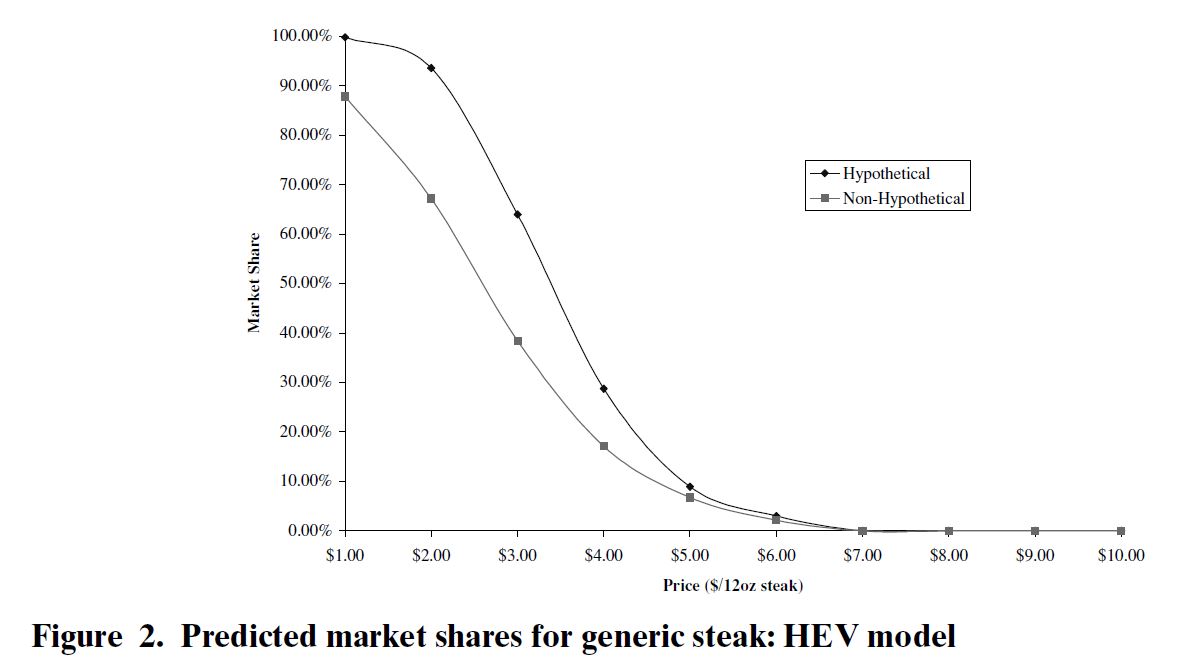
Here is a figure from one of my papers, where the demand curve is cleanly identified because we experimentally varied prices.  

And, of course, I've been doing a survey every month for over three years where we estimate demand curves for various food items.

In summary, I haven't the slightest idea what Levitt is talking about.  

Food Insecurity is Down

The USDA just released their annual accounting of food security in the United States.  Good news!  Food insecurity fell to 12.7% in 2015 (down from 14.9% in 2011).  Here's a key graph from the report.

One could quibble with the USDA's method of computing food security (it is based on  responses to a variety of survey questions), but whatever "flaws" are inherent in the USDA methods, as long as they have remained constant over time, the trends should be informative.  

Of interest is how food insecurity measures change with participation in SNAP (aka "food stamps).  Using USDA data on SNAP participation, I calculated per-capita participation which is shown in the following graph.  Though the pattern is somewhat similar (i.e., food insecurity and SNAP participation both rose after the Great Recession and then declined in 2015), it isn't a perfect corollary.  In particular, food insecurity is higher in 2015 than in was in 1995, but today there are more participants per capita on SNAP than there were in 1995.  

Another variable which might relate to food insecurity and SNAP participation is the price of food.  Here is a graph of Bureau of Labor Statistics data showing the price (or CPI) of food relative to the price (or CPI) of non-food items from 1995 to 2015.  

Over at the US Food Policy blog, Parke Wilde notes that even though food insecurity has fallen, it hasn't fallen nearly enough to keep up with food insecurity targets.  The above graphs suggest one potential reason why: food is relatively more expensive today than was the case 20 years ago.  Of course, the overall story is surely much more complicated than that.  

News on GMOs

There have been a couple news items regarding genetically engineered crops.  

The first is a new paper published in Science Advances (co-authored by a couple agricultural economists, David Hennessy and GianCarlo Moschini).  The authors used a large scale survey of corn and soybean farmers to determine the impact of biotech crops on pesticide and herbicide use.  By and large, I'd say the research confirms what has become the scientific consensus on these issues: 

Over the period 1998–2011, our results show that GE variety adoption reduced both herbicide and insecticide use in maize, while increasing herbicide use in soybeans. However, weighting pesticides by the EIQ [environmental impact quotient] lowers the difference in herbicide use by GT soybean adopters (such that the estimated average impact over the study period is statistically indistinguishable from zero). Adoption of Bt maize, on the other hand, is associated with a clearer decline in insecticide use.

This article at NPR interviewed weed scientists Andrew Kniss about the study, and he is critical of the use of EIQ. I believe his argument is that a proper toxicity-adjusted herbicide use might have shown a reduction in herbicide use in soybeans from adoption of GE.   Note also that several of the same authors published a related paper a few months ago showing adoption of GE herbicides led to higher rates of adoption of conservation tillage and no-till.  

In other news, Mark Bittman has an editorial today in the New York Times on the new GMO labeling laws.  I often disagree with Bittman, but I was pleased to see that he had a reasonably accurate portrayal of the science on GMOs:

These foods produced with G.M.O.s have not been found to be harmful to people who eat them. (This isn’t to say they won’t be; our system for declaring products safe leaves much to be desired.) In some instances, the technology has yielded great medical benefits and will certainly lead to more. In industrial agriculture, the technology has led to lower applications of insecticides. But it has also encouraged the growth of weeds that have become resistant to herbicides after years of exposure, often forcing growers to turn to more and different herbicides in a cycle of chemical warfare.

He goes a bit polemical at the end (as if organic and local producers don't use "chemicals" to control bugs and weeds).  And, he goes a bit off the rails in the next paragraph:

Another problem is that by simplifying the growing of almost unimaginably large tracts of crops, especially corn and soybeans, G.M.O.s have become an indispensable crutch for the fertilizer- and pesticide-dependent monoculture that is wrecking our land and water and generating the execrable excess of corn- and soy-based junk food that is sickening our population and decreasing our life spans.

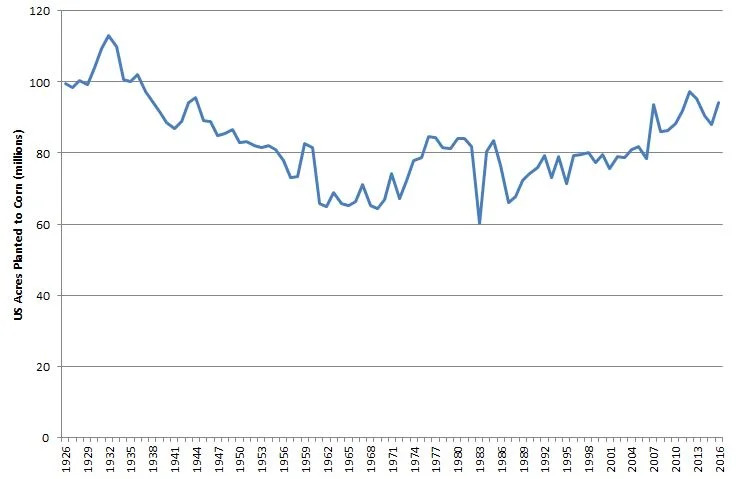
The implication seems to be without GMOs we wouldn't have as much corn and soy.  But, here's data from USDA on the number of acres in the US planted to corn over time.  

Yes, there has been an increase in corn acres since the mid 1980s, but biotech corn didn't start being grown in earnest until about 2005 (that's when more than half of US corn acres were biotech), and of course we had ethanol policies emerge in the mid to late 2000s, which promoted movement to corn acres too.  

More important, look at the data prior to 1950.  We were planting more corn then than now.  But prior to 1950, there was no biotech.  Use of hybrid corn and "synthetic" fertilizer didn't begin in a big way util the late 1930s.  And, yet in the 1920s, we planted more corn than we do now.  So much for the "chemical warfare", "fertilizer-dependent" story that explains our "monoculture" production system.  That is, the figure above suggests Bittman might want to rethink some of the key underlying economic reasons why we plant hardy, easily storeable, easily transportable crops like corn.  

In any event, Bittman's larger point is that he hopes the new mandated QR codes will be used to disclose all kinds of other information about food:

Where are the ingredients from? Were antibiotics routinely administered to animals? What pesticides and other chemicals were used, and do traces of these chemicals remain? Was animal welfare considered, and how? What farming practices were used? How much water was required? Let’s really get down to it. Were the workers who sweated to put food on my table paid at least minimum wage? Did they get health benefits? Overtime? Were they unionized? Protected from pesticide exposure?

I suspect there are some people who would value such information.  However, my research shows most people mainly care about something much more basic: : is this food tasty, safe, healthy, and affordable?