Blog

Country of Origin Labeling and Cattle Prices

Last week, I traveled quite a bit - from Georgia to Montana and back to Oklahoma.  In all three locations, I heard a claim that I hadn't yet heard before.  Namely that the low cattle prices we are now observing is a result of the repeal of mandatory country of origin labeling (MCOOL) for meat around the first of this year (note: the repeal came about a result of a series of World Trade Organization rulings against the U.S. policy).

I have to admit to being skeptical of the claim.  Agricultural economists have been researching this issue for quite some time (e.g., I have a paper on the topic with John Anderson published more than a decade ago back in 2004).  By and large the conclusion from this body of research is that MCOOL has had detrimental effects on beef producers and consumers (e.g., see this recent report prepared for the USDA chief economist by Tonsor, Schroeder, and Parcell).  It is true that some consumer research (including my own) reveals consumer interest in the topic and willingness-to-pay premiums for U.S. beef over Canadian or Mexican beef in surveys and experiments; however, most consumers were unaware MCOOL was even in place, and research using actual market data hasn't been able to identify any shifts in retail demand as a result of the policy (a summary of this research is in the aforementioned report).

So, let's put my initial skepticism to the side and look at the data.  Here is a graph of fed steer prices (blue line) and number of fed steers marketed (red line) over the past several years (these are USDA data from the LMIC and represent the 5-market weekly weighted average including all grades).   

The solid black vertical line indicates the point where MCOOL stopped being enforced by the USDA (just prior to January 1, 2016).  Looking at cattle prices, one can see how the claim that the repeal of MCOOL caused a drop in cattle prices came about, as the repeal came right after the peak of fed steer prices, after which prices began to fall rather dramatically.  

But, is this just a coincidence?  Correlation is not always causation.  

The red line in the graph shows the number of steers marketed (I plotted the 6 week moving average to smooth out some of the "jumpiness" in the line).  There is a strong inverse correlation between the number of fed steers marketed and the price of fed steers.  When more cattle are brought to market, prices fall and vice versa.  The correlation coefficient is -0.78 over this time period (January 2, 2000 to early November 2016).  

What started happening at almost the exact same time MCOOL was repealed?  Producers started marketing more cattle.  Here's the thing: one can't create a fed steer overnight.  The production decisions that led to the increase in fed steers around January 1, 2016 would have had to have been made around two years before.  Were producers so prescient that they could anticipate the exact time of the repeal of MCOOL two years prior?  Or, rather, was this a "natural" part of the cattle cycle?  

As the above graph shows, producers started having many fewer cattle to sell beginning in '08 on into 2012 for a variety of reasons such as drought and high feed prices.  These lower cattle numbers led to higher prices, which in turn eventually incentivized producers to retain heifers and add more supply to reap the benefits of higher prices.  When did all those extra cattle start hitting the market?  It turns out (largely by chance) that it was the same time MCOOL was repealed.  

Let's go one step further.  Because the supply of fed cattle is relatively fixed in the short run (as production decisions have to be made many months prior), we can use the above data to get a very crude estimate of the demand for fed cattle.  Using just the data shown in the above graph, I find that 81% of the variation in (log) live steer prices is explained by changes in the (log) quantity of steers marketed.  Estimates suggest that a 1% increase in the (six month moving average of the) number of steers marketed is associated with a 0.5% decline in live steer prices.  

Since the 1st of the year there has been a roughly 120% increase in the number of steers marketed (from an average of around 14,600 head/week just prior to the first of the year to an average of around 32,500 head today), and our simple demand model would suggest that this would lead to a 120*0.5=60% decline in cattle prices.  Yet, cattle prices have "only" declined about 25% (from around $133/cwt at the first of the year to around $100/cwt now).  So what?  Well, if MCOOL was the cause of the reduction in cattle prices, we would have expected an even larger fall in cattle prices than our simple demand model predicted, but instead, we're actually seeing a smaller fall than expected.  

Now, let's address one possible criticism of the above discussion.  What if the rise in fed steers marketed in the graph above is because of cattle flowing into the US from Canada and Mexico once MCOOL was repealed?  Here is data on imports of cattle from Canada to the US (again from LMIC).

There was a fall and then a larger uptick in the number of cattle imported from Canada to the US right after MCOOL, but nothing out of the ordinary from the typical fluctuations in the three years prior.  For example, the "spike" in total imports (slaughter cows + fed cattle + feeder cattle) around May of 2016 is at least 5,000 head smaller than the five previous spikes that occurred when MCOOL was in place.   

Even if I take the roughly 5,000 extra imports of fed cattle that came in from Canada after MCOOL from January 1, 2016 to the middle of May, and assumed even than 75% were steers, this would represent only 13% of the number of steers in the 5-market dataset sold to packers.  At most, this would cause a 13*0.5 = 6.5% decline in U.S. fed cattle prices according to my simple demand model.  This is nowhere near the 25% decline actually observed since the 1st of the year.  Moreover, look at what happened to cattle imports during this summer.  They fell.  They fell at a time when U.S. cattle prices were falling.  So, it can't be that extra Canadian imports were the cause of falling U.S. prices during mid summer.

In summary: while it is conceptually possible that the repeal of MCOOL could adversely affect U.S. cattle prices, any actual effect appears to be quite small (if there is any effect at all).  The fact that cattle prices fell immediately after the repeal of MCOOL appears to be a coincidence.  The falling prices seem more to do with "normal" changes in supply resulting from the cattle cycle than anything to do with MCOOL.  
Food and Ag Related Election Results

Donald Trumps surprising electoral win is likely to dominate the headlines for weeks.  But, across the nation there were a variety of less-well-publicized votes on issues related to food and agriculture.  Here are a few of those results. 

Massachusetts Ballot Question 3 appears to have passed with a whopping 78% of the vote.  This state ballot initiative bans farmers from producing eggs from hens in so-called battery cage systems and it bars grocery stores from selling eggs from such systems.  Here are results from my research papers on the effects of this type of regulation in California. 

Oklahoma State Question 777 appears to have failed garnering only about 40% of the vote.  This was a so-called "right to farm" amendment to the state constitution (details here).  Also in Oklahoma, state question 792 passed, allowing (among other things) grocery stores to sell wine and liquor stores to sell cold beer.

Soda taxes appear to have passed in San Francisco and Oakland with roughly 60% of the vote and also appears to have passed in Boulder, CO with about 55% voting in favor.   These cities now join Berkeley, Chicago, and Philadelphia in instituting soda taxes on the premise that they will fight obesity.

Marijuana legalization was on the ballot in several states, While perhaps not considered an agricultural issue, somebody has to grow the stuff!  A majority of California, Nevada, and Massachusetts citizens voted in favor of legalizing recreational marijuana use, but the issue failed to garner majority support in Arizona.   

Chicken Price Manipulation?

This article in the New York Times by Stephanie Strom argues that something may be fishy with chicken prices.  

The main focus of the article is about a widely used price index of chicken prices (the so-called Georgia Dock index) that is used by some retailers to negotiate prices with poultry producers.  Apparently the Georgia Dock price of chicken is higher than a couple of other price indices of wholesale chicken prices (one of which the USDA just created), and the Georgia Dock price hasn't fallen by as much as another index in recent months.  The article insinuates that something nefarious could be going on to artificially inflate the Georgia Dock price (and by extension the retail prices you and I pay for chicken).  

I have no deep insights into the allegations in the article.  However, I do want to push back just a bit on the broader issue of chicken prices relative to beef and pork.  Here is Strom: 

Beef prices at grocery stores are lower. So, too, are pork prices. But chicken? Steady as she goes.

A glut of corn and soybeans has led to lower prices for a variety of meats. But chicken in grocery stores has bucked the trend, leaving prices up for shoppers and buoying the fortunes of major chicken producers.

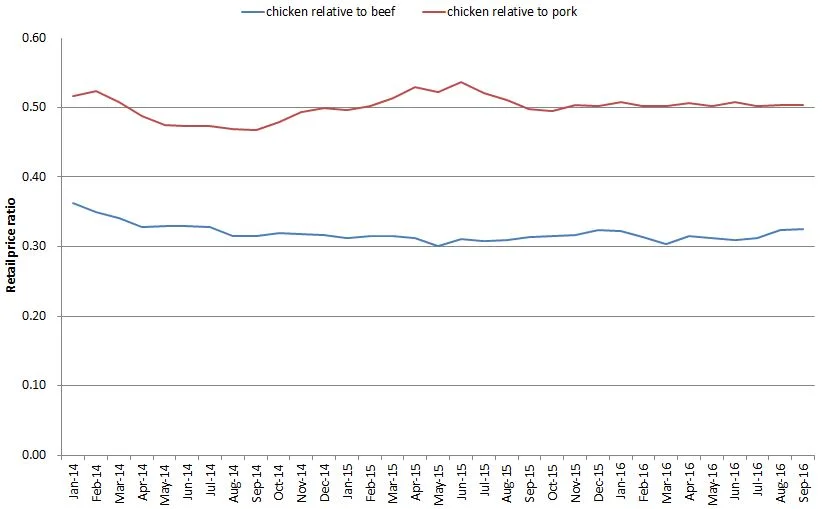
I'm not so sure about that first line - that beef and pork have become cheaper relative to chicken. Using data from the USDA-ERS on retail meat prices, I constructed the following graph showing the retail price of chicken relative to the retail prices of beef and pork.  Unfortunately, the last data point is September (the USDA bases it's calculations on retail prices reported by Bureau of Labor Statistics, but BLS hasn't released October prices yet), so it is possible that there have been some changes in recent weeks that aren't reflected in the graph below (but, even still, one might wonder why it's just now in the past month or two that the poultry producers figured out how to rig the wholesale price).  

Two broad points: 

1) As of September, the ratio of chicken to pork prices is essentially flat (i.e., chicken isn't getting more expensive relative to pork).  While chicken is a tad more expensive than beef in August and September relative to July, overall the trend looks pretty flat to me.  

2) Chicken is really cheap!  It is about half the price of pork and about a third the price of beef.

Moreover, if we take a step back and take the long view, chicken has progressively gotten cheaper relative to beef.  (note: the graph below uses the price for a whole chicken rather than composite retail prices as in the prior graph because the whole chicken data series goes back further in time).  Whereas whole chickens sold about 40% the price of beef in the 1970's, today they're about 25% the price of beef.

So, are poultry producers manipulating a price index leading us to pay more than we otherwise would have paid for chicken?  I don't know.  But, as the above graph shows, there's a whole lot of other things poultry producers have done over time (better genetics, better feed, better housing, etc.) to make chicken ever more affordably priced compared to other proteins.  

New York Times on GMOs

A New York Times article by Danny Hakim came out this weekend arguing that genetically engineered crops (aka "GMOs") have failed to live up to their promise: namely that they haven't increased yields or reduced pesticide use.  

The implications seems to be that Hakim believes farmers shouldn't be using biotechnology or that they were duped into adopting.  Even if we grant Hakim's premises that biotech crops increased herbicide use and didn't increase yield (as I'll detail below, there are good reasons not to fully accept these claims), the conclusions that benefits are "over hyped" seems a bit misplaced.   

To see this, let's consider a different example.  When Apple came out with the first edition of the iPhone, one might too have said its benefits were over-promised.  After all, we already had flip phones to make mobile calls, the iPod to listen to music, the Blackberry to type emails and texts, and so on.  Did the iPhone really offer that much new?  Was it all that much better than what previously existed?

Well, rather than trying to studiously compare features of the new iPhone to all the previous devices, shouldn't we just look and see whether consumers actually bought it?  Look at the millions of decisions of individual consumers who weighted the relative costs and benefits.  It seems millions of consumers judged the new phone to be worth the extra money (indeed, some people stood outside in lines for days to get it).  In short, we know the iPhone delivered on its promise because millions of customers bought the phone and have come back again and again to buy new versions.

This is what economists call revealed preferences.  If we want to know whether people think product A is better than product B, we don't have to survey and ask, we just have to look and see what they chose.  

Ok, what about biotech seeds?  Here is a graph from the USDA on farmer adoption of biotech corn, soybeans, and cotton in the U.S.  For each of these these three crops, adoption of genetically engineered varieties (including both herbicide tolerant (HT) and insect resistant (Bt)) is over 89% of acres planted.  So, when we look at the decisions made by thousands of real-life flesh and blood farmers who have weighted the costs and benefits, they have voluntarily adopted GMOs en mass.  The fact that biotech was so readily adopted by farmers (and is still so widely in use) aught to tell us something. 


Now, one possible explanation explanation is that farmers have no choice - they have to buy the biotech seed.  Yet, as you can read in many places (see here, here, or here), farmers have lots of seed choices.  Indeed, farmers pay hefty premiums to have the biotech varieties.  

Yet, if we are to believe the NYT's story, farmers are paying these higher premiums but aren't getting higher yields and they're spending more on herbicide.  They must be really dumb right?  I'm going to reject the dumb farmer hypothesis, which means that either the NYT's data are wrong or there are other benefits to biotech aside from yield (or some combination of both).  

The data and comparisons used in the Times story to support their claims are pretty crude (comparing national aggregates over time in the US and France).  It is curious they used these data when we have recent, well-done research summaries such as this one from the National Academies of Science.  Weed scientist, Andrew Kniss, has the best, most well-reasoned response to the article I've seen.

Kniss writes:

I have to say this comparison seems borderline disingenuous; certainly not what I’d expect from an “extensive examination” published in the New York Times. The NYT provides a few charts in the article, one of which supports the statement about France’s reduced pesticide use. But the figures used to compare pesticide use in France vs the USA are convoluted and misleading. First, the data is presented in different units (thousand metric tons for France, compared to million pounds in the US), making a direct comparison nearly impossible. Second, the pesticide amounts are not standardized per unit area, which is critically important since the USA has over 9 times the amount of farmland that France does; it would be shocking if the U.S. didn’t use far more pesticide when expressed this way.

and

It is true that France has been reducing pesticide use, but France still uses more pesticides per arable hectare than we do in the USA. In the case of fungicide & insecticides, a LOT more. But a relatively tiny proportion of these differences are likely due to GMOs; pesticide use depends on climate, pest species, crop species, economics, availability, tillage practices, crop rotations, and countless other factors. And almost all of these factors differ between France and the U.S. So this comparison between France and the U.S., especially at such a coarse scale, is mostly meaningless, especially with respect to the GMO question. If one of France’s neighboring EU countries with similar climate and cropping practices had adopted GMOs, that may have been a more enlightening (but still imperfect) comparison.

Given all of these confounding factors, I wonder why France was singled out by Mr. Hakim as the only comparison to compare pesticide use trends. Pesticide use across Europe varies quite a bit, and trends in most EU countries are increasing, France is the exception in this respect, not the rule.

My take?  As I've noted in previous posts before, it is pretty well acknowledged that biotech likely increased herbicide (but not pesticide) use, though it is important to consider relative toxicity of different pesticides used (which the Times article didn't do as best I can tell).  It is also important to recognize that research shows that adoption of herbicide resistant soy has led to greater adoption of low- and no-till farming practices.  And, while the biotech traits have sometimes been incorporated into varieties that were lower yielding, if you look, on average, at a large number of studies, that yield tends to increase with biotech adoption.   Moreover, as I wrote in a post about a study in Nature Biotechnology: 

the biotech varieties had an important risk-reducing effects, even if they sometimes led to slightly lower yields. Moreover, biotech can save on other inputs like labor. When I was a teenager, I spent a lot of time hoeing and spraying cotton weeds. That job is (thankfully) now obsolete due to biotechnology.

I don't know whether GMOs have fail to live up to their promise.  That would require us to know something about farmers' expectations prior to adoption.  What I do know is that the vast majority of corn, soybean, and cotton farmers have continued to buy higher priced biotech seeds.  Why?  The NYT article makes no attempt to answer this question.