Blog

Personal Choices to Reduce Greenhouse Gas Emissions

This article in Environmental Research Letters by Seth Wynes and Kimberly Nicholas calculates the ways various personal choices affect greenhouse gasses. The paper has received a lot of attention in the media (e.g., see here or here).   At the heart of the issue are the results from this figure in the original paper showing the relative effect of different actions on greenhouse gas emissions.
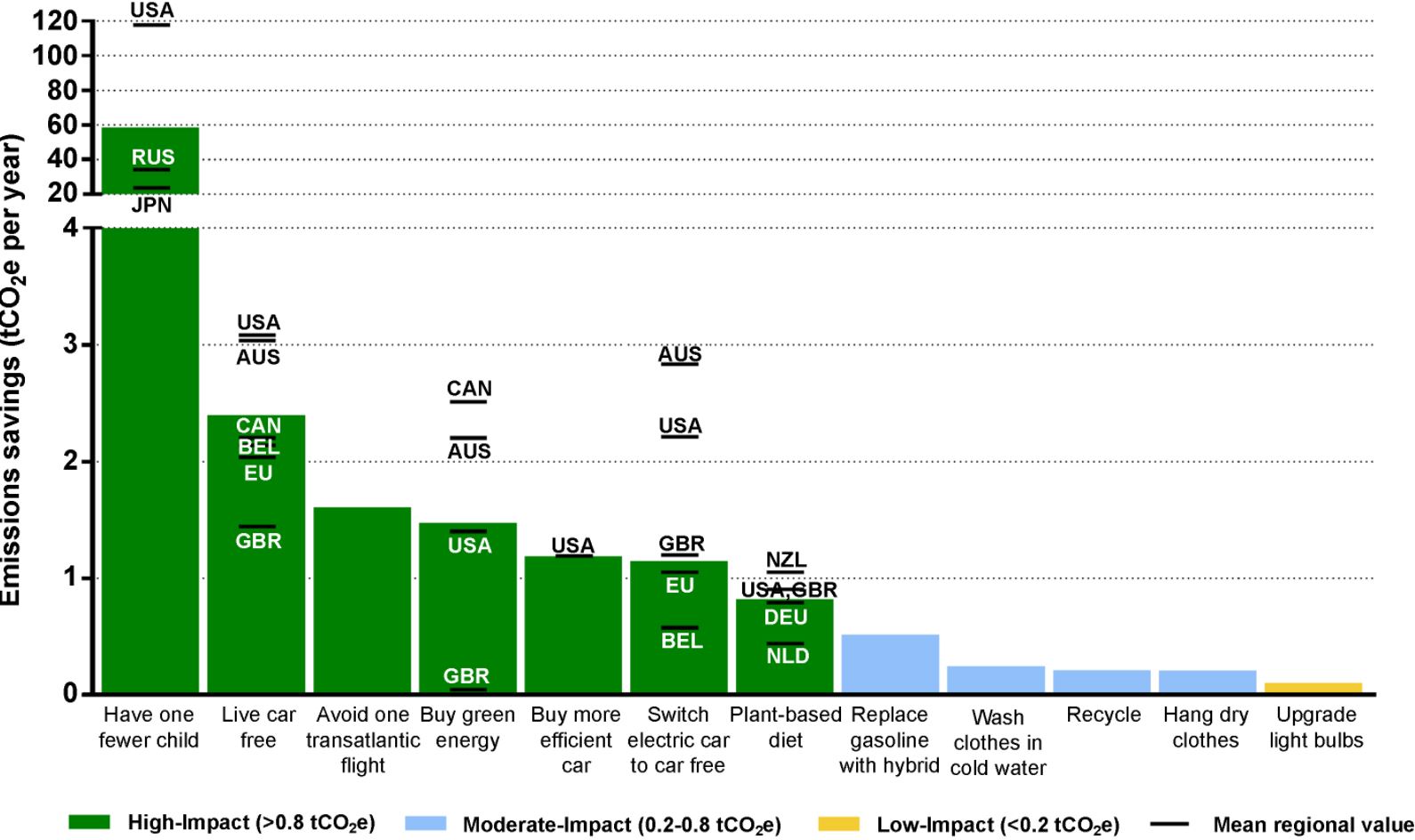
 

The findings led to headlines like this one in The Guardian, "Want to fight climate change? Have fewer children."  The findings are interesting on a number of fronts.  For example, I regularly see stories suggesting that the most impactful thing one can do to fight climate change is eat less meat.  That strategy shows up as a mere 7th on this chart, and way, way behind having children (not having a child has more than 60 times the emissions impact as moving to a more plant based diet).  

The implication that we should have fewer children raises a number of thorny issues that have long been debated.  Since at least Malthus, folks have been worried about a growing world population.  Stanford biologist Paul Ehrlich has raised alarm since the 1960s about the dire consequences of a "population bomb."  At the heart of this thinking is the premise that an extra person is a kind of threat: a threat to food security, a threat to the climate, a threat to the environment.  There's even a bit of a hint of this thinking in the common mantra of many agricultural organizations that we need to do what we can so that we can feed nine billion people by 2050.  The extra people that will arrive in the next 30 years or so are placing a burden on us today to increasing productivity.  

An alternative perspective, one often attributed to Julian Simon, is that an extra person is a blessing rather than a curse.  People aren't just consumers of resources but are are sources of ideas, creativity, and ultimately new resources.  An extra person isn't a threat but an opportunity.

Regardless of where one falls in this debate, it should be noted the above graph looks at just one side of the equation: the cost of an extra human in terms of extra greenhouse gasses.  What is ignored is the potential benefit of an extra human.  What is the opportunity cost of a foregone Einstein, Edison, or Jobs?  Going further, who are the folks most likely to heed the advice to forego children for the climate, and what would their would-be kids have been like?

It is also worthwhile mentioning that there is no guarantee that population will continue to grow, particularly if the world continues to develop and incomes rise.  Even the UN projections place some probability on a population decline in 30 years time.  One writer of Wired magazine, Kevin Kelly, when asked what we should be worried about (but presumable are not), fretted about about an underpopulation bomb.  Here's what he writes:

Here is the challenge: This is a world where every year there is a smaller audience than the year before, a smaller market for your goods or services, fewer workers to choose from, and a ballooning elder population that must be cared for. We’ve never seen this in modern times; our progress has always paralleled rising populations, bigger audiences, larger markets and bigger pools of workers. It’s hard to see how a declining yet aging population functions as an engine for increasing the standard of living every year. To do so would require a completely different economic system, one that we are not prepared for at all right now. The challenges of a peak human population are real, but we know what we have to do; the challenges of a dwindling human population tending toward zero in a developed world are scarier because we’ve never been there before. It’s something to worry about.

 A couple final thoughts.  The above graphs shows several possible mitigation options, but I haven't heard much discussion of tradeoffs.  Surely the end goal in life isn't to focus all our individual energies on activities to reduce carbon emissions.  So, given my preferences for driving, eating meat, or being a parent, the figures above suggest useful ways of thinking about this problem.  Maybe I don't want to have a more plant-based diet, but at least in terms of greenhouse gas impacts, I can "offset" that and more by foregoing my trip to Paris this year.  

More broadly, we don't normally worry about impacts of our various consumption choices on availability of other resources like steel or fertilizer or labor.  Why?  Because the market price for the goods should reflect the relative scarcity of these items.  One upside to a carbon tax is that we could forego all the moralizing and all these sorts of "consumption advice" types of papers and simply allow consumers to make choices they want given the relative prices of different goods.  But what about children?  The above graph would seem to justify a large carbon tax on having kids.  I'd guess that is a highly unpopular idea, which suggests to me that most of us are more likely to be in the Simon camp than the Ehrlich one when thinking about our own offspring.  

ABC, BPI, and LFTB

A couple weeks ago, the lawsuit between BPI, the maker of lean finely textured beef (LFTB), aka "pink slime", and ABC news finally came to an end after the two parties agreed to an settlement for an undisclosed amount of money (here's one summary from CNN).

Here's another story from Inside Sources that touches on the economic impacts of the original ABC news coverage.  They reached out to me for comment and you can read a tad bit of what I had to say at the link above.  

Better yet, check out the chapter in my book 2016 Unnaturally Delicious entitled "Waste Not Want Not."  In that chapter, I talked about the history of BPI and it's founder Eldon Roth, the technology used in creating LFTB, some intriguing background on how BPI wound up in the documentary Food, Inc., and more.  Here are the law few paragraphs from that chapter.    

It’s a bit hard to know what to make of all that transpired. To be sure, much of what was said about BPI was sensationalized. BPI didn’t use organ meats or bones or hoofs or hides or
“dog food.” The company used slightly fattier versions of same beef cuts that usually become roasts or ground beef. In fact, the day I visited BPI’s South Dakota plant, which is adjacent to a
Tyson packing facility, I was amazed at the beef entering BPI’s facility. The meat traveled on a conveyer belt in a tunnel that connects BPI and Tyson. A steer or heifer enters one end of the
Tyson facility, and a few hours later beef trimmings emerge at BPI without ever seeing the light of day. The trimmings consist of some small cuts of beef but there are also huge hunks of meat that looked almost identical to the briskets that I love to barbeque for get-togethers with friends and family. Lean finely textured beef is beef. That’s all. I suppose that’s why the company created a website called beefisbeef.com. No bone goes into the process. Big beef hunks go in one end and out the other end come three products: tallow, cartilage (which is the only waste), and lean finely textured beef.

I’ve visited a lot of food plants, and BPI’s was one of the most technologically advanced, safety-conscious plants I’ve seen. That a company that proactively invested millions in food safety measures found itself embroiled in controversy involving perceived (but unfounded) safety concerns is deeply ironic. What tarnished BPI’s reputation was no actual sickness or recall or outbreak; it was a series of TV shows and news stories.

But, given the information that consumers received, it is hard to fault them for their reaction. After all, best-selling authors and journalists have primed the public’s distrust of Big Food. In
an era when processed food has come to be seen as almost evil, “pink slime” struck a chord with consumers. Perhaps BPI should have required labeling of the beef that contained its products. Surely some of the public outcry arose from a feeling of having been deceived and of having no control over what is in our food. But from BPI’s perspective, what’s to label? “This product of ground-up beef parts contains more ground-up beef parts”? More fundamentally, BPI didn’t sell directly to consumers. Rather, the company sold to other processors, who sold to restaurants and grocery store chains. BPI was hardly in a position to force others to label products that contained lean finely textured beef.

So where does that leave us? Many shoppers, although I am not among them, no doubt want to avoid lean finely textured beef and are willing to pay a premium to purchase lean ground beef that does not contain it. There’s no harm in that.

But if we are really concerned about food waste, we probably need to change some of our narratives. We shouldn’t say we want companies to recycle and reuse and then turn around and vilify them for doing so.

The comedian Jon Stewart, who was more than willing to jump on the Big-Food-is-bad bandwagon, remarked that pink slime should instead be called “ammonia-soaked centrifuge-separated by-product paste.” He was working off a popular narrative. He could have instead featured the harm to a family owned business that was innovating to make food safer and more affordable by preventing food waste. But that’s not very funny.

Food Demand Survey (FooDS) - May 2017

The results from the May 2017 edition of the Food Demand Survey (FooDS) are now in.

Some observations from the regular tracking portion of the survey:

  • Willingness-to-pay for the "premium" cuts from each meat species (steak, chicken breast, and pork chop) all increased this month compared to last; exactly the opposite was true for the the lesser-valued cuts (ground beef, wings, and deli ham).  Willingness-to-pay for non-meat items declined significantly.
  • Awareness and concern for a list of 17 items all fell this month compared to last. Concern for antibiotic use rose to the top three behind E Coli and Salmonella.
  • Compared to last month, consumers increased expenditures on food at home but reduced expenditures on food away from home.  
  • Fewer people declared vegetarian status or indicated suffering from a food borne illness this month than has been the case for more than a year.

Several new ad hoc questions were added to the survey this month.  

The first set of questions was added in response to some queries by Ranjith Ramanathan who is a meat scientist at Oklahoma State. He was interested in some issues related to how consumers buy and cook ground beef.  To focus in on ground beef eaters, we first asked: “Do you eat ground beef patties (i.e., hamburgers)?” About 88% of the participants answered “yes”.  Those who answered yes were then asked several questions related to cooking and buying ground beef patties. 

Ground beef eaters were asked: “How do you determine the doneness of ground beef patties when cooking hamburger?”  Choice options were: A) By using a meat thermometer, B) By visual observation (i.e., looking at the color of meat in the center of the patty), C) By cooking a certain length of time, or D) Other ways.  

Approximately two-thirds of the participants who said they eat ground beef patties, stated they determine doneness by visual observation.  Next most common, selected by about 18% of respondents, was determining doneness by length of cooking time.  Only about 13.5% said they used a meat thermometer to determine doneness.   

The next question asked: “What is your preference for the cooked internal color of ground beef patties?”  Response options were: Red, Pink, Brown, or Another color.

The majority of participants, about 69%, stated they prefer the internal color of ground beef patties to be brown.  About 26% of participants stated pink as their preferred cooked internal color. Only 5% of participants stated they would want a red center in their ground beef patties.  Less than 1% stated they would want another color. 

Participants were then asked: “To what internal temperature (degrees Fahrenheit) does the USDA recommend cooking ground beef patties?”  Respondents could answer on a slider scale that ranged from 100 to 200 in one degree increments.

The average temperature stated by participants was 162 degrees Fahrenheit (the median was 161).  The figure is remarkably close to the actual USDA recommendation of 160F.  Nonetheless, a large share of participants were incorrect in their assessment.   Thirty one percent stated a temperature less than 160 and 54.5% stated a temperature higher than 160.  Even providing a five-degree margin of error, 28% stated a temperature less than 155 and 37% stated a temperature greater than 165.  Thus, 28%+37%=65% of respondents gave an answer that was at least 5 degrees higher or lower than the USDA recommendation.  Below is a histogram showing the distribution of responses.

Next, participants were asked: “How is the ground beef you normally buy packaged?”  Response categories included text and photos of six different packaging options including: vacuum sealed, in a box as frozen patties, in butcher wrapped paper, as a chub, film wrapped, and in a tray.

Of those who eat ground beef, about one third stated they buy packaged ground beef in a tray.  Ground beef in a film wrapped packaged was selected by about 28% of participants.  About 18.7% of respondents stated they buy ground beef packaged as a chub.  8.5% said they normally buy ground beef in a box as frozen patties.  Only 5.6% of participants said they normally purchase ground beef in a vacuum sealed package. 

Finally, as I was grading final projects from one of my classes, I noticed one team, comprised of Ph.D. students Bernadette Chimai and Pedro Machado, asked an interesting question on a survey they'd posed to students.  I modified it an included it on FooDs.  Here is a screenshot of the question asked:

Participants most frequently stated that free range chickens were the most efficient (i.e., used the least amount of feed to produce a pound of meat) followed by grass fed cattle and grain fed chickens.  However, response patterns were not necessarily symmetric.  Thirty percent of participants believed feedlot cattle were least efficient (i.e., used the most feed to produce a pound of meat) followed by 25%, who indicated grass fed cattle as most inefficient.  About an equal number of respondents thought free range pigs were both most and least efficient.  
 

To help summarize the results, I calculated the difference in the percent of respondents who viewed an animal and production system as most efficient and subtracted it from the percent who viewed it as least efficient.  Overall, free range and grain fed chickens were ranked highest in perceived efficienciency followed by free range pigs.  Grain fed pigs and feedlot cattle were perceived as least efficient.  

Food Demand Survey (FooDS) - March 2017

The March 2017 edition of the Food Demand Survey (FooDS) is now out.

Some items from the regular tracking portion of the survey:

  • Willingness-to-pay (WTP) decreased for steak, pork chops, and especially deli ham. WTP increased for chicken breast, hamburger, and chicken wings. WTPs for all meat products are lower than one year ago, except for hamburger.
  • Consumers expect higher beef, chicken, and pork prices compared to one month ago. Consumers plan to buy slightly less chicken and beef compared to last month.
  • The largest percentage increase in concern was for bird flu and the largest decrease in concern was for farm animal welfare.

Several new ad hoc questions were added to this month’s survey that mainly dealt with knowledge of farm production practices.

Participants were first asked: “Have you ever worked on a farm or ranch?”. About 17% of participants answered “yes.” Participants who answered “yes” were then asked “which of the following best describes the kind of farm you worked on?” Respondents were provided with six options and they could check all that applied.

Of the 17% who said they had worked on a farm, 43% checked “A farm that produces commodity crops (e.g. corn, wheat, soybeans, cotton, or rice)” followed by 40% who checked “A farm that produces commercial livestock (e.g. cattle, swine, or poultry).” “A garden in your backyard” was picked by 38% and “A chicken coop in your backyard” was picked by 23%. 20% checked “other” (and provided responses such as working on a dairy farm or a horse farm or on school farms such as FFA), and 12% checked “A community garden”.

Secondly, participants were asked: "Which of the following animal production industries use added growth hormones?” Over half of participants stated that believed beef, pork, poultry and dairy industries use added growth hormones. Over 75% of participants indicated that they thought that the beef cattle industry uses added growth hormones. Over half of the respondents stated they believe the swine and poultry industries to uses added growth hormones. In reality, the swine and poultry industries do not use any added growth hormones. About 57% of participants stated they believed added growth hormones are used in the dairy industry.

Third, participants were asked: “What percentage of dairy cattle in the U.S. are treated with rBGH?” Overall participants perceive a much greater use of rBGH in dairy cattle than what is actually used. About 20% of participants believe that 50-59% of dairy cattle are treated with rBGH. 5.7% believe that 90- 100% of dairy cattle are treated with rBGH. Only, 10.9% of participants stated that less than 10% of dairy cattle are treated with rBGH. In reality, less than ten percent of all dairy cattle in the U.S. are treated with rBGH.

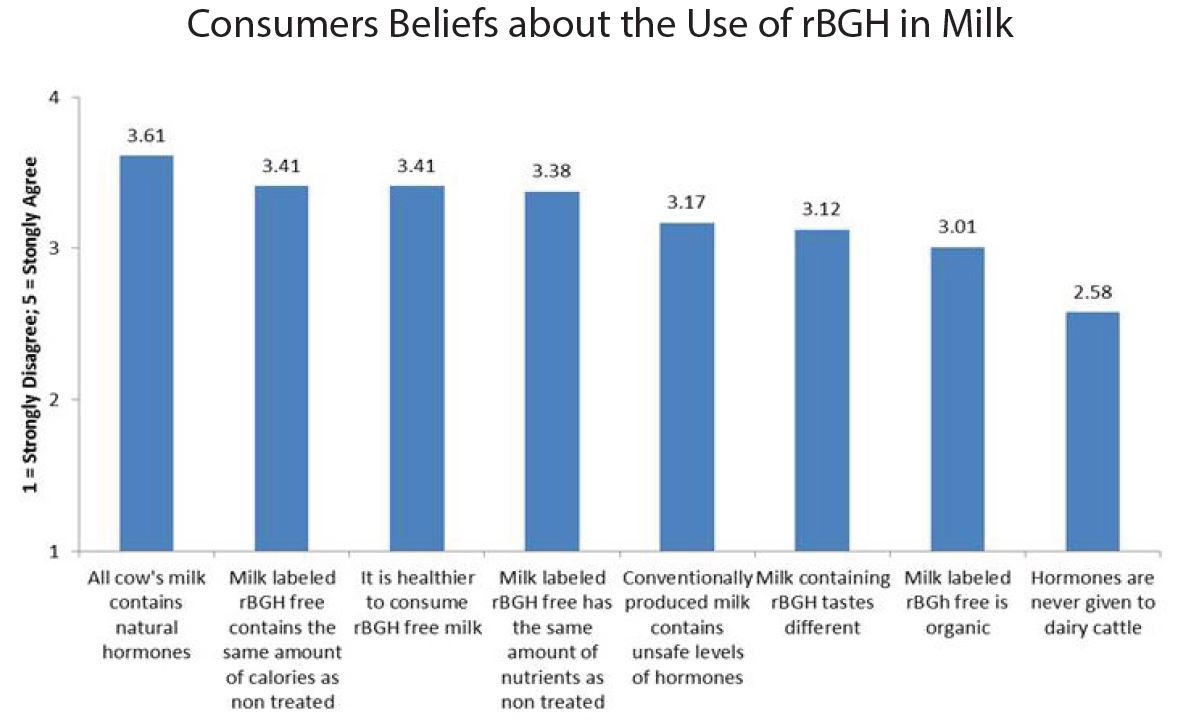
Lastly, participants were asked: “To what extent do you agree or disagree with the following statements?” Individuals responded on a 5-point scale: 1=strongly disagree, 2=somewhat disagree, 3=neither agree nor disagree, 4=somewhat agree, 5=strongly agree.

The most common answer for each item was “neither agree nor disagree”, except for the statement all milk contains natural hormones where the most common answer was “somewhat agree”. The statement “all cow’s milk contains natural hormones” was agreed upon most, whereas the statement “hormones are never given to dairy cattle” was agreed upon least.
About 38% of participants answered “somewhat agree” or “strongly agree” that it is healthier to consume milk labeled rBGH free. Approximately 30% of participants answered “somewhat agree or “strongly agree” that conventionally produced milk contains unsafe levels of hormones. Only 5.6% of participants selected “strongly disagree” that milk containing rBGH tastes different.

Measuring Beef Demand

There has been a lot of negative publicity about the health and environmental impacts of meat eating lately.  Has this reduced consumers' demand for beef?  Commodity organizations like the Beef Board run ads like "Beef It's What's for Dinner."  Have these ads increased beef demand?  To answer these sorts of questions, one needs a measure of consumer demand for beef.  In my FooDS project, I try to measure this by using consumers' willingness-to-pay for meat cuts over time.  But, there are other ways.

I just ran across this fascinating report Glynn Tonsor and Ted Scroeder wrote on beef demand.  At the onset, they explain their overall approach.

One way to synthesize beef demand is through construction of an index that measures and tracks changes in demand over time. An index is appealing because it provides an easy to understand, single-measure indicator of beef demand change over time. A demand index can be created by inferring the price one would expect to observe if demand was unchanged with that experienced in a base year (Tonsor, 2010). The “inferred” constant-demand price is compared to the beef price actually transpiring in the marketplace to indicate changes in underlying demand. If the realized beef price is higher (lower) than what is expected if demand were constant, economists say demand has increased (decreased) by the percentage difference detected. Applying this approach to publically available annual USDA aggregate beef disappearance and BLS retail price data provides information such as contained in Figure 1 indicating notable demand growth between 2010 and 2015 based upon existing indices currently maintained at Kansas State University.

They then show the beef demand index that Glynn has been updating for several years now based on aggregate USDA data.

In their report, Tonsor and Schroeder show, however, that measures of beef demand depend greatly on: 1) the data source being used, 2) the cut of beef in question, and 3) consumers' region of residence.  For example, here is a different beef demand index based on data from restaurants (or the "food service sector") segmented into different types of beef.  You'll notice the pattern of results below differs quite a bit from the aggregate measure above.  And, whereas demand for steak fell during the recession, demand for ground beef rose.

Another interesting result from their study is that the commonly used retail beef price series reported by the Bureau of Labor Statistics doesn't always mesh well with what we learn from from retail scanner data (in their case, data from the compiled by the company IRI).  Not only are BLS prices a biased estimate of scanner data prices, the bias isn’t constant over time.  In the report, Tonsor and Schroeder speculate a bit on why this is the case.  

In the near future, Glynn and I aim to compare my demand measures from FooDS with these demand measures.