Blog

Experimental Auction Summer School

For the 3rd year in a row, I've had the privileged to co-teach a summer school for the University of Bologna in Italy with Rudy Nayga, Andreas Drichoutis, and Maurizio Canavari.  The topic of the school is experimental auctions, which is a method used to measure consumer preferences and study consumer behavior. 

We have a great group of students this year from Italy, Germany, Sweden, France, South Africa, China, Thailand, and the U.S, among other places.   Here are a few of us learning a bit about the history of Bologna on our day off.

bologna.JPG

We also caught a couple races at the Dino and Enzo Ferrari Autodrome race track in Imola.  After the Ferrari's and Lamborghini's cleared the track, they had an interesting race with Mini Coopers.

imolatrack.JPG

Today we are back at work thinking about economics, consumer behavior, food policy, and food marketing.   

My colleagues have had a good time harassing me about eating horse meat (yes, I willingly ate some two days ago and I'm pleased to say it was perfectly eatable as I've previously argued) and organics (for my latest take on that one see here), and why Americans eat differently than Europeans.  

Here's the whole group just outside the classroom:

imolagroup2013.JPG

Am I Pro- or Anti-Garden?

Partially in response to the opening lines of my piece in Townhall magazine related to the Obama's White House garden, one of my colleagues (Francis Epplin) said he didn't understand my objection to gardens, and he pointed out that they are bi-partisan (apparently our Republican-led Dept of Ag in Oklahoma has a garden too).    

My response was that I didn't mean to come across as "anti garden." Up until a couple years ago, my 91 year old grandmother grew tomatoes, okra, and other goodies in her backyard.  That said, I do find it strange when public officials (whether Obama or Governor Fallin) grow "symbolic" gardens.  In these cases, I think it is fair to ask what is being symbolized and ask whether the arguments used to promote gardens hold up to the scientific evidence.  Of course not all gardens are symbols of something bigger, and it seems perfectly reasonable for someone to say they grow a garden because "they like to."  There are certainly worse things one can do with their time.   

In any event, Epplin advanced an interesting hypothesis, which he consented to me sharing here:  

My hypothesis would be that families that grow, or try to grow gardens, would have a better understanding of the weed and pest challenges encountered by farmers.  I would also hypothesize that they would be more sympathetic toward herbicides and pesticides.

This is a testable hypothesis and would make a great research project.  A part of me thinks Francis is right.  However, tending a garden is also different than managing a 1000 acre farm, and I'm not sure it translates.  Indeed, I think it is possible that just the opposite opinion will be formed.

This reminds me a bit of the conversation that came up in the Food Dialogues Event I participated in a couple months ago.  The former deputy secretary of agriculture, Kathleen Merrigan, talked about farmers selling at farmer's markets as being agricultural ambassadors and representing farmers more generally.  The implication was that such farmers would help the average consumer better understand production agriculture.  However, someone in the audience made a good point when he argued that the farmer at the farmers market was not the same kind of farmer he was.  The implication is that the guy at the farmers market was just as apt to say something bad about his farm than be an ambassador.  

Will gardens or farmers markets make people more or less accepting of modern production agriculture?   

I don't know.  

What Do Food Stamp Recipients Buy?

This editorial in the LA Times sounds an "alarm" about our lack of knowledge about how food stamp recipients spend their money:

The debate in Congress  about cutting the food stamp program has sparked predictable clashes between those who want to help the poor and those who want to cut government spending. But strangely missing from the arguments is a shocking fact: The public, including Congress, knows almost nothing about how the program's $80 billion is spent.

The underlying premise of article seems to be a notion that we need to know how food stamp recipients spend their money so we can decide if they are using it wisely.  That is, should purchases of food stamp recipients should be restricted to exclude unhealthy items?  I'm a bit skeptical of the impacts of such policies for reasons I talked about previously:

we have to realize that restricting [food stamp] use may not have the intended effect.  Money is fungible.  If you can't use food stamps to buy sodas, you'll use them to buy more of something else - freeing up money to buy soda.

But, that's not the reason I'm weighing in here.  Coming off a highly successful meeting of the Agricultural and Applied Economics Association earlier this week, I was again reminded of the exciting and energetic work being done by my fellow food and agricultural economists.  I can only think that many of them who study food stamp (SNAP) issues would bristle at the statement in the LA Times that: 

SNAP is kept under wraps. And Congress acts blindly, with the House voting to remove SNAP from the farm bill altogether and the Senate proposing to cut $4 billion from the program.

If Congress acts blindly, it is only because they (or their staffers) are unwilling to read the peer-reviewed research.   The fact is that there are large number of studies that, by merging various data sets, have investigated what SNAP recipients eat, how their purchases differ from non-SNAP recipients, and whether SNAP participation causes things like obesity.  

True, we may not have scanner-type data from grocery stories tied to EBT cards, but that is a far stretch from claiming we know nothing or act "blindly". 


Role of technology in the global economic importance and viability of animal protein production

That mouthful is the name of an article I wrote for the journal Animal Frontiers.     

Here are a few excerpts: 

Walk in almost any Department of Animal Science in the U.S. and one is likely to find a few black and white photos of stern, cowboy-hat wearing animal husbandry students from the early part of the last century. The remarkable thing about those photos is not the now unfashionable clothes but rather the champion cattle the students were proudly displaying for posterity. Today, one can scarcely find a bovine as fat and squatty as those that were once so esteemed. Pondering the difference between the prized cattle in those black and white photos and almost any old steer in a modern feedlot provides a stark illustration of the role of technology in shaping animal production over the past century

and

The direst of the Malthusian predictions have failed to materialize. Although the population of the world has grown dramatically over the past three centuries (and is expected to grow further still), the rate of growth has slowed, and in some developed countries has even begun to fall. While people of Malthus’s day probably could not have envisioned modern birth control methods, the most pessimistic interpreters of Malthus’s model almost certainly underestimated the impacts of productivity-increasing technological change.

I used a number of approaches to calculate the economic value of the productivity gains that have occurred in meat production in the past 40 years.  Here are the results of one approach applied to beef cattle:

if we applied the same genetics and technology used in 1970 to a cow herd the size of the one at present, we would expect to experience only $24.8 billion in farm value produced. The remaining $37.16 - $24.80 = $12.36 billion in value actually observed (or about 33% of current total value) is a result of factors (e.g., genetics, technology) that gave rise to improved productivity


Do Consumers Want Mandatory GMO Labeling?

The newest release of our monthly, nationwide food demand survey (FooDS) is now up.  The report contains data on trends in meat demand and awareness and concern over various food issues.  

Given the renewed interesting in mandatory labeling for genetically engineered food, we added two new questions to the July survey (if you're interested, you can see the results of a previous survey we conducted in California just before the Prop 37 vote); a version of that report is coming out in the Journal of Agricultural and Resource Economics).

The first question on GMO labeling asked in the most recent survey was worded:

Which of the following do you think the FDA or USDA should require to be labeled on food packaging?

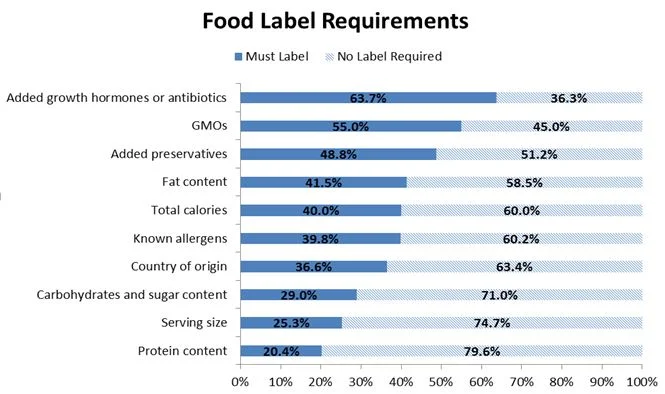
Then, 10 items were listed, and respondents had to place four and only four items in a box indicating which items they though were most important to label.  Here are the results.


gmolabelin1.JPG

I must say that I am shocked by the results.  63.6% said they thought "added growth hormones and antibiotics" should be labeled followed by 55% who said "GMOs."  Oddly, those items which ARE currently required to be labeled, including fat content, total calories, and known allergens (e.g., nuts), fell further down the list.  At first I thought this might be a mistake, but after double and triple checking the data, this is apparently how consumers responded.  Perhaps they take currently mandated information (e.g., calorie content) for granted (or don't realize it is mandated).  Perhaps GMOs are just more in news these days drawing attention?  On a technical note, the order of the 10 items was randomized across respondents, so these findings cannot result from some sort of order effect.  All in all, I'm not sure what is driving the result but I welcome any insights if you have them.

Secondly, we asked consumers: 

Which of the following best describes your views on mandatory labeling of foods containing genetically modified (GMO) ingredients?

They could pick one (and only one) of the following responses: 

  • I support mandatory labeling because consumers have a right to know regardless of the cost 
  • I support mandatory labeling, but only if it doesn't significantly raise food prices or cause frivolous lawsuits
  • I do not support mandatory labeling because voluntary labeling exists and will thrive if consumers really want to avoid GMOs
  • I do not support mandatory labels because the scientific consensus suggests GMOs are safe to eat
  • I don't know (5)

Here are the results


gmolabelin2.JPG

A majority (54%) said they wanted mandatory GMO labeling because they said they had a right to know regardless of the costs.  This result is surprisingly high and doesn't quite mesh with the actual voting outcome in California (or our previous survey which showed voting intentions influenced by cost and information).

As I articulated in several editorials in Sept-November last year, I do not think the economic arguments for mandatory GMO labeling are particularly strong (voluntary labeling is a different matter all together).  These survey results suggest little public support for that particular view.  However, there is also ample evidence to show that most consumers are woefully uninformed about biotechnology and that information can have big effects on attitudes (and as Prop 37 showed - voting outcomes).