Blog

Similarity and substitution: Using pile sorting methods to explore economic behavior

That’s the title of a new paper I’ve co-authored with Amelia Ales and Vincenzina Caputo that has been accepted for publication in the Journal of the Agricultural and Applied Economics Association.

It has long been conjectured in economics that goods that are more similar will be stronger substitutes, but there is surprisingly scant evidence for this assertion.

To explore this issue, we turn to a research method called “pile sorting.” Pile sorting, also known as card sorting, is a method long used in qualitative social sciences, but it is largely unknown or unused by economists. The method, in use for over 50 years, entails asking people to sort items or concepts into piles or groups according to their similarities or dissimilarities. Responses are used to identify the structure of the cognitive relationships between items through cluster analysis and multidimensional scaling.

In this new paper, we explore whether perceptions of similarity or dissimilarity can help explain why consumers treat products as utility substitutes or complements. We also introduce an approach to modeling pile-sorting data that avoids downsides of common analytic techniques used in previous work.

Here’s a figure showing the analysis of the pile sort data for foods purchased in a grocery setting. People tend to rate the plant-based (PB) meats as similar to each other and very different from bananas, strawberries and apples.
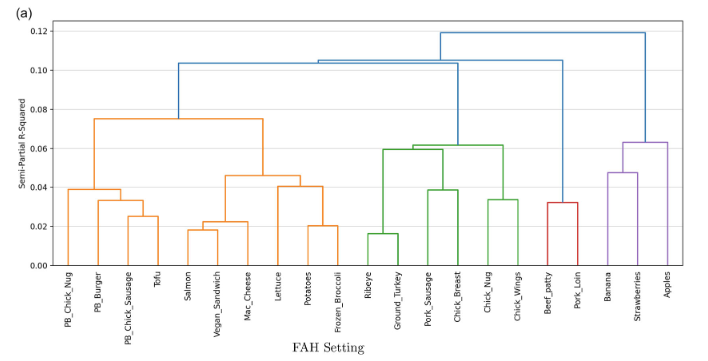
Are products perceived as more similar stronger demand substitutes? No, not necessarily. In fact, in a grocery setting, foods that are perceived as more similar are more likely to be demand complements (i.e., purchased together)
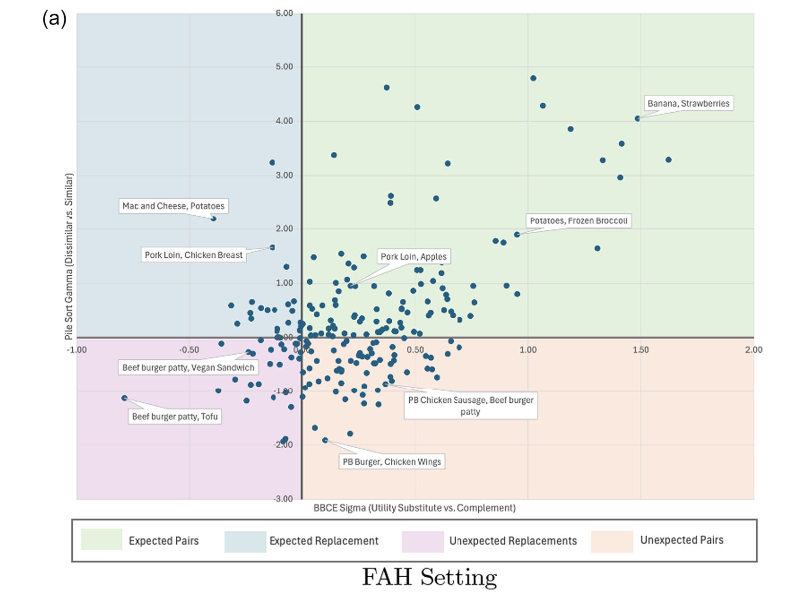
We find the opposite in a restaurant setting.

There’s a lot more in the paper including a discussion of implications for food marketing.

Innovation in Gene Editing and Plant Breeding

Yesterday I had the privilege of moderating a panel discussion focused on gene editing hosted by the Farm Foundation. The main speakers included:

  • Allen Van Deynze, Ph. D., Director, Seed Biotechnology Center and Associate Director, Plant Breeding Center, University of California, Davis

  • Richard Lawrence, Ph.D., Head of Genome Editing, Yield, Disease, and Quality Research, Bayer Crop Science

  • Fan-Li Chou, Ph. D., Senior Vice President, Scientific Affairs and Policy, American Seed Trade Association

  • Alison Van Eenennaam, Ph.D., Professor of Cooperative Extension in Animal Biotechnology and Genomics, University of California, Davis

You can watch the presentations and discussion here or at the video link below.

Plant-Based versus Conventional Meat: Substitution, Complementarity, and Market Impacts

That’s the title of a new paper co-authored with Vincenzina Caputo and Dan Blaustein-Rejto. Here’s the abstract:

Evidence regarding whether consumers view plant-based meat alternatives (PBMAs) as substitutes or complements to animal-based meat is limited; however, the ultimate effect of increased demand for plant-based meats on poultry and livestock production depends on this relationship. While the research on consumer demand for meat alternatives is growing, most current elasticity estimates are based on stated preferences discrete choice models, which assume consumers choose only one option and that all options are substitutes. This study employs a basket-based choice experiment (BBCE) to estimate own- and cross-price elasticities at both disaggregate and aggregate product levels. We utilized a between-sample approach and designed two BBCEs to reflect both at-home and away-from-home consumption settings. We then used the results from the BBCE to inform an equilibrium displacement model. Our findings indicate that: 1) consumers are more price-sensitive when dining out than when eating at home, 2) own price elasticity for PBMAs lie between premium meat options (salmon and ribeye steak) and more affordable choices (burgers and chicken breast), 3) PBMAs complement conventional meat in at-home consumption but show a mix of complementarity and substitution dynamics in dining out; and 4) lowering prices of plant-based beef and chicken alternatives is unlikely to significantly impact conventional poultry and livestock production.

Read the whole thing here.

Research Reports on Soy-based Food Demand

With the Center for Food Demand Analysis and Sustainability (CFDAS) at Purdue, we’ve been working on a project funded by the United Soybean Board and the Foundation for Food and Agricultural Research to explore the impacts of various investment alternatives on soy farmer profitability. To undertake the economic modeling, we need to understand consumer demand for a variety of soy-based foods, and the extent to which consumers are willing to substitute between soy-based foods and other products.

We’ve now released three short research reports on consumer demand for:

There is a lot of interesting material in each report. For example, here are a couple graphs showing trends in the milk and milk-alternative markets. The big story here is the rise of oat milk, which has cut into sales of other milk-alternatives.

Another interesting finding from the meat and meat-alternatives paper that is consistent with prior research is the low degree of substitutability between conventional meats and the new meat alternatives. In fact, the estimates suggest chicken is a weak complement with (rather than a substitute to) meat alternatives.

Dine in and Dash - Spending on Food Away from Home

A couple months ago, I mentioned the new data dashboards we’ve created in the Center for Food Demand Analysis and Sustainability (CFDAS) showing spending on different restaurants over time and across location.

We are continuing to update that data and now have an associated series of infographics at our main site. Below are a few screenshots.

Embed Block
Add an embed URL or code.

There is a lot more at the CFDAS website, including a cool animation showing trends in food delivery sales.