Blog

Future Food Demand

Will we be able to produce enough food to feed a more populated and likely richer world in 2050?  The answer to this question depends not just on what technologies we develop but also on what people in different parts of the world will want to eat in 2050.  A new paper by Christophe Gouel and Houssein Guimbard in the American Journal of Agricultural Economics takes data from consumption of 7 categories of food in over 100 different countries to explore how food demand changes with income and population, and then they use these estimates to project future food demand given estimates of income and population growth.  

First, they show that as incomes rise, demand for oils and fats and for animal-based food increases. 

futurefooddemand1.JPG

The following graph (from their appendix) shows the projected changes in global demand for different types of food on out to 2100.

futurefooddemand2.JPG

Here is a summary of their findings:

The main results of our projections to 2050 are that (a) food demand will increase by 47%, representing less than half of the growth experienced in the four decades before 2010; (b) this growth will come mainly from developing countries because in high-income countries, food demand is already at high per capita levels and population growth will be low; (c) growth in starchy staples will be small at 19%, supported by population increases because per capita consumption is predicted to decrease while demand for animal-based food will double, thereby increasing the global share of animal-based calories from 17% in 2010 to 23% in 2050; and (d) these projections present large uncertainties that are neglected in related studies: under alternative plausible futures for GDP and population, demand for animal-based calories increases between 74% and 114%.

Defining Meat

Meat and livestock producers are taking notice of the the rising interest in lab-based, cultured, and plant-based "meat."  Some of the larger meat packers and producers have chosen to invest in these new start-ups.  Other producers, facing the competitive threat, are turning to the legal system.  The U.S. Cattlemen's Association (not to be confused with the National Cattlemen's Beef Association) has officially petitioned the USDA to:

limit the definition of beef to product from cattle born, raised, and harvested in the traditional manner. Specifically, [the USDA Food Safety Inspection Service] should require that any product labeled as “beef” come from cattle that have been born, raised, and harvested in the traditional manner, rather than coming from alternative sources such as a synthetic product from plant, insects, or other non-animal components and any product grown in labs from animal cells.

The state of Missouri already passed a similar law (although it has yet to be signed by the governor).

The labeling requests are in keeping with a long list of "standards of identity" whereby the government defines how certain words can be used on food labels and in marketing.  The stated purpose of the laws are to protect consumers and to prevent consumers from being misled.  In some cases cases, I suspect they standards have done just that.  However, in other cases, the rules can be used by incumbent firms to ward off competition from potentially innovative entrants.  In one particularly egregious example, a small creamery marketing "natural milk" didn't want to add vitamin A to its milk.  However, because the standard of identity say that skim milk contains vitamin A, a judge ruled they must label their milk "imitation skim milk" even though they added literally nothing to the milk (the ruling was later overturned).  Another recent example is when Hampton Creek was told they couldn't label their product mayonnaise because it didn't contain eggs.  I wrote about that case here, and concluded by saying:

Ultimately, I think there are good arguments on both sides of this case, and it isn’t obvious what would be the consequences of the unraveling of these sorts of “food purity” laws. Sometimes it’s hard to know when consumer protection becomes protectionism.

In the case of beef, I am a bit skeptical that consumers will be mislead by the start-up meat alternatives.  Why?  These aren't generic products being sold by companies trying to water down or adulterate a product with cheaper inputs.  These are branded products created by firms whose whole marketing strategy is to tell people their product is NOT beef.  Here's a picture I took with my cellphone at a restaurant selling the Impossible Burger, where plain as day its says "Meat from Plants." 

impossibleburger2.JPG

Here is an image of package of Beyond Meat.  Again, plain as day, it says "Plant-Based Burger."

beyondmeat.JPG

In neither of the cases above, do the companies claim to be "beef" in the ads or packaging.  So, in a lot of ways, I suspect the calls for standards of identity may be much to do about nothing. 

Even without the identity standards, it is not as if consumers are totally unprotected.  If they are, in fact, misled, the legal system offers possible remedy. As witnessed by the numerous lawsuits over the use of the word "natural," I suspect there are plenty of lawyers out there willing to help a consumer who can show they've experienced damages.   

My New TEDx Talk on Animal Agriculture and Animal Welfare

A couple months ago, I was asked to give a talk at a TEDx event put on at Purdue University.  The video is finally available online.  I talked about the evolution of animal agriculture and the impacts on food prices and animal welfare, and I ended with my proposal for an animal welfare market, which I've previously written about here and here.

Recently there has been a strong push for better treatment of produce animals. Jason's talk asks whether society is ready to pay the price for the better treatment and if the better treatment society is pushing for really increases the animal's standard of living.

Pork: The Other Red Meat

Remember the long running campaign by the Pork Board?

pork_white.JPG

The campaign pitching pork as the other white meat made sense at a time when there was rising concern about fat content and red meat consumption and increased competition from chicken.  But, times have changed.

One of the changes has come about from scientific developments.  As it turns out, pork color is a good indicator of eating quality, and in blind taste tests, consumers prefer redder pork to whiter pork.  Do consumers know this?  Could a quality labeling system help coordinate the pork supply chain and better align production with consumers' eating expectations?

These were the questions that led to this paper just released by the journal Food Policy that I co-authored with Glynn Tonsor, Ted Schroeder, and Dermot Hayes with funding by the National Pork Board (a longer report of the results is here).

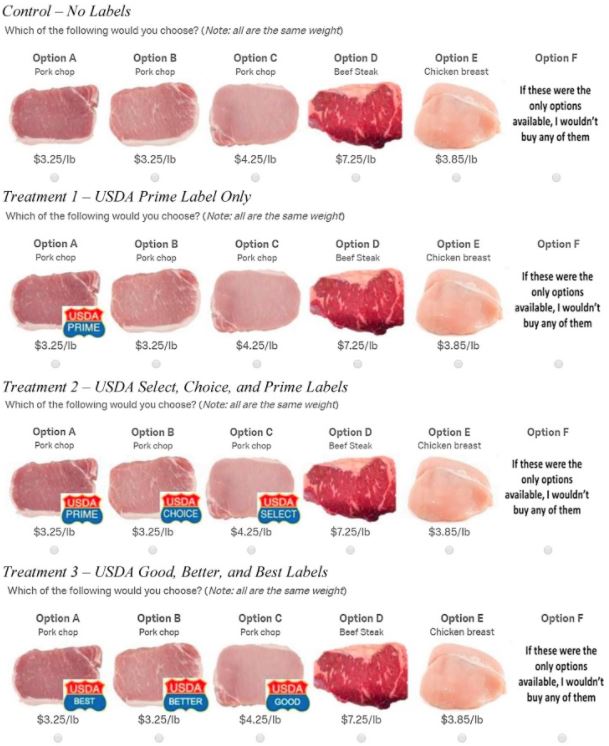
We surveyed about 2,000 consumers for the analysis reported in the Food Policy paper.  We were mainly interested in how consumers' choices between pork (and other meat) products varied with the color of the pork and whether and which kinds of labels were present.  Consumers were randomly assigned to a control (with no labels) or one of several treatment groups that utilized different labeling systems.  Below shows a particular choice question used in the various treatments.  

pork_1.JPG

We use the choices consumers made in these treatments to back out consumers' willingness-to-pay, but even more importantly, the probability a consumer buys any type of pork and the expected revenue from pork.  For the economists out there, I'll note that we also have some methodological innovation.  Rather than just looking at the probability of buying a type of pork at a given set of prices, we also invert the equations to look at the equilibrium price of pork at a given quantity of different types of pork (this is important because in the short run, pork producers can't easily produce a larger amount of higher quality pork).

So, what did we find?

pork_wtp.JPG

We find: 

In the absence of a cue in the “no labels” control, on average, participants do not differentiate among the three quality levels [or pork colors]. There is no significant difference in average WTP [willingness-to-pay] for the three different colored chops. This is consistent with industry interest in adding quality labels to facilitate further separation of pork quality by consumers. The introduction of a single Prime label for the highest quality chop in Treatment 1 results in a significant increase in the WTP for the chop that would carry the highest quality grade; however, there is a significant reduction in WTP for the lower quality chops that did not carry labels in this treatment.  ... When all pork products have grade labels, there is a significant premium for higher vs. lower quality pork and total pork sales rise, as do expected revenues. This can be seen in [the figure] as the mean WTP estimates for all pork qualities lie above those in the control condition with no labels.

We go on to show there is significant heterogeneity in consumer preferences.  We find that 28% to 40%, depending on the labeling condition, of consumers prefer white pork to red pork.  

From the conclusions: 

The choice experiment data analysis suggests that a USDA grade using Prime, Choice, and Select or Good, Better, Best labels would be most likely to increase expected pork revenue and the probability of purchasing pork. Additional important opportunities are present within this strategy. Foremost is that even with quality labels on the pork chops, a significant fraction of consumers preferred lower quality than Prime even when the three quality products were priced the same. Such consumers either do not understand the quality grade rankings of Prime, Choice, and Select (though results were similar for Best, Better, Good, which should be less prone to confusion), or this group of consumers were ignoring the quality grade labels and relying on product color to influence their choices. A possible response would be to segment consumers and to use the grading system only on those consumers who prefer red chops. Segmentation could be done by exploring preferences across states, institutions, income categories, ethnicity, and by export market. Despite the possibility for segmentation, however, we show, that if all qualities are present, only labeling the highest quality is likely to reduce total pork sales and revenue

As this piece in the Federal Register indicates, the USDA Agricultural Marketing Service is seeking public comment on the usefulness of such a labeling system.  Maybe one day in the future you will see new pork quality grade labels in the grocery store.  

An unplanned shock to beef quality supply

In economics, it's tough to separate correlation from causation because the world is a messy place with lots of things changing at the same time.  As a result, empirical economists are always on the lookout for natural experiments, or situations where there was some random, unanticipated "shock" to the market that can help us get closer to an experimental setting, where we know a change in X was not due to a change in Y.  

I was reading through the latest edition of Meatingplace magazine, and was surprised to see a story about an event that provides precisely the sort of unplanned "shock" that we are always looking for. In particular, about eight years, ago, the USDA started using cameras (rather than people) to determine meat quality.  The two main quality grades are Choice (more marbled (or fattier), higher quality) and Select (leaner, lower quality).  

Apparently in June 2017, the USDA issued an update to USDA's camera grading system that "appeared to inaccurately assess the degree of marbling on some carcasses - allegedly grading some Choice that should have been Select." The USDA issued a new update to the cameras in October in 2017 to correct the problem. One analysis, quoted in the article, estimates that about 12,000 cattle were inadvertently graded Choice rather than Select (a 2.4% increase according to the article, if I'm reading it right).

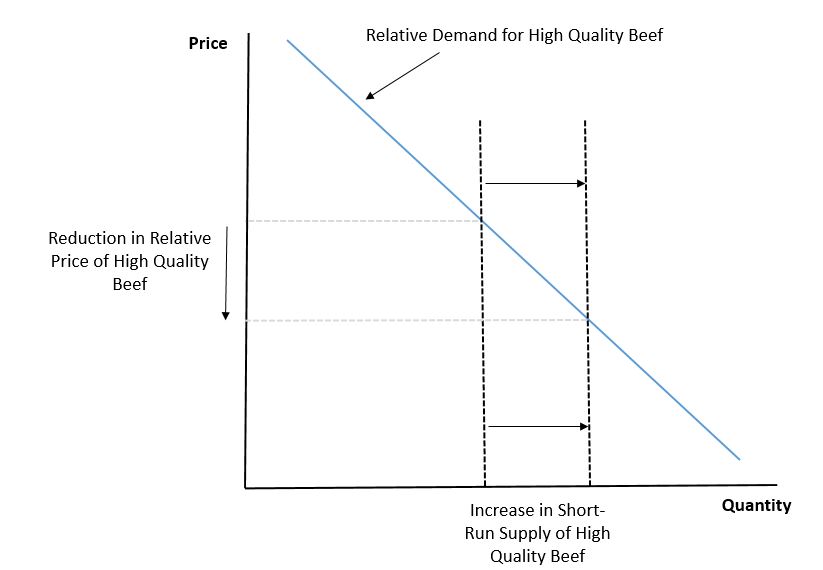
So, we have an unplanned, unanticipated "shock" to the beef quality market that shifted the supply of high quality meat and reduced the supply of lower quality meat.  This is illustrated by the two vertical lines in the figure (the lines are vertical because the supply is fixed in the short-run: you can't take Choice carcass and turn it into a Select one once the animal has been removed from feed).  If demand curve slopes downward, then this unanticipated increase in supply of Choice (and reduction in Select) quantity, should reduce the price premium for Choice over Select.  And in-fact, because the shock to supply is completely exogenous (it had nothing to do with demand but with a camera update), we should be able to use the natural experiment to estimate the slope of the relative demand curve for high quality beef (or the so-called elasticity of demand).  

choicetoselect2.JPG

Here is data from the USDA on the difference in price between Choice and Select beef, or the so-called Choice-to-Select spread, over the time period of interest (in particular, this is the difference in boxed beef cutout values measured in dollars per hundredweight - or cents per pound).    

choicetoselect.JPG

Just as one would expect, the increase supply of Choice relative to Select led to a reduction in the price premium charged for Choice relative to Select.  Of course, these raw data might be misleading - what if there is a seasonal pattern in which the Choice-to-Select spread falls every year from June to October?  To address this concern, I downloaded the last 10 years of data on the Choice-to-Select spread and found that the observed Choice-to-Select spread from mid June to late October in 2017 was $4.34/cwt lower than would be expected even after controlling for seasonality (month of the year), year, and a time trend.  This works out to about a 31% lower Choice-to-Select spread than would have expected during this time had it not been for the grading camera update (assuming there aren't other confounds I'm not controlling for).  

So, good news, it appears, the demand curves do indeed slope downward.  We can also go further if we take the aforementioned 2.4% change in quantity at face value that came from the Meatingplace article.  The price flexibility of demand (this is roughly the inverse of the elasticity of demand) for Choice (relative to Select) is given by the percent change in price over quantity, or -31%/2.4% = -12.9%.  So for every 1% increase in the quantity of Choice vs. Select supplied, there is a 12.9% reduction in the Choice-to-Select price spread.